Subcontract Execution With AI Agents Before Crews Mobilize
On many GC jobs the sub is framing walls while the subcontract is still in redlines. What that gap exposes, and how AI agents keep paper ahead of the field.
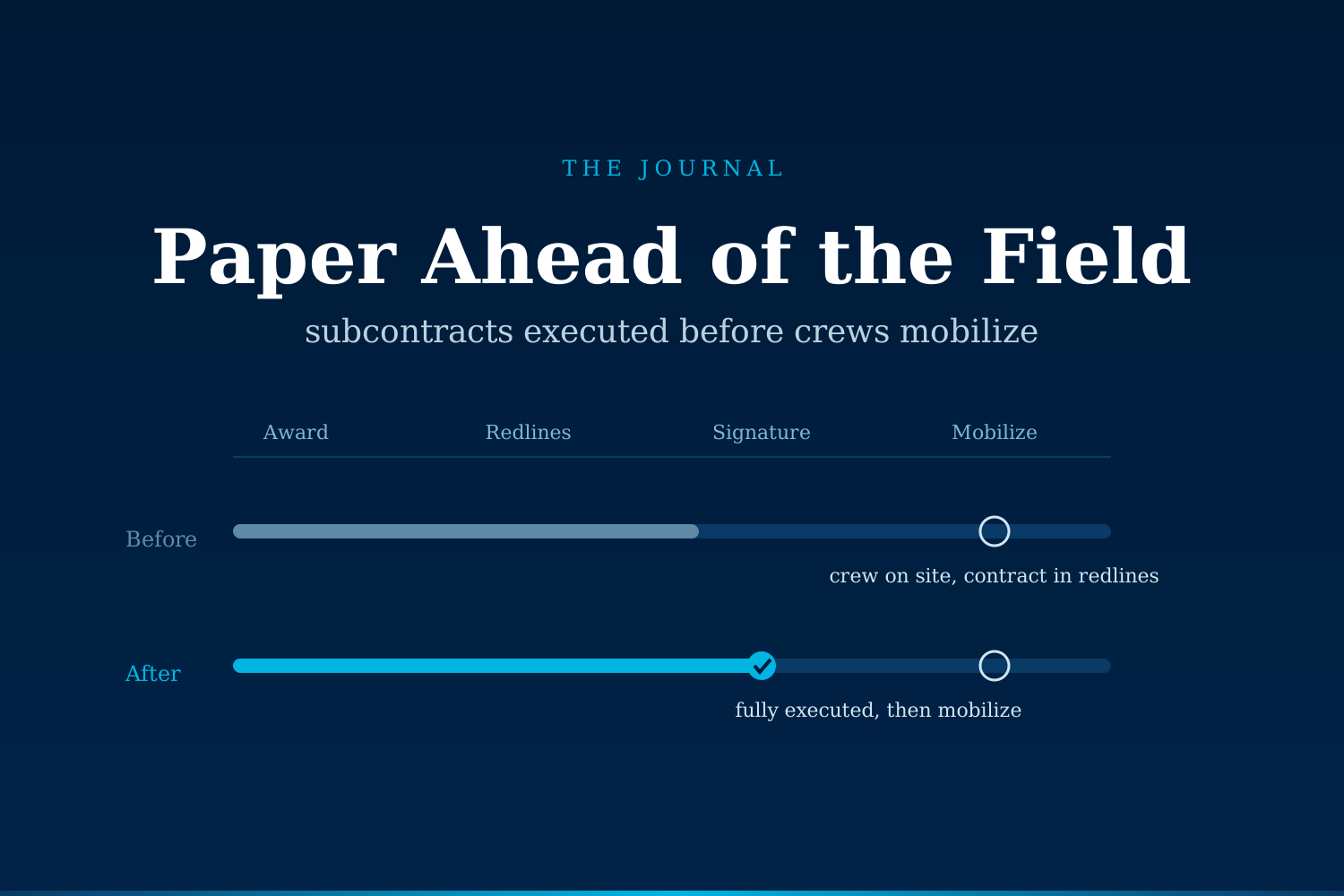
AI agents for subcontract execution track every awarded trade from award letter to fully signed subcontract, chase the missing signatures and exhibits, and flag redlines that change risk terms. For a mid-size general contractor, the payoff is simple: subs stop mobilizing on a handshake, and the indemnity, insurance and backcharge terms you negotiated actually apply on day one.
Why do subs mobilize before the subcontract is signed?
Because the schedule does not wait for paperwork, and nobody on the job wants to be the person who stopped a crew.
The pattern is familiar on most commercial jobs. Buyout wraps on the drywall package in week two. The award letter goes out. The subcontract goes out a few days later with the scope exhibit, the insurance exhibit and the schedule exhibit. The sub's office sends back redlines on the indemnity clause and the retainage terms. The redlines sit in the project manager's inbox behind forty RFI responses. Meanwhile the superintendent needs the layout started Monday, the sub is ready, and everyone agrees the paper will catch up.
Sometimes it does. Often it catches up four or six weeks later, after the first pay app, after the first scope disagreement, and occasionally not until the job is in closeout. On a job with fifteen to twenty-five subcontract packages, a handful of trades in that state at any given time is normal. The question is whether anyone can see which ones.
What is actually at risk when the field outruns the contract?
More than most project teams assume, because an unsigned subcontract is not the same thing as no contract.
Courts have enforced unsigned subcontracts where the parties showed agreement on the essential terms, and starting work while drafts are still being traded can be read as accepting the other side's version. A Snell & Wilmer analysis walks through cases where performance, not signature, decided whose paper governed, including one where a purchase order became the operative contract because work started against it.
That is the real exposure. The GC's carefully negotiated subcontract, with its flow-down clauses, indemnity, insurance requirements, notice provisions and backcharge rights, may not be the document a court or an arbitrator reaches for. It may be the sub's proposal with its exclusions, or a set of terms nobody actually agreed to on purpose.
A February 2026 piece from Stoel Rives makes the related point that working with no written agreement tends to produce disputes over scope, timelines, compensation and risk allocation, and that a written authorization to proceed with scope, cost limits, insurance and indemnity language is a better bridge than nothing. Plenty of GCs know this. The gap is not knowledge. It is that tracking the status of twenty packages across redline rounds is nobody's full-time job.
This is general information, not legal advice; your own counsel should set the policy. The operational problem is making sure the policy is followed on every job.
What does subcontract tracking look like on a typical GC desk?
Usually a spreadsheet, an inbox, and the memory of one project coordinator.
| Step | Manual desk | With AI agents |
|---|---|---|
| Award to draft subcontract | Drafted when someone has time, often days after the award letter | Draft package assembled as soon as buyout closes, with the right exhibits for that trade and job |
| Tracking status | A column in a log that is updated when someone remembers | Every package has a live status: sent, redlined, under review, signed by sub, fully executed |
| Redline review | Read line by line by a PM between other priorities | Changes compared against your standard terms; edits to indemnity, insurance, retainage, payment or notice clauses flagged for a person |
| Chasing signatures | Ad hoc emails and calls, usually after a problem surfaces | Polite, persistent follow-up on a cadence, routed to the right contact at the sub |
| Mobilization check | The super finds out the subcontract is unsigned when there is a dispute | Unsigned or unexecuted packages flagged against the look-ahead schedule before the crew arrives |
| Audit trail | Versions scattered across email threads | One record of every draft, redline and signature date per package |
Your PM or contracts lead still owns every negotiating call, including whether to accept a sub's change to the indemnity clause. What changes is that the person sees that redline the day it arrives, with the clause already isolated, instead of discovering it during a backcharge argument in month five.
Where do AI agents for construction contract admin pay off first?
Three situations tend to produce most of the value.
- Fast-track and design-assist jobs. When buyout runs alongside early work, subs are needed on site before the full package is ready. These are the jobs where an authorization to proceed, tracked to a hard expiry, matters most, and where it is easiest for one to lapse unnoticed.
- Trades with recurring redline habits. Some subs redline the same three clauses on every job. An agent that has seen those edits before can surface them instantly and show the PM how the same issue was settled last time, which shortens the back-and-forth considerably.
- Jobs with heavy flow-down obligations. Public work, lender-funded projects and owners with strict insurance or notice requirements raise the cost of a subcontract that does not mirror the prime contract. These are the packages worth checking against the prime before anyone signs.
The common thread is volume plus consequence. A small job with four subs and a forgiving owner rarely needs this. A $40M job with twenty-two packages and an aggressive schedule nearly always does.
How does this connect to the rest of the subcontractor file?
Subcontract execution sits next to a few other workflows that share the same data and the same failure mode.
Insurance is the obvious neighbor. A sub whose subcontract is unsigned often also has a certificate that has not been checked against the contract's requirements, a problem we covered in COI collection lag on GC jobs. Price is another. When the buyout number and the executed subcontract do not match, the margin leak we described in trade buyout overruns starts on paper before it shows up in cost reports. And recovery depends on it: backcharges are hard enough to collect under a signed subcontract, as our piece on why GC backcharges rarely get recovered in full explains, and harder still when the backcharge clause may not apply.
An agent that knows the status of all of these for each sub gives the PM one answer to a simple question before mobilization: is this trade actually ready to be on our site?
What changes on a job where execution stays ahead of the field?
The first change is quiet. Fewer trades arrive on site without a fully executed subcontract, and the ones that do arrive under a tracked, time-limited authorization rather than a verbal okay.
The second change shows up months later. When a scope disagreement or a schedule claim appears, the team pulls one executed document instead of reconstructing which draft was current in March. Arguments get shorter because the terms are not in question.
The third change is capacity. Project coordinators and PMs stop spending Friday afternoons rebuilding a contract log from their inboxes. That time goes back into the work the field actually needs from them: RFIs, submittals and owner coordination.
The aim is not paperwork for its own sake. It is making sure the terms your company negotiated are the terms that govern the work.
Is this worth a closer look on your next job?
If you can name a trade on a current job that is working without a fully executed subcontract, or you are not sure whether there is one, the gap is probably larger than it looks from the office. We build AI agents that sit alongside your existing contract templates and project management system and keep subcontract status visible from award to execution. You can see the kind of work we do for builders on our construction industry page.
We offer a completely free automation audit for general contractors. We will look at how subcontracts move from award to signature on one of your live jobs and show you where the hours and the exposure are sitting. No commitment, no pitch deck. → Book your free audit
Sami Raza
Software Developer & Technical Author
Sami Raza builds AI automation for logistics, DTC, and construction operations teams at ApexifyLabs, and writes about the operational failures that automation is actually worth pointing at.