COI Collection Lag Delays GC Job Mobilization
Subcontractor certificate of insurance collection can stretch mid-size GC mobilization by days per trade, and the variance rarely lands on the right cost line.
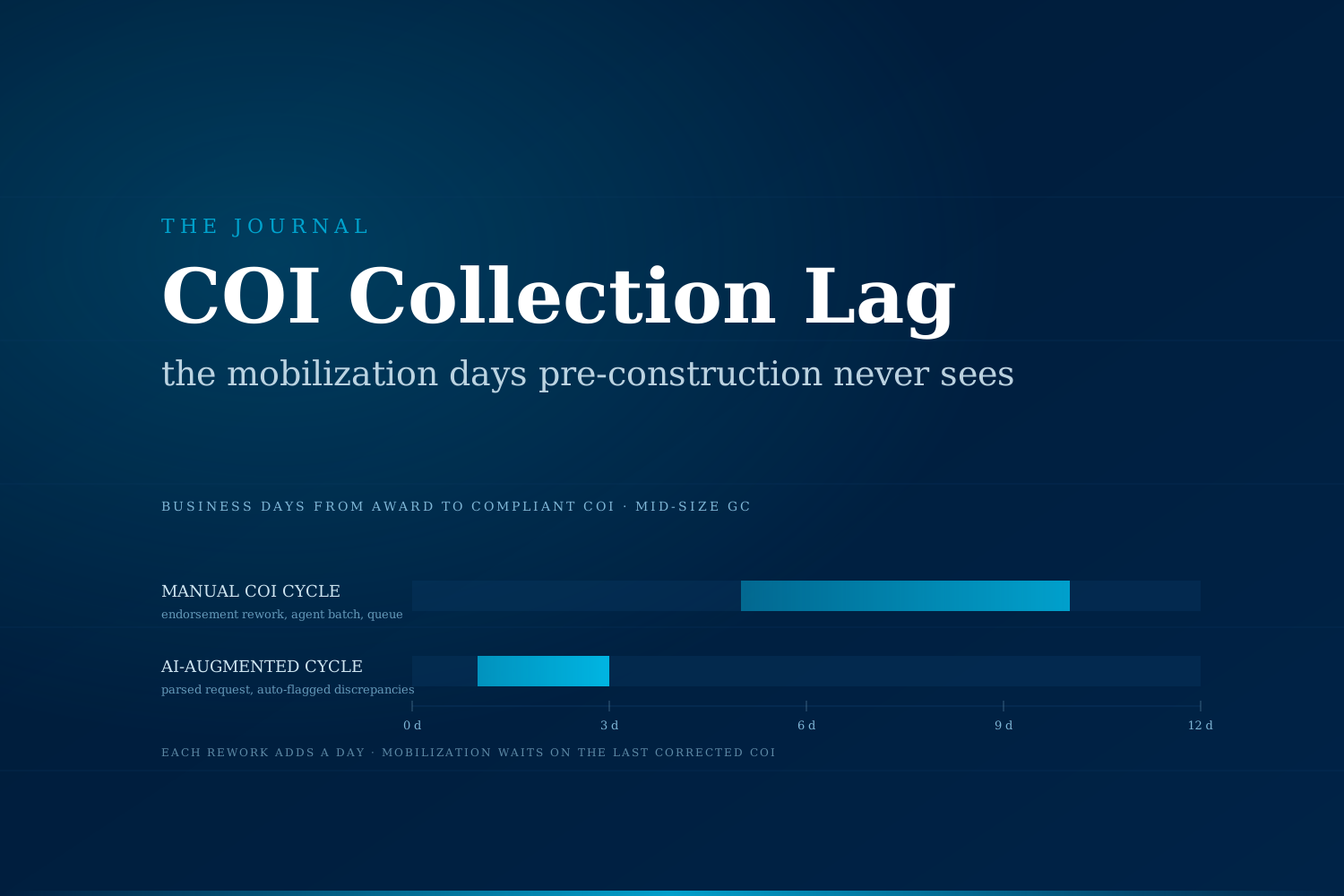
Certificate of insurance collection from awarded subcontractors is a paperwork step, but on mid-size general contractors it can extend job mobilization by three to seven business days per trade. The delay does not show up as a variance until the schedule tightens, at which point pre-construction is chasing certificates while the field waits on manpower.
What is COI collection on a construction job?
Every subcontractor working on a general contractor's site must furnish evidence of insurance meeting the contract's coverage, endorsement, and additional-insured requirements before mobilization. The certificate of insurance (COI) is the acknowledged proof. It gets requested at award, reviewed against the contract, corrected when it does not match, and stored against the sub's file for the duration of the job.
The step is standard on any commercial or institutional job. Public work, healthcare, higher education, and high-rise projects almost always require additional wording (waiver of subrogation, primary and noncontributory, per-project aggregate) that a standard ACORD 25 will not carry unless it is specifically requested from the sub's agent. That specificity is where the timeline starts to slip.
Why does COI collection lag push mobilization dates back?
A general contractor cannot legally allow an uninsured or insufficiently insured sub on site. Most GCs enforce this rigorously because their own umbrella and controlled insurance program (OCIP or CCIP) coverage depends on it. When a COI is missing, incorrect, or missing an endorsement, the sub does not mobilize. The trade sequence that depends on that sub cannot start. Successor trades queue behind them.
On a well-run mid-size GC job with 12 to 20 subcontract packages, the cumulative effect is measurable. A single sub's COI cycle time slipping from three days to seven days almost never triggers an alert. Five subs slipping in the same direction on a fast-track schedule pushes the critical-path start back by a week. Field crews sit, general conditions burn, and the schedule variance report records a "mobilization delay" without a clear owner.
Directional numbers cited in industry commentary from the Associated General Contractors of America (AGC) workforce and productivity surveys, ENR project delay reporting, and construction insurance benchmarking published by the International Risk Management Institute (IRMI) place average COI turnaround at 5 to 10 business days on complex projects with non-standard endorsement requirements.
Where does the lag actually come from?
The lag is rarely where GC project managers assume. Five common sources, roughly in order of frequency:
- Endorsement request mismatch. Pre-construction sends the sub the insurance requirements as a contract exhibit or a paragraph. The sub's agent works from a checkbox request. The first COI back is often missing one or two endorsements, which triggers a second and sometimes third round.
- Agent turnaround times. Independent insurance agents batch COI issuance during business hours. A Friday request often does not produce a corrected COI until Tuesday afternoon.
- Additional-insured wording. The contract may name "Owner, Architect, Lender, and GC" as additional insureds. The sub's policy may cover the GC directly and the others by scheduled endorsement only. Reconciling that costs another day per exchange.
- Manual review of returned COIs. The GC's compliance role compares the returned COI line by line against the contract requirement. On a busy pre-construction desk, that review sits in a queue behind bid analysis and buyout decisions.
- Renewal COIs during the job. Even after mobilization, policies renew mid-project. The renewal COI has to be re-collected, re-reviewed, and re-filed. This does not delay initial mobilization, but it does absorb compliance staff time that could otherwise clear new sub packages.
None of these individually looks like a bottleneck. Together they are why a mid-size GC's compliance team can be a week behind on multiple jobs simultaneously.
Manual COI collection vs AI-augmented COI collection
Directional benchmarks for a single sub's COI cycle on a complex project:
| Step | Manual COI collection | AI-augmented COI collection |
|---|---|---|
| Initial request | Email with contract exhibit attached | Structured request with parsed requirement list |
| Sub response time | 3 to 6 business days | 1 to 2 business days |
| Review of returned COI | 1 to 3 business days in the compliance queue | Minutes, discrepancies flagged automatically |
| Rework cycles per sub | 1.5 average, up to 3 on complex jobs | 0 to 1 on complex jobs |
| Total time to compliant COI | 5 to 10 business days | 1 to 3 business days |
| Compliance staff time per sub | 45 to 90 minutes across the cycle | Under 15 minutes across the cycle |
| Renewal COI handling | Manual re-review at each renewal | Auto-flag at renewal, review only exceptions |
Ranges reflect commentary published in construction insurance and risk-management reporting (IRMI, Willis Towers Watson construction practice notes, and vendor benchmarking on COI compliance workflows). The specific ranges vary by trade mix and endorsement complexity. The shape of the compression, days to hours, is consistent across the reporting.
The lever is not asking subs to move faster. It is compressing the review, correction, and re-issuance loop so a sub is not waiting on the GC to explain what is wrong.
What most GC project managers miss when pricing mobilization delays
A COI delay usually gets categorized as a "sub problem." That framing hides three costs the GC absorbs directly:
- General conditions burn during mobilization drag. Superintendent time, site trailer, temporary utilities, and hoisting all keep running while the trade sequence waits on paperwork.
- Overtime on successor trades. When a mobilization slips by a week and the substantial completion date does not move, downstream trades often absorb the compression with weekend work.
- Owner-side confidence. Owners notice mobilization delays even when they never see the underlying COI issue. A GC that consistently starts a week late on the first trades loses schedule credibility during the earliest, most visible phase of the job.
None of these show up as a "COI variance" in the cost report. They show up as small increases in general conditions, a slightly higher overtime line, and a softer relationship with the owner.
What changes when COI collection compresses to hours?
Two operational shifts follow a fast COI cycle.
The first is pre-construction bandwidth. A compliance team that clears COIs in hours instead of days spends the recovered time on higher-value work: verifying non-standard endorsements, chasing missing bond documentation, and closing insurance gaps at renewal without prompt. Throughput per person per week goes up without adding headcount.
The second is field-side schedule stability. When mobilization is not gated by paperwork, the schedule the field team publishes on Monday is usually still the schedule on Friday. That stability is what owners tend to reward with negotiated work and preferred-GC status on the next project.
We describe the outcomes here, not the workflow. The stack behind that (document parsing, endorsement matching, cross-project renewal tracking, and structured requests to agents) is where operator-level automation earns its budget.
Three signals worth checking on your own project
If you run pre-construction at a mid-size GC, three quick reads before the next award cycle:
- Average time from award to compliant COI, by trade type. If site-work subs land in three days and specialty MEP subs take twelve, the endorsement-complexity gap is where the compression opportunity sits.
- Rework cycles per COI. Anything above one rework per sub, on average, means the initial request is missing detail the sub cannot answer from the raw contract.
- Renewal COI backlog at any given moment. If the compliance team's renewal queue is more than two weeks deep, mid-job insurance gaps are a real exposure even when initial mobilization went smoothly.
None of these require new tooling to compute. They require pulling numbers from the COI log and the pre-construction schedule side by side.
Closing
COI collection lag is the kind of drag that never triggers an alarm because the field team sees it as a paperwork gate and pre-construction sees it as a compliance queue. The mobilization impact lands on general conditions, overtime, and owner confidence, three lines that rarely get traced back to their source.
If your team has not looked at COI cycle time this quarter, it is a fast audit worth running.
We run a completely free automation audit for GCs that want a second read on where pre-construction paperwork is costing schedule days without showing up in the variance report. No slide deck, no sales pitch, just the numbers on your own compliance workflow. → Book yours
Sami Raza
Software Developer & Technical Author
Sami Raza builds AI automation for logistics, DTC, and construction operations teams at ApexifyLabs, and writes about the operational failures that automation is actually worth pointing at.