AI Agents and the 3PL Client Email Backlog
Order status, stock counts, rush requests, missing ASNs. A 3PL's client inbox decides how service feels long before the contract review does.
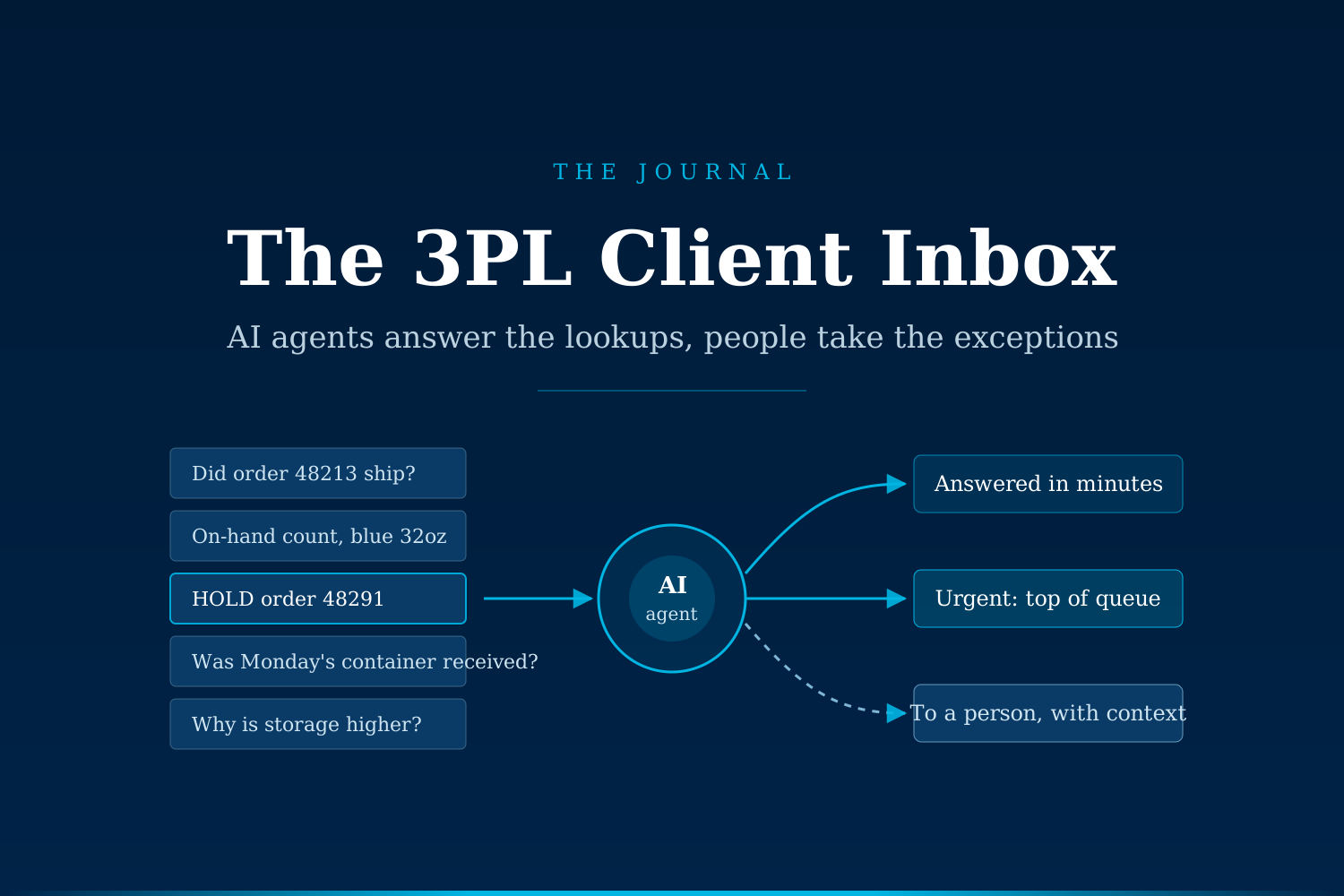
AI agents for 3PLs read the client emails that flood account managers every day (order status checks, inventory counts, rush and hold requests, receiving questions), look up the answer in the WMS, and reply or route the exception to a person. The result is faster answers for clients and account teams who spend their day on problems instead of lookups.
Why does the client inbox matter so much to a 3PL?
Most 3PL clients never walk the warehouse floor. Their experience of the relationship is almost entirely written: the order they asked about, the count they requested, the rush they flagged at 3:40 p.m. If those replies come back fast and correct, the warehouse feels well run. If they take until tomorrow, the warehouse feels slow, even when picking accuracy is excellent.
That perception now carries real commercial weight. The 31st annual Third-Party Logistics Study, produced with NTT DATA, Penske Logistics, the University of Tennessee and CSCMP, found that 93% of shippers consider AI capabilities important, particularly important or critical when selecting or retaining a logistics provider. The same study found that 74% of shippers are consolidating the number of providers they use, up from 50% in the previous edition. Fewer slots, and a new question on the scorecard.
There is also a perception split worth noticing. In that study, 94% of logistics providers believed their customers were satisfied with their IT capabilities, while only 70% of shippers said they were. Shippers also rated the return on AI for customer service and order visibility at 2.60 on a four-point scale, below the 2.71 they gave transportation planning and routing. Many 3PLs read that as a portal problem. In practice, a lot of it shows up in email.
What actually fills a 3PL account manager's day?
Ask an account manager at a mid-size 3PL to sort a typical morning's inbox and the pattern is familiar. A large share of messages are questions with an answer already sitting in the WMS:
- Order status. "Did order 48213 ship? Can you send tracking?"
- Inventory checks. "How many units of the blue 32oz do we have on hand, and how many are allocated?"
- Receiving questions. "Did the container from Monday get received? Any overages or damages?"
- Change requests. "Please hold order 48291," "upgrade these five to two-day," "cancel if not yet picked."
- Billing questions. "Why is storage higher this month?"
The first three are lookups. The fourth is time-sensitive, because a hold request that sits for two hours may arrive after the order is already packed. The fifth needs judgment and context. Yet all five arrive in the same inbox, in the same format, and usually get answered in the order they landed.
That ordering is where service slips. The urgent cancel waits behind six tracking requests. The account manager who knows the client best spends most of the morning copying numbers out of one screen and pasting them into another.
How do AI agents handle 3PL client emails?
An AI agent in this setting does a narrow, well-defined job. It reads each incoming client message, works out what is being asked and for which client, and checks the systems the 3PL already runs (the WMS, the order management layer, carrier tracking) for the answer.
When the question is a lookup with a clear answer, the agent drafts or sends the reply, depending on the rules the 3PL sets for that client. When the message is a change request, it checks whether the change is still possible (has the order been picked? has the label printed?) and puts it in front of the right person with that context attached, at the top of the queue. When the message is a complaint, a billing dispute or anything ambiguous, it goes to a human, summarized, with the relevant order and inventory history already pulled.
This is the same pattern large logistics firms are now publicizing. C.H. Robinson reported in January 2026 that AI agents now handle 95% of its checks on missed LTL pickups, saving more than 350 hours of manual work per day, work its LTL lead described as teams spending over half the day chasing. The task there is different, but the shape is the same: high-volume, repetitive status work where the answer exists somewhere and a person was the only bridge to it. We covered a similar shift on the brokerage side in freight check calls before and after AI.
Manual inbox vs AI agent: what changes for the client?
| Client request | Typical manual handling | With an AI agent in the inbox |
|---|---|---|
| Order status and tracking | Answered when the account manager reaches it, often hours later | Answered in minutes from WMS and carrier data |
| On-hand and allocated inventory | Account manager runs a report and pastes numbers | Current figures pulled and sent, with the snapshot time noted |
| Receiving confirmation | Depends on whether the dock team updated the system and someone checked | Status reported, discrepancies flagged to the receiving lead |
| Hold, cancel or upgrade | Queued behind routine questions; may arrive after packing | Checked against pick status and escalated immediately |
| Billing dispute or complaint | Mixed in with everything else | Routed to a person with order history and invoice lines attached |
The account manager does not leave the picture in any row. What moves is the order in which their attention gets spent. Routine lookups stop competing with the requests where timing or judgment matters.
Is this the same as putting a chatbot on the client portal?
Not quite, and the difference matters for buyers. A client-facing AI chatbot can be useful, and we explain the trade-offs in our piece on AI chatbots vs rule-based chatbots. But many 3PL clients do not want to log into another portal. Their buyers, planners and customer service reps already work from email, and they will keep sending email whatever the portal offers.
An AI agent working the inbox meets clients where they already are. It also sees the full picture across clients, which a portal chatbot usually does not: the same receiving delay affecting four brands, or a single client sending three follow-ups on one stuck order. Those patterns are exactly what an operations leader wants surfaced before the quarterly business review, not during it.
What should a 3PL owner or COO watch for before adding AI agents?
The upside depends heavily on the condition of the data underneath. The 3PL study cited above lists data quality and availability (61%) and legacy systems and integration complexity (54%) as the top barriers to AI adoption among respondents. In a warehouse, that usually means receiving that gets keyed in late, inventory adjustments that live in a spreadsheet, or client SKU names that differ from the WMS item master.
None of that rules a 3PL out. It does shape where an agent can answer on its own on day one and where it should still hand off to a person. A few questions help frame the decision:
- How much of the inbox is lookup work? If most messages are status and inventory questions, the hours return quickly.
- How current is the WMS during the day? An agent can only be as accurate as the system it reads. Gaps in receiving or adjustments show up quickly in client replies, as they do in issues like inbound ASN errors at the 3PL.
- Which clients carry the most email per dollar of revenue? Those accounts are usually where the margin pressure and the renewal risk sit together.
The Extensiv 3PL Warehouse Benchmark Report, drawn from more than 250 3PL warehouses, showed the share of 3PLs looking into AI rising from 16% to 25% in a single year. Interest is clearly moving. The 3PLs that turn it into a measurable service advantage tend to start with one well-scoped workflow, prove it with a handful of clients, then widen it.
What does a 3PL gain beyond faster replies?
Speed is the obvious result, but it is not the only one. When every client message is read, classified and tied to an order, a 3PL gets a running record of what clients actually ask about and how long each type of request takes to close. That record is useful evidence at renewal time, when a shipper's procurement team asks how the provider uses technology and AI.
It also changes the account manager role. Instead of spending the morning as a lookup service, they can spend it on the client who is planning a promotion, the SKU that keeps getting mispicked, or the receiving delay that keeps recurring. That is the work clients remember, and the work that keeps a 3PL on a shrinking provider list.
The pitch
Where AI agents fit in a specific warehouse depends on its client mix, its WMS and how its account team already works. We look at those first, before suggesting anything. You can see how we approach warehouse and freight operations on our logistics industry page.
If your account managers spend their mornings answering the same questions the WMS already knows, we offer a completely free automation audit for 3PLs. We will review a sample of real client traffic with you and show where an agent could take the routine load, and where your people should stay in charge. → Book your free audit
Sami Raza
Software Developer & Technical Author
Sami Raza builds AI automation for logistics, DTC, and construction operations teams at ApexifyLabs, and writes about the operational failures that automation is actually worth pointing at.