AI Chatbot Dock Scheduling: Fewer Calls at Receiving
Carriers calling for slots, drivers asking where to check in, reschedules at 6 a.m. The receiving office runs on conversations, and most of them repeat.
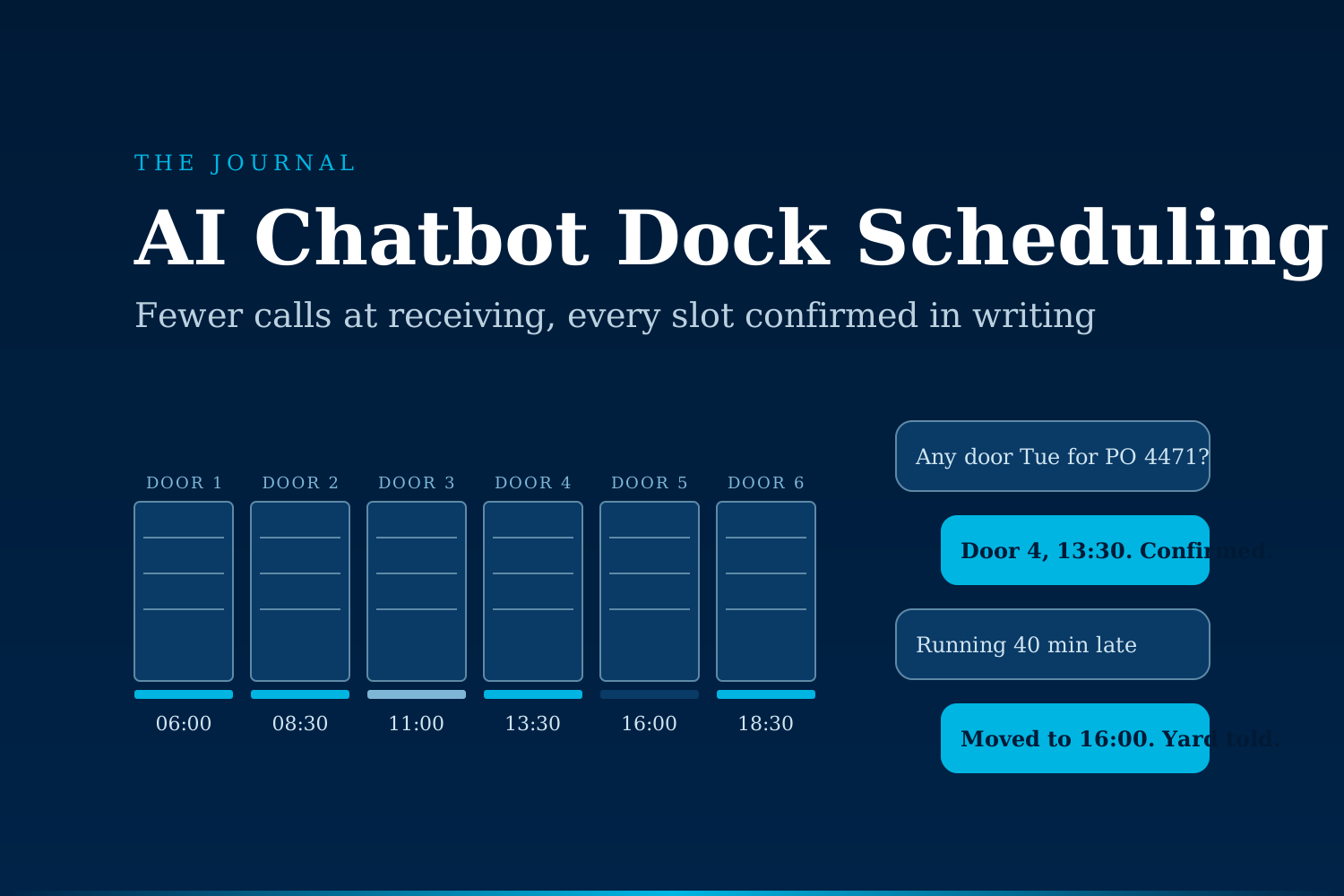
An AI chatbot for warehouse dock scheduling answers carriers, brokers and drivers by text, email or web chat, books and reschedules inbound appointments against your real dock capacity, sends check-in instructions, and flags late or early arrivals to the yard. Receiving teams stop working the phone and start working the dock, with every appointment confirmed in writing.
Why does dock scheduling still run through the receiving office phone?
Ask a distribution center manager in Columbus, Leicester or Mississauga how inbound appointments get made and the honest answer is usually "several ways at once." Some carriers use a scheduling portal. Some brokers email a PO number and ask for "anything Tuesday." Some drivers call the guard shack from the highway because their dispatcher never booked a slot at all. A few retailers and larger shippers send structured requests; most of the freight from smaller vendors does not.
All of those requests land on the same small group: a receiving coordinator, an inventory lead, sometimes the shift supervisor. Their day is broken into short interruptions. Is there a 2 p.m. door for a floor-loaded container? Can the 8 a.m. reefer push to 11? Which gate does the driver use? Is the PO even open? Each answer takes a minute or two, but the questions never stop, and every one of them pulls someone away from the dock itself.
The cost of getting this wrong shows up outside the building first. The American Transportation Research Institute's 2024 detention study found US truck drivers were detained for more than two hours at 39.3% of stops in 2023, rising to 56.2% for refrigerated drivers. ATRI put the industry toll at $3.6 billion in direct expenses and $11.5 billion in lost productivity. Carriers remember which facilities hold them, and that memory shows up later in rates, tender acceptance and how hard a carrier works to make your appointment.
What does an AI chatbot actually do for dock scheduling?
Think of the chatbot as the front desk for inbound freight. It sits on the channels carriers and drivers already use (SMS, email, a web chat on your carrier page) and handles the conversation layer that sits around your dock schedule:
- Appointment requests. It reads the request in plain language, checks the PO or ASN, looks at open doors and labor for that window, and offers real slots that fit the load type.
- Reschedules and cancellations. A carrier running late can text the bot instead of calling. The bot moves the slot within your rules and tells the yard team what changed.
- Pre-arrival instructions. Gate location, check-in requirements, paperwork the guard will ask for, lumper or unload policy, site safety rules. Sent automatically, the same way every time.
- Arrival status. Drivers check in by text; the bot confirms whether they are early, on time or late against the appointment and routes the exceptions to a person.
- Questions that would otherwise be phone calls. "Is my load unloaded yet?" "Can I drop the trailer?" "Who signs the BOL?" Answered from your data, with anything outside policy handed to staff.
What it does not do is decide policy. Whether a late refrigerated load gets worked in, whether a vendor with three no-shows loses its standing slot, whether overtime opens a second shift on the dock: those stay with your receiving lead. The chatbot gives that person a clean, written record of every request so the decision is faster.
How does manual dock scheduling compare with an AI chatbot?
The table below shows how the same inbound day plays out under each model at a mid-size DC or 3PL building.
| Moment in the inbound day | Phone and inbox scheduling | AI chatbot dock scheduling |
|---|---|---|
| Carrier asks for a slot | Call or email waits until a coordinator is free | Request answered in minutes, any hour, against live door availability |
| PO is closed or wrong | Discovered when the driver arrives | Flagged at booking; vendor or broker told before the truck is dispatched |
| Carrier running late | Driver calls the guard shack; message may not reach receiving | Driver texts, bot reschedules within rules and alerts the yard |
| Check-in instructions | Repeated verbally, varies by who answers | Sent identically to every confirmed appointment |
| No-show and late patterns | Held in someone's memory | Logged by carrier, broker and vendor for review |
| After-hours requests | Wait until the morning shift | Handled overnight, with exceptions queued for 6 a.m. |
| Dispute over detention | Reconstructed from notes and phone logs | Timestamped conversation trail for every appointment |
The receiving team does not get smaller in this picture. It gets its attention back for the work that needs eyes on the floor: door assignments, unload sequencing, discrepancies and damage.
Does better appointment discipline really affect detention and safety?
Detention has more than one cause. Labor shortages, poor yard flow and late-arriving trucks all play a part, and a chatbot does not fix unloading speed on its own. What it does fix is the information gap that makes detention worse: drivers arriving without a valid appointment, appointments booked against doors that are already full, and changes that never reach the people working the dock.
Those gaps carry real weight. A US Department of Transportation Inspector General audit, using 2013 data, estimated that each 15-minute increase in average dwell time raised the expected crash rate by 6.2%, and that detention cut driver earnings by $1.1 billion to $1.3 billion a year. The data is old and the audit called it limited, but the direction is clear, and drivers in Canada, the UK and Australia report the same pressures at congested sites.
There is a commercial side too. ATRI found that while 94.5% of fleets charge detention fees, fewer than half of those invoices get paid. When a carrier bills you for detention, the facility with a timestamped record of when the appointment was booked, when the driver checked in and when the door opened is in a much stronger position. Brokers face the same problem from the other direction, which we cover in why brokerages leave detention dollars on the dock.
Which warehouses get the most from an AI chatbot at receiving?
Not every building needs one. The fit is strongest where inbound volume is high, sources are fragmented and the receiving office is small. Common profiles:
- Multi-client 3PL warehouses. Dozens of client vendors, each with their own carriers, booking into the same doors. The chatbot can apply client-specific rules (required ASN, pallet limits, appointment lead time) without anyone memorizing them.
- Distributors and wholesalers with many small vendors. Large suppliers book through portals; small ones call. The chatbot gives the small ones a channel that is just as easy as a phone call and far easier for you to manage.
- Cold storage and food-grade facilities. Reefer loads are detained most often and are the least tolerant of delay. Tight scheduling and early warnings on late arrivals matter more here than anywhere.
- Sites with a portal that carriers avoid. If you already have dock scheduling software but half your bookings still arrive by email, the chatbot can sit in front of the portal and book into it on the carrier's behalf.
If you are on the carrier side of this, the same friction shows up as portal fatigue at receivers; our piece on receiver appointment portals and FTL broker cycle time looks at it from the brokerage desk.
What should you check before adding a chatbot to the dock?
Three questions tend to decide whether a receiving chatbot works well in the first month:
- Where does the truth about door capacity live? If the real dock schedule is a whiteboard and a supervisor's judgment, the chatbot needs a reliable source of open slots before it can promise any. Sometimes that means tidying the schedule before automating the conversation around it.
- How consistent are your receiving rules? Lead times, load types per door, reefer priorities, late-arrival policy. Rules that live only in people's heads need writing down; the useful side effect is that new coordinators learn them faster too.
- Which conversations must reach a person immediately? Hazmat, damaged loads, security issues, high-value clients. Decide the escalation list up front so the bot hands these off at the first message.
Teams that answer those three well usually find the chatbot handles the bulk of routine scheduling traffic, while staff deal with fewer, better-documented exceptions. For a look at how the same approach works on the outbound side, see our article on AI chatbots for final-mile delivery scheduling.
How do we approach a receiving chatbot project?
Every building schedules a little differently: different WMS, different dock software (or none), different client rules, different carriers. We start with a sample of a real week of inbound requests, calls and emails, and map which ones are routine and which need judgment. The chatbot is then built around your systems and your receiving policy, not a generic script. You can see the kind of work we do on our AI chatbot development page and our logistics industry page.
If your receiving office spends more time answering the phone than running the dock, we offer a completely free automation audit for warehouses, DCs and 3PLs. Bring a week of inbound scheduling traffic and we will show you which conversations a chatbot could take over and which belong with your team. → Book your free audit
Sami Raza
Software Developer & Technical Author
Sami Raza builds AI automation for logistics, DTC, and construction operations teams at ApexifyLabs, and writes about the operational failures that automation is actually worth pointing at.