Mispick Rates on DTC 3PL Contracts Drive Reorder Losses
The reship credit and return label look like the full cost of a wrong-item shipment. On DTC brands the deeper hit lands on the reorder rate, and it is the number most 3PL scorecards never track.
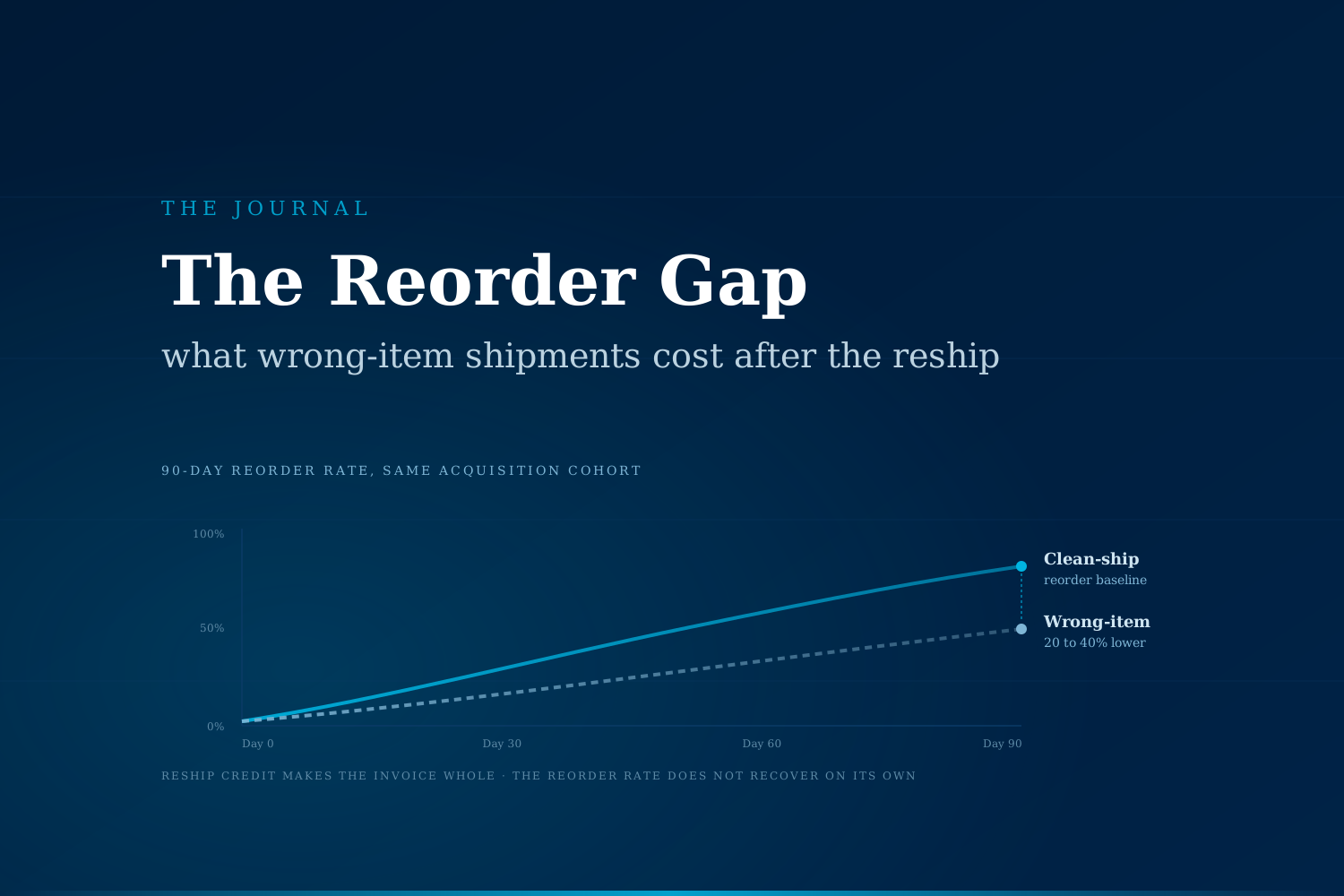
Most DTC brands price a mispick as the reship credit, the return label, and the extra CX minute it burns. That is the cost the finance team sees on the P&L. The larger cost lands on the reorder rate for that customer cohort, and on most 3PL scorecards it does not appear at all.
What counts as a mispick on a DTC 3PL contract?
A mispick is any shipment that leaves the fulfillment center with something the order did not call for. The three common variants are a wrong SKU shipped, a right SKU in the wrong size or variant, and a short or long pick where quantity is off. In the industry, they are usually rolled together under a single "order accuracy" metric on the 3PL scorecard.
Warehousing Education and Research Council (WERC) benchmarking studies have for years pegged best-in-class order accuracy at 99.9 percent or higher, with median performance closer to 99.5 percent. Those numbers sound tight, but the tail matters. At 99.5 percent accuracy, a brand shipping 40,000 orders a month sees around 200 mispicks. At 99.0 percent, that doubles to 400. In a specialty apparel or supplements catalog, that is a lot of customers meeting the brand for the first time through a wrong-item unbox.
Why does the reorder impact stay hidden?
Three structural reasons keep the second-order damage off the dashboard.
First, the SLA the brand negotiated with the 3PL is almost always defined at the shipment level: cost per pick, cost per pack, credit for a mispick above a threshold. The contract makes the operational unit whole. It does not make the customer relationship whole. The reorder never happens, and there is no line item on the invoice that flags it.
Second, most brand analytics stacks look at reorder rate as a cohort average, not as a segment cut by fulfillment experience. The customers who got the wrong SKU are folded back into the same monthly cohort as the customers whose orders shipped clean. Their behavior gets averaged out.
Third, CX ticket tagging is inconsistent across DTC brands. "Wrong item received" tickets are often lumped under a broader "returns" or "order issue" tag, so even brands that could isolate the cohort do not, because the source data is not clean enough to pull.
The 3PL is not hiding anything. The brand simply is not counting the number that matters most to it.
What does a wrong-item unbox actually cost?
The visible cost has three components: the reship (product cost plus outbound freight, often 15 to 25 percent of AOV depending on category), the return handling (reverse label, receive, inspect, restock or dispose, typically 8 to 15 percent of AOV), and the CX time (a mispick ticket runs 4 to 8 minutes on chat, longer on email). For a brand with a $70 AOV, this often totals $18 to $35 in direct out-of-pocket cost per mispick.
The invisible cost sits on the customer. Multiple e-commerce experience studies, including a widely cited PwC customer-experience survey, report that a single bad delivery experience meaningfully depresses future purchase intent, with roughly one in three customers saying they would leave a brand they liked after a single poor experience. Zendesk's annual CX Trends report tells a similar story on repeat purchases.
Translated to reorder math, brands that instrument this cohort tend to see the 90-day reorder rate for wrong-item customers land 20 to 40 percent below the clean-shipment baseline for the same acquisition cohort. On a customer worth $180 in expected 12-month contribution margin, a 30 percent reorder drag is roughly $54 of lifetime value gone per event. That is two to three times the direct reship cost, and it sits nowhere on the 3PL invoice.
Manual mispick handling versus AI-assisted mispick handling
The comparison is not about replacing pickers. It is about compressing the loop between the mispick event and the customer's second impression, and about routing the exception cleanly instead of leaving it to a CX rep working from a shipping notification and a photo attachment.
| Step | Typical manual flow | AI-assisted flow |
|---|---|---|
| Detection | Customer reports it via chat or email | Weight-check and pack-verification anomalies flagged at the pack station, cross-checked against SKU dimensions |
| Ticket routing | Rep tags "order issue," triages by hand | Auto-classified as mispick, priority set by AOV, category, and customer LTV band |
| Correct SKU decision | Rep reads order, decides reship vs refund | System proposes reship of correct SKU with same-day carrier upgrade for high-LTV customers, refund for low-margin items |
| Return label | Rep generates in the shipping tool | Auto-generated with prepaid label and pickup option where useful |
| 3PL feedback loop | Monthly scorecard review | Per-event root cause tagged (SKU confusion, similar packaging, slotting error) and fed back to the FC weekly |
| Recovery gesture | Ad hoc discount code, sometimes forgotten | Rules-based apology credit sized to LTV band, delivered inside the same conversation |
| Reorder tracking | Not tracked as its own cohort | Cohort tagged and monitored against the clean-ship baseline for 30, 60, 90 days |
The AI layer removes the parts of the flow that are decision-support work dressed up as human work. The CX rep still handles the empathy piece, still owns the customer relationship, and still overrides the system when a case needs judgment.
Three signals a DTC brand is under-measuring mispick damage
If a founder or head of ops wants to sanity-check whether this pattern is live in their business, three signals usually surface it fast.
- Reorder rate is only reported at the cohort level. If the analytics stack cannot pull "reorder rate among customers whose most recent order had a wrong-item ticket," the impact is invisible by construction. It is happening; it is just not being measured.
- CX tickets tagged "order issue" are more than 2 percent of shipped orders. Industry conversations put clean DTC brands under 1 percent on this tag. Above 2 percent, the mispick share is usually large enough to matter, and the tag is doing double duty (mispicks, wrong quantities, missing items in a multi-SKU pack).
- The 3PL scorecard shows 99.5 percent accuracy but CX volume disagrees. When the 3PL's self-reported accuracy is well above what CX ticket volume implies, the definition of "mispick" is drifting between the two sides. That is a data conversation before it is a performance conversation.
None of these alone proves the reorder rate is being dragged down. Together they usually mean it is.
What changes when the mispick loop tightens?
The most direct change is that the customer who got the wrong shirt or the wrong bottle sees a competent, fast recovery instead of a two-day chase. The reship arrives before they have decided to leave the brand, not after. That single change bends the 90-day reorder curve for the affected cohort back toward the clean-ship baseline.
Downstream, three things shift. The 3PL relationship becomes a data conversation instead of a blame conversation, because per-event root causes get tagged in near-real time and clustered by cause (adjacent slotting, similar packaging, SKU proliferation on a new drop). CX capacity frees up because mispick tickets stop consuming the volume they used to. And the LTV model the brand feeds into its acquisition budget stops overpaying, because the true post-fulfillment reorder curve replaces the assumed one.
None of this shows up as a single big savings line. It shows up as a slightly higher reorder rate on a cohort the brand had already written off, a slightly cleaner P&L, and a fulfillment relationship that is easier to manage on both sides.
The pitch
If the CX inbox is quietly carrying more "wrong item" tickets than the 3PL scorecard implies, or if the reorder rate is being averaged across cohorts that had very different fulfillment experiences, the mispick loop is worth looking at as its own workflow. We map the end-to-end path from pack anomaly to recovered customer, and we usually find one or two exception routes that were never designed on purpose.
If this pattern sounds familiar in your fulfillment, we run a completely free automation audit for DTC ops teams. No slide deck, no commitment. → Book the audit
Sami Raza
Software Developer & Technical Author
Sami Raza builds AI automation for logistics, DTC, and construction operations teams at ApexifyLabs, and writes about the operational failures that automation is actually worth pointing at.