Delivery Promise Dates and the DTC Cost of Missing Them
The date on the product page is a forecast most DTC brands never revisit. When it drifts from reality, the cost lands on conversion, support volume, and repeat rate at once.
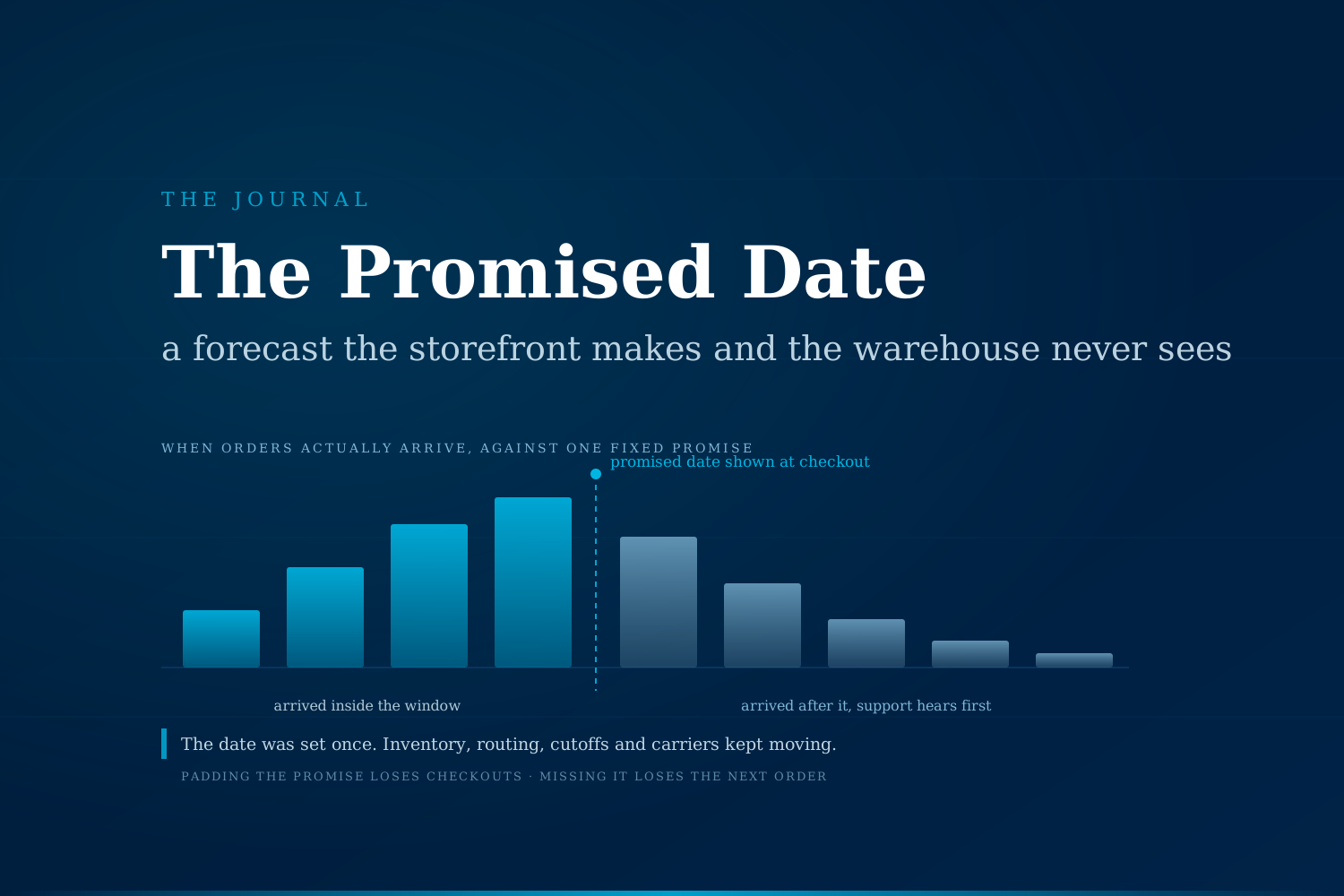
A delivery promise date is the arrival window a storefront shows before checkout. On most mid-size DTC brands it is a static rule written once, not a live calculation. When real fulfillment capacity moves and the promise does not, the brand pays twice: once in checkouts that never convert, and again in the support volume that follows every order that does.
What is a delivery promise date, and where does the number actually come from?
Ask a founder where the "arrives Tuesday" on their product page comes from and the answer is usually a shipping settings screen configured during the last platform migration. A processing window of one to two business days, plus a carrier transit map, plus a cutoff time that was accurate when the warehouse ran a single shift.
That configuration is a forecast. It quietly assumes the item is in the warehouse the customer's order will route to, that the pick queue is not backed up, that the cutoff will actually be met today, and that the carrier's service map still reflects the network the carrier is currently running. Each of those assumptions is true most days. The problem is that they fail independently, and the storefront has no way to know when one of them has.
Enterprise retailers solve this with an order promising layer that reads live inventory position, node capacity, and carrier performance before it renders a date. A $2M to $30M DTC brand almost never has that layer. It has a settings page and a team that finds out after the fact.
Why does the promise drift after the order is placed?
The drift is rarely one dramatic failure. It is an accumulation of ordinary operational reality that the promise logic was never told about.
Inventory position moves faster than the promise assumes. A unit shows available at the moment of checkout, then gets allocated to an order that came in ninety seconds earlier, or turns out to be a mispick sitting in the wrong bin. The order is now waiting on a replenishment nobody has told the customer about.
Node routing changes the transit math. A brand running two or three fulfillment locations promises based on the node it expects to ship from. When that node is short and the order reroutes, the transit leg gets longer while the displayed date stays where it was.
Cutoffs are aspirational, not enforced. The 2pm cutoff on the product page describes intent. On a heavy day, or the Monday after a promotion, the pick queue does not clear by 2pm and a batch of orders quietly slides a day. Nothing on the customer's side updates.
Carrier performance is treated as a constant. Transit maps are published service standards, not observed results. Actual door-to-door performance varies by lane, by season, and by how the carrier is managing its own peak. Most DTC promise logic uses the published number all year.
None of these is a mistake anyone made. They are the normal texture of running fulfillment. The gap opens because the promise was set once and the operation kept moving.
What does a missed promise date actually cost?
The cost shows up in three places, and only one of them is visible on a P&L line.
The first is conversion, and it lands before the order exists. Baymard Institute's long-running checkout research puts the documented average cart abandonment rate at roughly 70 percent, and among shoppers who abandon at checkout, delivery being too slow is consistently one of the leading stated reasons, cited by around one in five. A conservative promise built to be safe is a promise that loses checkouts to a competitor showing a date the brand could probably have met.
The second is support load. When a date passes without a delivery, the customer contacts the brand. Order status inquiries are routinely the single largest ticket category for DTC support teams, and the volume is almost entirely reactive: the contact exists because the customer was told one thing and experienced another. Contact-center benchmarks generally place the fully loaded cost of a live-handled contact in the low single-digit dollars, which makes a promise-date problem an ongoing headcount question rather than a one-time cost.
The third is repeat rate, and it is the expensive one. Consumer research published by industry bodies including the National Retail Federation has repeatedly placed delivery reliability among the leading factors in where shoppers choose to buy again. A late order that arrives is still a completed transaction. What it changes is the probability of the next one, at the exact point where the brand has already paid the acquisition cost and needs the second purchase to make the cohort work.
Worth noting: the brand that promises seven days and delivers in four is not safe either. It bought its reliability by losing checkouts to faster-looking competitors. Padding is not a fix, it is a different invoice.
Static shipping settings versus a live promise
The comparison below is not about replacing the ops team. Carrier negotiation, node strategy, and the call on what service levels to offer stay human. What changes is whether the date shown to a customer is connected to what the operation can currently do.
| Input | Static settings approach | Live promise approach |
|---|---|---|
| Inventory | Assumed available if the catalog says so | Checked against real allocatable position per node |
| Node selection | Expected node, decided by rule | Actual routing decision, factored into transit before display |
| Cutoff time | Fixed value on the settings page | Adjusted against the current pick queue and shift capacity |
| Carrier transit | Published service map | Observed door-to-door performance per lane and season |
| Peak periods | Same promise all year | Promise tightens or widens with real throughput |
| A date at risk | Discovered when the customer emails | Flagged before the promise is breached, while a recovery still exists |
| Customer message | Reactive reply to a WISMO ticket | Proactive notice with a revised window |
| Feedback loop | None; the settings stay as configured | Every delivered order updates the model that made the promise |
The pattern is that the AI-assisted version is not being clever about shipping. It is keeping a customer-facing number honest against an operation that changes daily, which is precisely the kind of continuous reconciliation a person cannot do by hand and a static settings page was never built to do at all.
Three signs a DTC brand's promise dates are guesses
- Nobody can state the current on-time delivery rate against the promised date. Carrier on-time performance is not the same measure. The number that matters is the percentage of orders that arrived within the window the customer was actually shown. If that figure is not on a dashboard, the promise is unmeasured, and unmeasured promises drift in one direction.
- The shipping settings have not changed since the last platform migration. Compare the configured processing window against the last quarter of actual ship timestamps. A consistent spread means the storefront has been quoting a cutoff the warehouse stopped hitting some time ago.
- Order status is the top support ticket category and it is treated as normal. High WISMO volume is usually read as a customer service staffing problem. It is more often a symptom that the promise and the operation disagree, and the customer is the first system to notice.
Any one of these is manageable. All three together generally mean the storefront and the warehouse have been running on separate assumptions for a while.
What changes when the promise reflects reality?
The first change is that the brand can stop padding defensively. Once promise accuracy is measured per lane and per node rather than assumed globally, the safe buffer can shrink where performance is genuinely reliable and widen only where it is not. That recovers checkouts the padding was quietly costing.
The second change is that exceptions surface while they are still recoverable. A date at risk detected on the morning of the pick is an upgrade decision or a node switch. The same date detected when the customer emails is a refund conversation.
The third change is where the support team's hours go. Proactive notice on the small number of orders that are genuinely going to be late removes most of the reactive contacts on the ones that are not. The team moves from answering "where is my order" to handling the cases that actually need judgment.
None of this appears as a single savings line. It shows up as a slightly higher checkout conversion rate, a materially smaller order-status ticket queue, and a repeat purchase rate that stops being eroded by a number nobody owned.
The pitch
If the delivery date on the product page comes from a settings screen rather than from what the warehouse can currently do, that gap is worth mapping as its own workflow. In our experience it is seldom one broken setting. It is usually the inventory signal, the routing decision, and the customer message living in three systems that were never introduced to each other.
If that sounds like your order desk, we run a completely free automation audit for DTC ops teams that want a second opinion before committing to anything. No obligation, no slide deck. → Book the audit
Sami Raza
Software Developer & Technical Author
Sami Raza builds AI automation for logistics, DTC, and construction operations teams at ApexifyLabs, and writes about the operational failures that automation is actually worth pointing at.