What Bundle and Kit Errors Cost DTC Brands at Peak
A bundle sells as one line and ships as four. When component stock and kit definitions drift apart, peak volume turns a small gap into cancellations.
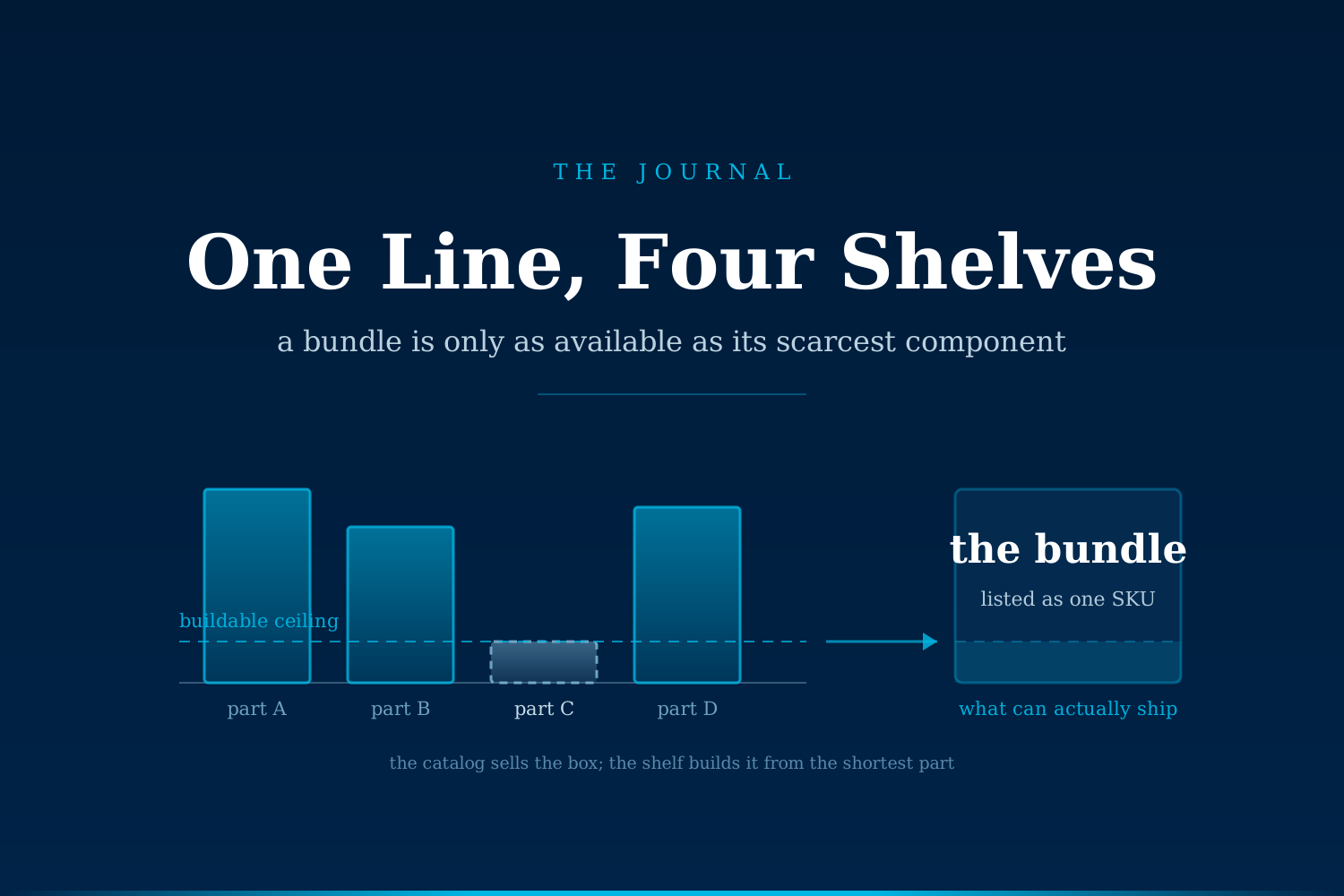
A bundle is not a SKU with a different price. It is a promise to ship several components that each carry their own stock position, supplier and lead time. When one component runs short, the bundle usually keeps selling. At peak volume, the gap between what the catalog offers and what the shelf can actually assemble compounds quickly.
Why does a bundle behave differently from a normal SKU?
Because its availability is a calculation, not a count.
A single SKU has one number attached to it. Somebody counted units, and the catalog shows that number. A bundle has no units of its own sitting anywhere. Its real availability is the smallest ratio across its components: how many of each are on hand, divided by how many each bundle consumes. That number moves every time any component moves, including when a component sells on its own as a standalone product.
Two consequences follow, and both are easy to miss.
First, a bundle competes with its own parts. A component selling well individually quietly reduces how many bundles can be built, without touching the bundle's own sales data. Nothing looks wrong in the bundle's report right up to the moment it cannot be picked.
Second, most commerce stacks will happily let a merchandiser type a fixed availability number against a bundle listing. That number is a snapshot of a calculation that has since moved on. It is correct on the day it is entered and decays from there, at a speed set by how fast the components sell.
Neither of these is a mistake by anyone. They are the normal behaviour of a catalog that treats a bundle as an item and a warehouse that treats it as an assembly.
Where do kit definitions actually drift?
In our experience, the bill of materials for a bundle is rarely wrong on the day it is created. It drifts afterwards, from ordinary operating decisions that nobody would describe as a change to the product.
- The component substitution that never propagated. A supplier ships a revised colorway, a new formulation, or a different cap. Purchasing accepts it, receiving accepts it, and the kit definition still names the retired component code.
- The insert added at the pack bench. A gift with purchase, a sample sachet, a seasonal card. It is a real component consuming real stock, and it usually enters the process as a verbal instruction rather than as a line on the kit.
- Channel-by-channel divergence. The site listing, the marketplace listing and the wholesale line sheet each hold their own copy of what the bundle contains. Updates land on one and not the others, and the discrepancy only becomes visible when a customer compares.
- Returned bundles. A returned kit can be restocked as a bundle, disassembled into components, or partially returned with one item missing. Each path implies a different inventory movement, and if the disposition is recorded as a single line, component counts are now wrong in a direction nobody can reconstruct.
- Shared components across several bundles. A hero product sitting inside four different kits is being consumed by four listings that each believe they have first claim on it. No single listing is wrong. The sum is.
- Case-pack and packaging changes. A component that arrives in a different inner-pack quantity changes what the picker actually pulls, without changing anything the catalog can see.
None of these is unusual on a growing catalog. What they share is that the correct answer exists somewhere in the business. It just cannot be produced quickly enough to act on.
Why does peak volume turn a rounding error into a real number?
Because peak compresses a quarter of demand into a handful of days, and errors that were survivable at a trickle stop being survivable at a flood.
Adobe Analytics put US online spending for the 2024 holiday season, 1 November to 31 December, at $241.4 billion, up 8.7 percent year over year, with Cyber Monday alone at $13.3 billion in a single day. Bundles are heavily represented in that window because gifting is the natural use case for a curated multi-item pack, which means a brand's kit-dependent revenue is concentrated in exactly the period when there is no slack to absorb a fault.
The arithmetic of compounding does the rest. Inventory record accuracy is a long-standing operational problem in its own right: the academic work on inventory record inaccuracy by DeHoratius and Raman, published in Management Science, found that a large majority of stock records at the retailer they studied did not match the physical count. Apply even a mild version of that to a kit. Four components, each with a record you would call reliable 97 percent of the time, give a bundle that is fully correct roughly 88 percent of the time, because every component has to be right at once. The bundle is always less accurate than its worst part, and the more thoughtfully curated the kit, the more parts there are to be wrong.
Then the return arrives. The National Retail Federation, working with Happy Returns, estimated total US retail returns in 2024 at roughly $890 billion, about 16.9 percent of sales. Bundles return worse than single items, because a customer who wants to keep three of four things creates a partial return that the system was never asked to model.
Static kit definitions versus continuously reconciled ones
Which bundles to build, what to price them at, and when to accept a substitute component are commercial judgements, and they belong to a merchandiser. The table below changes nothing about who makes those calls. It changes whether they are made against a current picture or a remembered one.
| Dimension | Static kit definition | Continuously reconciled bundle |
|---|---|---|
| Availability source | A number entered by hand | Derived from live component positions |
| Refresh | When somebody remembers | On every component movement |
| Component sold standalone | Invisible to the bundle | Reduces buildable count immediately |
| Substituted component | Discovered at the pack bench | Flagged at receipt, before it ships |
| Channel copies | Each maintained separately | One definition, reconciled outward |
| Shared components | Each kit assumes first claim | Contention visible across all kits |
| Oversell detection | At pick, or by the customer | Before the listing goes live that morning |
| Partial returns | A manual judgement call | Component-level disposition recorded |
| Merchandising input | Last season's sell-through | What is actually buildable this week |
| Finance view | Bundle margin as a blended guess | Margin attributable to each component |
Read down that second column and you will notice how little of it is clever. There is no product intuition in it, no taste, no judgement about what customers want. It is component positions, kit definitions and channel listings held in agreement continuously, at a cadence and volume no person can sustain by hand alongside the job they were actually hired for.
Where does a drifted kit show itself first?
- Nobody can state right now how many live bundle listings are unbuildable. Not total units on hand, not bundle sell-through: how many kits currently offered for sale cannot be assembled from stock today. If producing that answer takes an afternoon, it is already stale by the time it lands.
- Bundle cancellations are not tracked separately from single-item cancellations. A blended cancellation rate hides the pattern completely, because bundles are a minority of orders and a majority of the failures. Split the number and the shape usually appears immediately.
- The bill of materials exists in more than one place. A spreadsheet the merchandiser keeps, a field in the commerce platform, a pick instruction at the warehouse. Three sources means three answers, and the one the customer experiences is whichever the picker read.
Any one of these on its own is normal on a catalog that grew faster than its processes. All three at once usually means the catalog is making promises the shelf has no way to check.
What changes when component availability is watched instead of assumed?
The catalog stops offering what cannot be built. Buildable count becomes a live figure rather than a periodic reconciliation, which means the failure is prevented at the listing instead of apologised for at the confirmation email. That is a materially cheaper place to solve it.
Merchandising gets a real constraint to design against. Curation improves when the person choosing components can see which combinations are actually supportable through the season, rather than discovering the binding component after the campaign has shipped.
Returns stop being a guess. When a partial return is recorded against components rather than against a single bundle line, the resulting stock position is right, and the next buildable count is right along with it.
Bundle margin becomes measurable. Attribution down to component level turns the profitability of a kit from an estimate into a number, which is the difference between repeating a bundle next year out of habit and repeating it because it earned its place.
What is striking about all four is how little has to change physically. Same components, same catalog, same people, same building. The only thing that moves is how current the arithmetic between them happens to be.
The pitch
If your bundles sell well and your bundle cancellations look worse than the rest of the catalog, the distance between those two facts is worth mapping before the next peak rather than during it. What usually turns up is not a system that failed. It is a kit definition, a component position and a channel listing that were each maintained honestly, on three different rhythms, by people who never had a reason to compare them side by side.
If that sounds like your ops desk, we run a completely free automation audit for DTC teams that want an outside read before committing to anything. No obligation, no pitch deck. → Book yours
Sami Raza
Software Developer & Technical Author
Sami Raza builds AI automation for logistics, DTC, and construction operations teams at ApexifyLabs, and writes about the operational failures that automation is actually worth pointing at.