Multi-Channel Inventory Drift on a $10M DTC Brand
On a $10M DTC brand selling across Shopify, Amazon, and wholesale, inventory drift costs more than the visible oversells. Here is where the gap actually lands.
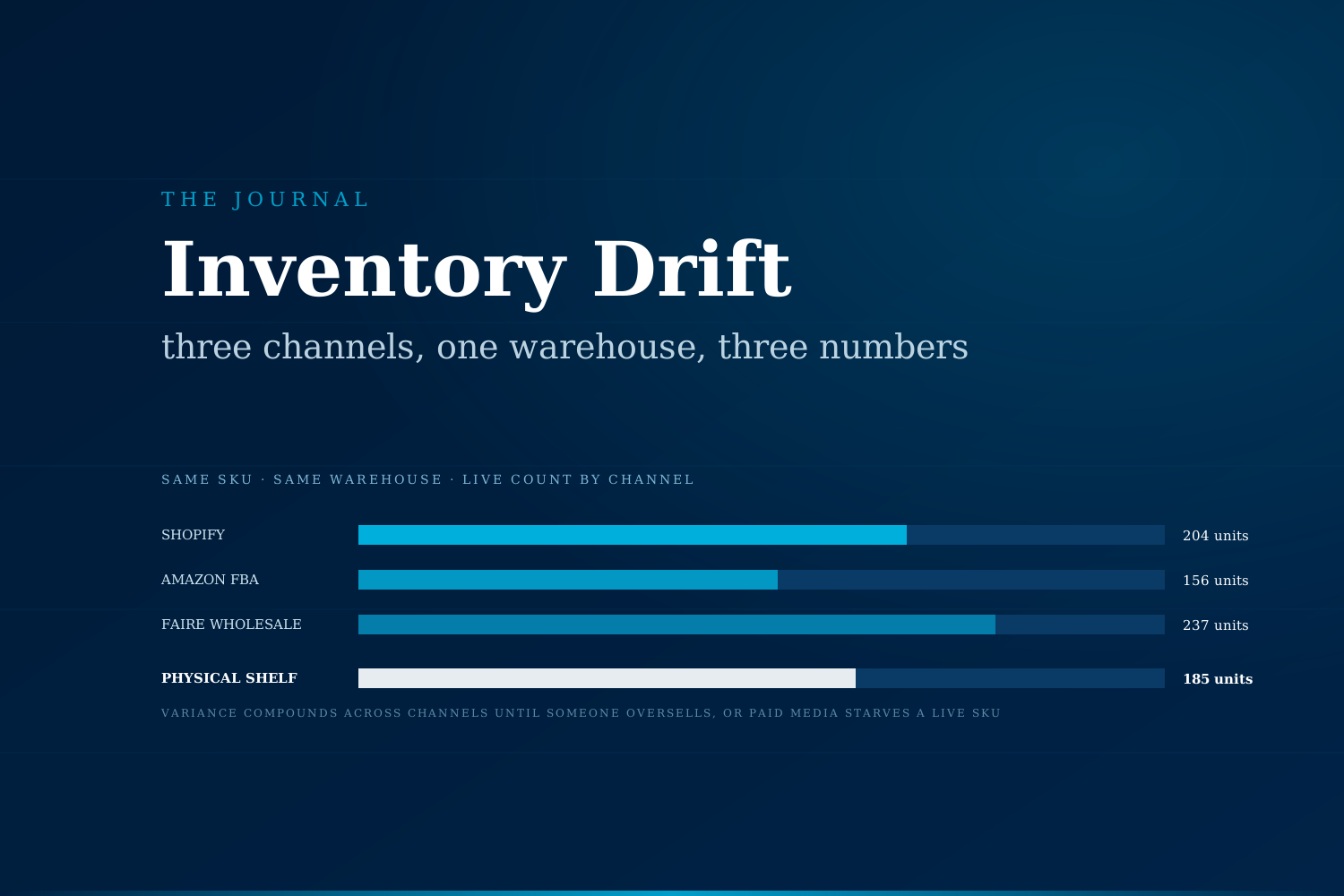
Multi-channel inventory drift is the gap between what a DTC brand thinks it has in stock and what it actually has, spread across Shopify, Amazon, Faire, and retailer EDI feeds. On a $10M brand, the drift costs more than the visible oversells. It accumulates in reconciliation hours, marketplace account health, and stockouts on bestsellers that were technically in stock.
What is inventory drift, and why is it a multi-channel problem?
A DTC brand running on a single Shopify store does not have an inventory drift problem. It has a stockout problem, which is annoying but tractable. The drift problem appears the moment the same SKU is being sold on a second channel that draws from the same warehouse. The Shopify available count, the Amazon FBA available count, and the Faire wholesale available count each track the same physical units, but each updates on its own cadence, from its own source of truth, after its own latency.
At $1M to $3M, the gap is small and the operator absorbs it. At $10M with three or more channels, the gap turns into a category of cost that no single dashboard captures. Industry studies of mid-market multi-channel operations (Pipe17, Cin7, and Brightpearl have all published comparable figures) consistently report 3% to 8% inventory variance between systems, with peak-season variance pushing toward 15%. On a brand carrying $1M to $2M in inventory at any given moment, that is between $30K and $300K of stock sitting in the wrong place for ops decisions to be correct.
Where does the cost of inventory drift actually show up?
Four places, and almost none of them roll up under "inventory" on a P&L.
Oversells and the cascading refund
The most visible cost is the oversell. A bestseller goes deep into restock at one warehouse, the Amazon feed lags four hours, and a customer orders on Amazon what the brand cannot fulfill. The brand cancels, refunds, ships a substitute, or absorbs a back-order penalty. On Amazon, oversells also drag account health metrics. Seller Central's Order Defect Rate (ODR) and Cancellation Rate are both reviewed against published thresholds, and a quarter of elevated cancellations can suppress Buy Box share for months afterward.
The visible cost is the refund. The compounded cost is the CS ticket, the reimbursement claim, the account-health dent, and the customer who never reorders.
Stockouts that were technically in stock
The opposite failure is just as expensive and twice as invisible. A SKU shows zero on Shopify because the morning import pulled the wrong warehouse view, while the 3PL has 200 units sitting on the shelf. Paid media keeps spending against the SKU. Conversion craters. The brand never reconciles "why did sales drop on this SKU last Tuesday" against "the inventory feed showed zero for nine hours."
E-commerce operations research from the major multi-channel platforms has consistently put unintended stockout rates at mid-market brands in the 5% to 12% range of SKU-day observations. On a brand spending $1M annually on paid media, even 5% of media wasted against false stockouts is real money landing against the marketing line rather than the inventory line, which is part of why it never gets caught.
The reconciliation tax on ops time
Most $10M to $30M DTC ops teams have at least one person, sometimes two, who spend a meaningful share of their week reconciling inventory across systems. They pull the Shopify variant report, the FBA inventory report, the WMS report, and last week's spreadsheet. They flag the deltas. They open tickets with the 3PL, with Seller Central support, with the WMS vendor. They republish corrected counts upstream.
That person is operationally critical and operationally invisible. Their work appears in no dashboard. The cost is roughly $40K to $70K of fully loaded labor annually, spent reconstructing data the brand already has, just in incompatible formats.
Marketplace standing and EDI penalties
Wholesale channels and Amazon Vendor Central both impose hard penalties for fulfillment failures: chargebacks on short-shipped POs, demotion in Buy Box on Amazon Seller, account health flags on Amazon Vendor, dropped placement on Faire. Those penalties are line items on a chargebacks statement. They are also a structural drag on the retailer relationship. A brand whose fill rate slips below the buyer's threshold gets fewer orders next season, regardless of how good the product is.
What does a manual inventory desk look like every day?
A typical mid-market DTC ops team running multi-channel inventory manually looks roughly like this. The ops lead opens a stack of reports on Monday morning. They pull the Shopify variant inventory export, the Amazon FBA CSV, the wholesale 3PL pick-pack report, and last week's reconciliation sheet. They spend the first hour matching columns. The second flagging variance. They open a Seller Central case if a phantom adjustment shows up. They email the 3PL about the SKUs whose physical count looks low. They request a cycle count on bestsellers. They republish a corrected feed to the channels that source from Shopify.
By Wednesday, the reconciliation has half-aged. By Friday, the drift has reaccumulated. The cycle restarts the following Monday. The work is necessary, structured, and invisible to anyone above the ops lead in the org chart.
Manual reconciliation vs agentic reconciliation: what changes?
The shift from a manual to an AI-augmented inventory desk is not "fewer people on the desk." It is "people on the cases that need judgment, agents on the cases that do not."
| Workflow stage | Manual inventory desk | AI-augmented inventory desk |
|---|---|---|
| Cross-channel reconciliation | Weekly export, manual column matching | Continuous, exception-flagged in near real time |
| Cycle count requests | Quarterly, by SKU class | Triggered by variance signals on bestsellers |
| Oversell prevention | Static buffer, set conservatively | Channel-specific buffer derived from velocity and lead time |
| Phantom adjustments | Ops lead investigates and files a case | Agent compiles event history and drafts the case |
| Wholesale fill-rate monitoring | Reviewed monthly, often retrospectively | Tracked per PO, warning issued before cutoff |
| Stockout root cause | Retrospective, sometimes | Per-SKU root cause surfaced within hours |
| Coverage | Ops team's working hours | 24/7 |
| Outcome | Drift reaccumulates between weekly cycles | Variance stays inside a defined exception envelope |
The work does not disappear. Edge cases (a 3PL miscount on a high-velocity SKU, a wholesale buyer disputing a chargeback, a phantom adjustment that requires a Seller Central escalation) still belong to a human. What disappears is the choreography.
When does inventory drift become an ops problem rather than a 3PL problem?
There is a quiet inflection point on most DTC brands. While the brand is on a single channel, drift is a 3PL accuracy problem, and the 3PL solves it with a cycle count program. Past a certain volume and channel count, drift becomes an operations and finance problem, and treating it as a 3PL problem leaves money on the table.
Signals the inflection has already happened:
- Three or more sales channels are sourcing the same physical warehouse.
- Wholesale and DTC are mixed in one operation, with shared SKUs.
- Daily order volume is above 100, spiked above 500 on launch days.
- Recurring chargebacks from a retail partner that the team cannot fully reconstruct.
- Paid media performance variance on bestsellers that does not match the creative cycle.
Most brands we talk to see at least three of these by the time they cross $10M. The cost is real. Like most operational drag at this stage, it is the kind that gets absorbed into "that is just running multi-channel" until someone counts what the absorption is actually worth.
Reconciling five partial truths is an integration problem before it is a reporting one, and it is the most common reason a brand ends up commissioning software built around its own data instead of buying another connector. The visible symptoms are covered in out-of-stock conversion spillover, stale product data on marketplaces, and split shipments across warehouses.
Three signs inventory drift is costing more than it looks
- The team cannot tell you, today, the exact unit count for the top 10 SKUs across every channel. If the answer requires three exports and a half-hour, the drift has already accumulated.
- Oversells happen at least once a week and the postmortem stops at "lag in the feed." The actual cause is rarely a single feed; it is the absence of a continuous reconciliation layer.
- Wholesale fill rate is calculated in arrears. Brands that learn about a missed PO threshold from a chargebacks statement rather than from a pre-cutoff warning are leaving margin and retailer goodwill on the table every cycle.
Curious what your inventory drift is actually costing?
We run a completely free automation audit for DTC ops teams that want a second opinion on where inventory drift is leaking margin before committing to anything. No slide deck, no procurement gauntlet. We map your current reconciliation flow, look at the channels where drift compounds invisibly, and show you what the same desk looks like with an agentic reconciliation layer on top.
Sami Raza
Software Developer & Technical Author
Sami Raza builds AI automation for logistics, DTC, and construction operations teams at ApexifyLabs, and writes about the operational failures that automation is actually worth pointing at.