Out-of-Stock Pages and the DTC Conversion Spillover Few Track
A sold-out SKU costs more than the missed order. Where DTC catalogs lose downstream conversion to a bad out-of-stock moment and what a cleanly handled one changes.
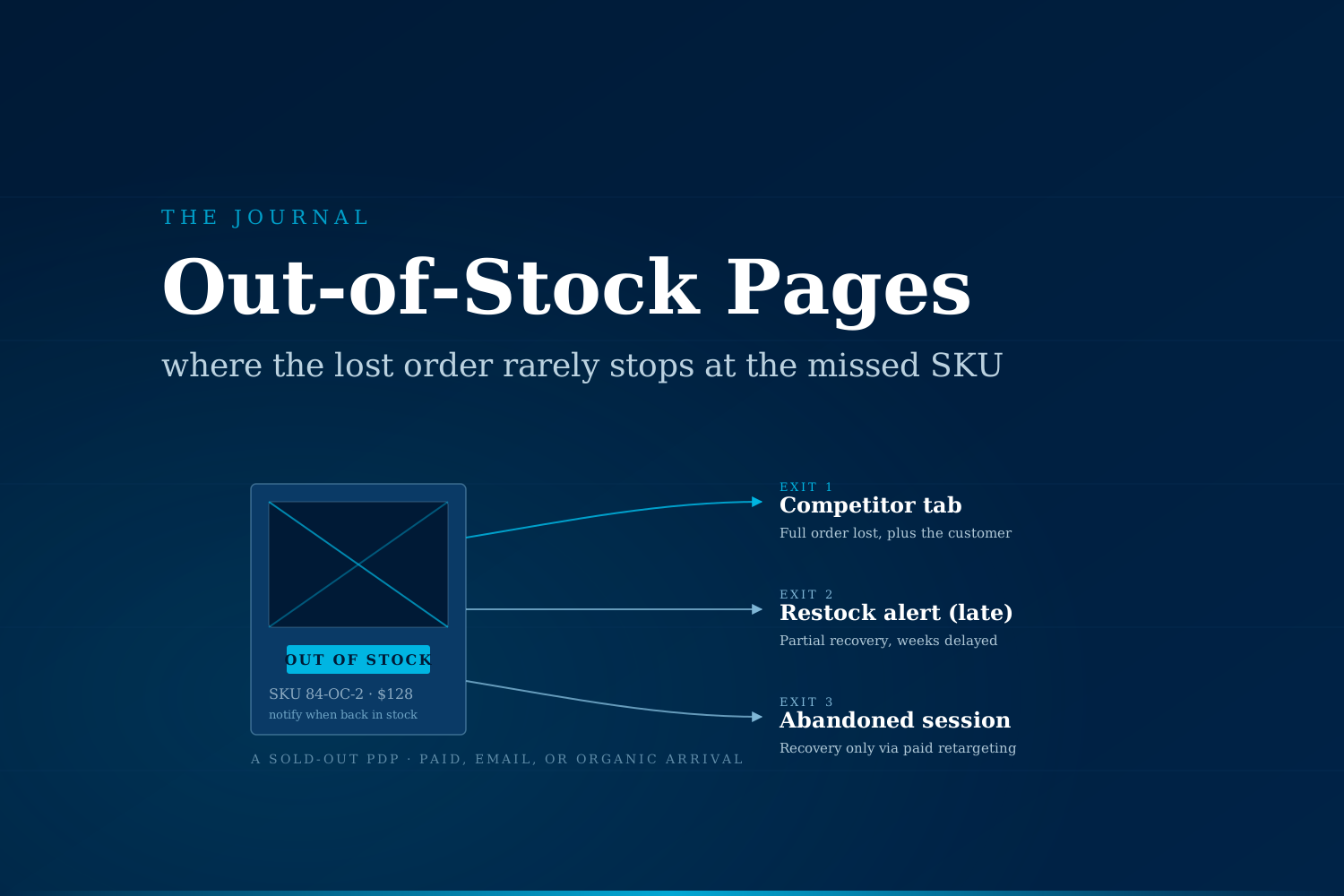
When a DTC product page renders as out of stock, the shopper sees a dead end and the brand sees a missed order. The cost rarely stops there. Across hundreds of SKUs and weeks of paid traffic, the way a brand handles its sold-out moments compounds into a measurable conversion tax that most ops teams underestimate.
This article looks at how a typical DTC out-of-stock page behaves today, why the lost conversion extends well past the single sold-out SKU, where the missed order actually lands across competing tabs and abandoned sessions, and what shifts when an AI-managed layer holds the out-of-stock moment for the brand.
What does an out-of-stock page typically do on a DTC site?
Most DTC sites handle the sold-out state in one of three ways, and each one drops the shopper into a different exit door.
- The product page renders normally with the Add to Cart button greyed out and no further instruction. The shopper is left to figure out what to do next.
- The product page redirects to a category page, often without a notice. The shopper lands on a wall of other products and treats the trip as a search reset.
- The product page is removed entirely, returning a 404 or a soft 404 (a page that loads but has no product). Search engines start dropping the URL from the index after a few weeks.
In every case, the shopper arrived with intent. They clicked a paid ad, an email, a marketplace link, or a search result that promised a specific SKU. The out-of-stock state, however it is served, asks them to start over. Most do not.
Why does the conversion loss extend past the single sold-out SKU?
The first-order loss is the order that did not happen. The second-order losses are larger and easier to overlook.
- The shopper sent by a paid ad: the ad spend on that click is already booked. The brand pays for the visit and ships no product.
- The shopper sent by an email: the warmest cohort the brand owns clicks and finds a wall. The next email's open rate dips measurably for a week or two.
- The shopper arriving from organic search: Google sees the soft-404 and starts removing the URL from the index, which compresses the brand's long-tail catalog presence over time.
- The shopper who treats the out-of-stock moment as a category-wide signal: a single bad encounter cools their browsing for the rest of the session, and category page conversion drops alongside.
Industry coverage of retail out-of-stock impact, including long-running research by IHL Group on store and digital stockouts, has flagged that out-of-stock encounters meaningfully lift the chance the shopper does not return on the same visit and a notable share never returns at all. The lost conversion is not bounded by the dollars on the missing SKU.
Where does the missed order actually go?
A shopper who hits an out-of-stock page on a DTC site has a small set of next steps. The split between them shifts with category, brand loyalty, and price point.
| Shopper next step | Where the order goes | What the brand pays |
|---|---|---|
| Opens a competing tab | A competitor PDP for the same or close-substitute product | The full lost order, often the customer for the next cycle |
| Searches the same brand for an alternate SKU | A different product page on the same site | A smaller order at a thinner margin, or no order at all |
| Subscribes to a restock alert | Returns later if the alert actually arrives before competing intent fades | Partial recovery, delayed by weeks |
| Abandons the session | Cookie may carry to a retargeted ad later | Recovery only with paid spend on top of the original spend |
The pattern across these four is that the only one with a clean recovery path is the restock alert, and even that path depends on the brand actually sending the alert when stock returns, before the shopper has solved the problem somewhere else.
A meaningful share of DTC carts never set up a working restock alert at all. The form exists, the address is captured, and the outbound email is either delayed by weeks or never sent because the integration between the inventory system and the messaging platform was never closed end to end. The order is recoverable in theory and lost in practice.
Why does this leak survive the dashboards?
Three structural reasons keep out-of-stock spillover off most ops radars longer than it should.
- The site analytics record the sold-out PDP visit as a session with a low time-on-page, indistinguishable from a casual bounce. There is no exception queue for an out-of-stock encounter because nothing technically went wrong.
- The paid media dashboard reports the click and the CPA against the campaign, not against the landing-page state. A click that landed on a sold-out SKU still counts as a delivered click.
- The merchandising team owns SKU availability, the paid team owns ad spend, the email team owns the warm cohort, and the SEO team owns the catalog's index footprint. The out-of-stock moment hits all four, and no single team currently owns the cross-cut view.
The data sits in the warehouse. The cost shows up as small dips across four separate reports, none of which alone looks urgent.
What signals usually mean a DTC brand is paying a heavy out-of-stock tax?
Three operational signals tend to mean the math has shifted enough to deserve a closer look.
- A growing share of paid-ad landing pages that have rendered as out of stock at least once in the campaign window, especially during sales events and post-launch demand surges.
- A persistent share of restock-alert sign-ups where no outbound email was ever sent, or where the email was sent more than a week after the restock actually posted to inventory.
- A measurable dip in category-page conversion on the days following an out-of-stock encounter on a top-traffic SKU, suggesting the bad first impression is cooling browsing across the catalog.
The tighter those signals get, the more likely the conversion math is being dragged by a moment that nobody on the team currently owns end to end.
What changes when an AI-managed layer handles the out-of-stock moment?
The interesting outcome is not a brand that never runs out of stock. Inventory will swing, supply chains will miss windows, and demand will surprise the forecast. The change is in what the shopper experiences when it happens, and in how cleanly the recovery path closes.
A managed layer at the out-of-stock moment does three things that no single team currently owns.
- At the product page, it reads the sold-out state, the catalog's substitution map, the shopper's session and customer record, and the inbound campaign context, then serves the recovery offer the brand actually wrote, whether that is a substitution, a restock alert with a real send-time commitment, or a tiered bundle alternative.
- At the alert stage, it watches inventory in real time and triggers the restock email the moment stock posts, with cohort-aware send-time logic so the alert lands when the shopper is most likely to act on it, instead of when the operations team next runs a manual sync.
- At the catalog level, it flags every SKU whose out-of-stock pattern is producing measurable spillover into category-page cooling or ad-spend waste, and routes those flags to merchandising and inventory as a prioritised list rather than another aggregate dashboard line.
That is the change. Not a brand pretending it never sells out. A brand that knows, for every out-of-stock moment, what the shopper saw, what recovery path was offered, whether the alert actually fired, and what the moment cost across paid spend, lost conversion, and customer cooling.
What this does not solve
It does not pick the brand's demand forecast, set the safety-stock policy, or negotiate the manufacturer's lead times. Those remain finance, ops, and merchandising calls. What it does is take the policy the team has already written for how a sold-out moment should land, and enforce it consistently at every product page, every alert, and every campaign so the cost the brand believed it was paying is the cost the brand actually pays.
Where this lands for a DTC brand thinking it through
Out-of-stock pages are one of those moments that look small at any single SKU and material across a quarter of campaigns. The brands that get hurt the worst are rarely the ones with no inventory discipline. They are the ones that scaled SKU count, paid spend, and email list size in parallel without closing the loop on what the shopper sees when those three lines collide on a sold-out PDP.
We run a completely free automation audit for DTC ops teams that want a clear read on what their out-of-stock moments are actually costing across paid spend, conversion, and customer cooling. No commitment, no slide deck, no upsell. → Book the audit
Sami Raza
Software Developer & Technical Author
Sami Raza builds AI automation for logistics, DTC, and construction operations teams at ApexifyLabs, and writes about the operational failures that automation is actually worth pointing at.