Receiver Appointment Portals and the FTL Broker Cycle Time Hit
Portal-based receiver scheduling has become one of the largest invisible time sinks on a mid-size FTL broker's desk. Here is where the cycle time actually leaks.
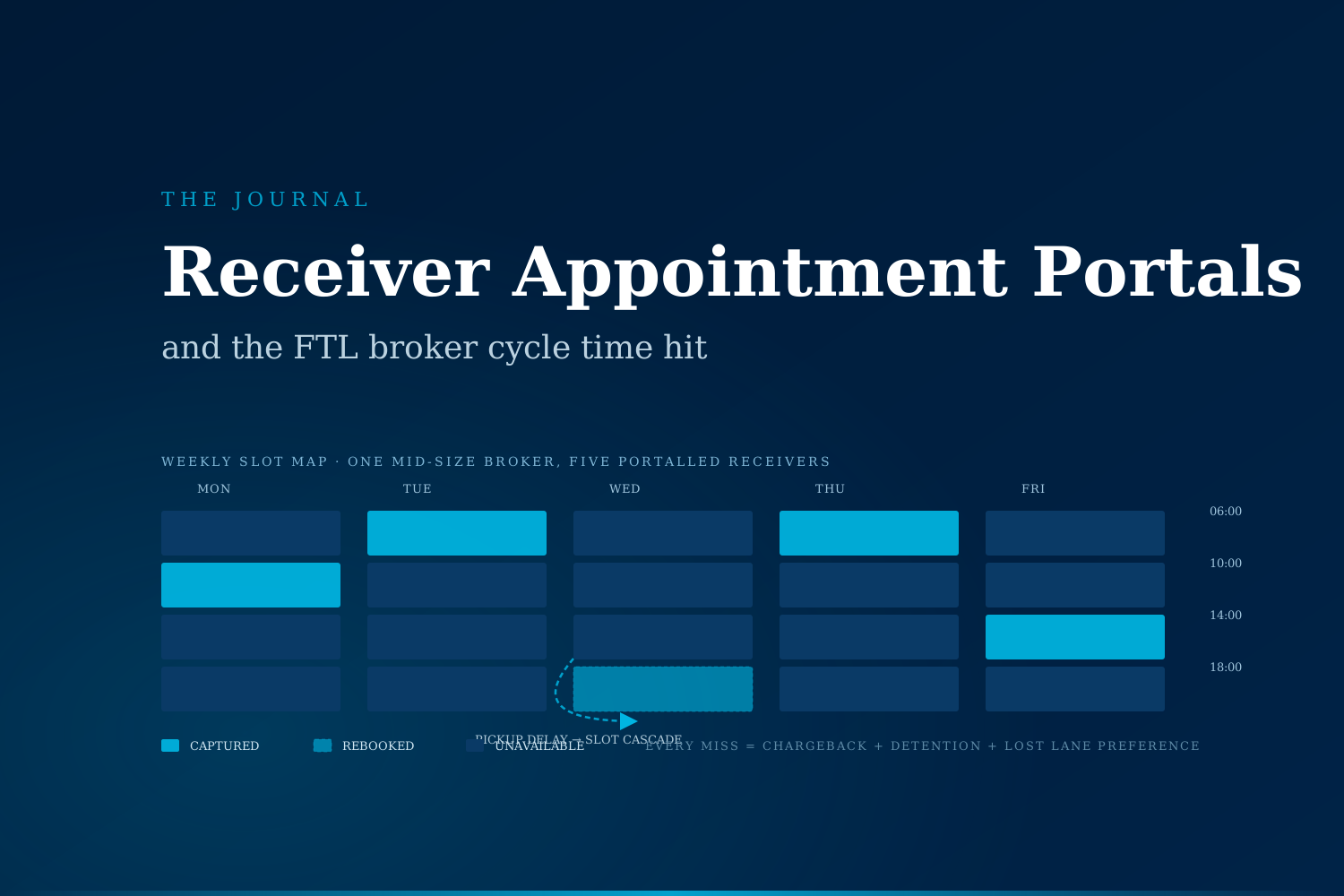
Receiver appointment scheduling has become one of the largest invisible time sinks on a mid-size FTL broker's desk. Most operators describe it as a few minutes here, a few there. Add the portal logins, the slot hunting, and the reschedule loops when pickup pushes by an hour, and the work consumes more dispatcher attention than load coverage itself on busy weeks.
This article looks at why appointment work has gotten harder, where the time and margin actually leak, what a single missed window costs, and what changes when an AI-augmented layer handles the portal interaction and the cascade.
What is receiver appointment scheduling for an FTL broker?
Receiver appointment scheduling is the work a broker's dispatcher does to secure a specific arrival window at the consignee's dock for every covered load. For grocery, big-box retail, and large industrial receivers, that window is usually booked through a customer portal, sometimes a phone tree, and occasionally an EDI 856 plus a follow-up call. The slot fixes everything downstream: the carrier's dispatch, the driver's hours-of-service plan, the receiver's labor schedule, and the broker's exposure to detention and on-time penalties.
For a mid-size FTL brokerage running 200 to 800 covered loads a week, this work touches almost every load. The patterns we hear from operators are remarkably consistent.
Why has receiver appointment scheduling gotten harder, not easier?
Three structural shifts have pushed appointment work from a coordination chore to a margin lever.
First, large retailers have tightened on-time, in-full (OTIF) and must-arrive-by-date (MABD) policies. Walmart's program, widely covered across freight trade press including FreightWaves and Logistics Management, has narrowed acceptable arrival windows by category and applies chargebacks calculated as a percentage of invoice for late or short shipments. Target, Kroger, Costco, and the major regional grocers run similar regimes. Retailer scorecards publicly track shipper performance against those windows, and the brokered carrier is the line on the report.
Second, the receiver side has fragmented across portals. A single FTL broker covering grocery, retail, and big-box accounts now logs into a different scheduling system for each receiver: One Network, Retalix, Manhattan Active, Blue Yonder, plus a long tail of in-house systems that only accept a vendor portal login. None of them share state. The dispatcher copies a load number into each one separately.
Third, slot availability has tightened. Industry reporting on labor-constrained DCs in FreightWaves and Logistics Management consistently describes appointment slots filling within minutes of release, sometimes hours before the truck even tenders. The first dispatcher to check the portal at 6 a.m. gets the lane's working slots. The third one rebooks for the next day.
The result is a workload that used to live inside dispatch and now sits in the middle of the broker's P&L.
Where does the time and margin actually leak?
Operators we speak with describe the same five leak points, in roughly the same order.
- Portal logging and initial booking. A multi-stop load can touch three to five separate portals at booking. Each login, each two-factor prompt, each slot search, each form submission stacks 5 to 15 minutes per load. That is before any rescheduling.
- Slot scarcity rebookings. When the requested window is unavailable, the dispatcher hunts for the next viable slot across days, then walks it back to the carrier's dispatch. A surprising share of loads get rebooked at least once before pickup.
- Pickup-side delays cascading downstream. When a shipper releases late or a driver runs over hours, the receiver slot is in jeopardy. The dispatcher reopens every downstream portal, requests a new window, and often loses the lane's preferred slot to another shipper's truck.
- Detention exposure from missed windows. A miss on a strict MABD window translates into a chargeback against the broker's customer, who in turn passes the pressure back through the contract. Industry surveys on retail compliance fees consistently put per-incident exposure in the low four figures, with frequent shippers describing meaningful annualized totals.
- TONU and dry-run absorptions. When the appointment cannot be rebooked in time, the carrier sits or returns empty. The truck-order-not-used charge does not always make it through to the customer. The broker absorbs.
Most of these leaks are not separately measured. They sit inside dispatch hours and the unattributed line on the lane's margin report.
What does a single missed appointment cost?
Three categories sit behind a missed appointment, only one of which usually shows up on the invoice. The other two stay buried in lane economics until someone audits a quarter end to end.
| Cost category | Where it shows up | Visibility today |
|---|---|---|
| OTIF / MABD chargeback | Customer invoice deduction | High, the customer surfaces it |
| Detention and driver pay | Carrier invoice plus accessorials | Medium, sits inside lane margin |
| Dispatcher reschedule loop | Salaried hours absorbed | Low, never measured |
| Lost lane preference | Future bookings at worse slots | Very low, rarely traced |
The cost is not the chargeback line alone. It is the slow erosion of the lane's economics as the broker's truck moves to the second-best window every time pickup runs even slightly late.
How does an AI-augmented scheduling layer change the workflow?
This is where the question gets practical. AI-augmented appointment work does not replace the dispatcher. It changes what the dispatcher is paid to think about. The system handles portal interaction, slot watching, reschedule cascades, and customer notification. The dispatcher handles the carrier relationship and the exceptions that need a human voice.
| Workflow step | Manual scheduling | AI-augmented scheduling |
|---|---|---|
| Initial portal booking | 5 to 15 min per load, manual entry | Submitted in seconds against preferred window |
| Slot availability tracking | Refreshes during business hours | Continuous, alerts on open slots in real time |
| Pickup-delay rescheduling | Phone and portal rebooking, end of cycle | Cascades through downstream portals on the trigger event |
| Reschedule communication | Dispatcher emails and calls each party | Customer, carrier, and receiver updated automatically |
| Exception handling | Buried in chat threads | Surfaced with the relevant context to one dispatcher |
| Audit trail | Spreadsheet plus inbox | Every action logged against the load record |
The interesting outcome is not the time saved at booking. It is the reschedule cascade. A pickup delay that used to consume an hour of dispatcher attention and still cost the lane a slot becomes a propagation that recovers the next-best window before the driver even calls.
What changes for the dispatcher's day?
The reaction we hear from dispatchers after the shift settles is consistent. Less portal switching. Fewer late-day surprises. Time freed for the calls that actually move freight: carrier development, exception handling, customer service.
Onboarding new accounts also stops being a portal-training exercise. The first time a broker books into a new retailer, the system has already encoded the rules, the windows, the chargeback regime, and the contact pattern. The dispatcher learns the relationship, not the software.
The customer-facing posture improves as well. The broker becomes the party that catches the slot risk before it becomes a chargeback conversation. That is a different position than running the same lanes at the back of the slot queue.
Where this lands for a brokerage thinking it through
Receiver appointment work is not a single problem. It is a tax on every covered load that touches a portalled receiver, sitting partly in dispatch hours and partly in lost lane economics. Most operators we meet have not measured the full size because the work is distributed across people and shifts.
The brokerage that benefits most from rethinking this layer tends to share three signals. A growing share of weekly loads delivering to MABD or OTIF receivers. A dispatch team that has expanded headcount over the last year and is still under water. A customer or two whose chargebacks have been creeping up quarter on quarter.
If those signals are present, this is a margin conversation, not an ops one.
We run a completely free automation audit for brokerages that want a second opinion on where appointment work is leaking time and lanes. No commitment, no slide deck, no upsell. → Book yours
Sami Raza
Software Developer & Technical Author
Sami Raza builds AI automation for logistics, DTC, and construction operations teams at ApexifyLabs, and writes about the operational failures that automation is actually worth pointing at.