AI Chatbot vs Rule-Based Chatbot
One follows a script, the other interprets the message. The real difference is what happens to the question nobody mapped, and what the bot can reach.
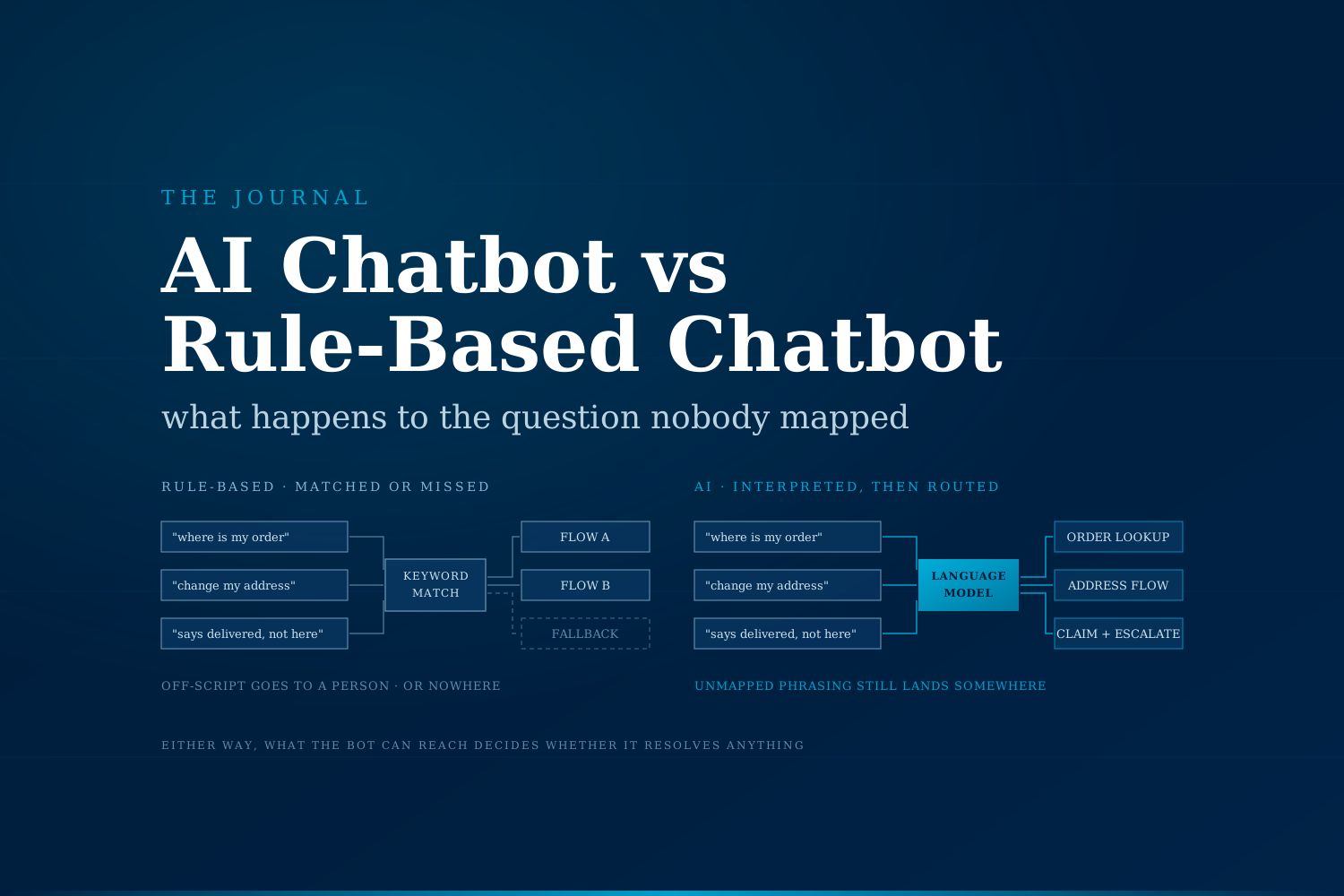
A rule-based chatbot follows a decision tree the team wrote in advance and answers only what it was scripted to answer. An AI chatbot interprets the message and composes a response. The practical difference is what happens to the question nobody predicted, and how much of the operation the bot can actually reach.
What is a rule-based chatbot?
A rule-based chatbot, sometimes called a scripted, decision-tree, or menu bot, runs on logic somebody wrote by hand. An incoming message is matched against keywords or a fixed list of intents, and the match routes the conversation down a predetermined branch. If the customer stays on the path, the bot performs well. If the message falls outside the map, the bot returns a fallback line.
None of this is primitive. A well-built scripted flow is fast, cheap to run, entirely predictable, and trivially auditable, because the flow diagram is the specification. For a bounded task with a stable set of inputs, that is frequently what an operation needs.
What is an AI chatbot?
An AI chatbot uses a language model to interpret the message rather than match it. It reads phrasing it has never seen before, holds the thread of a conversation, and composes a reply rather than selecting one. Connected to the business's own systems, it can answer from the actual order, the actual load, or the actual job record instead of from a script.
The trade is that behaviour is probabilistic rather than fixed. The same question asked twice may come back worded two different ways. That is an advantage for comprehension and a liability for compliance, which is why the engineering effort moves from mapping branches to constraining behaviour.
How do the two actually differ?
| Dimension | Rule-based chatbot | AI chatbot |
|---|---|---|
| How it decides | Keyword or fixed-intent match into a predefined branch | A model interprets the message in context |
| Unfamiliar phrasing | Drops to a fallback message | Handled, within the limits of its instructions and data |
| Behaviour | Deterministic, identical every time | Probabilistic, varies within bounds |
| Where the build effort goes | Mapping every branch of every flow | Grounding, guardrails, and evaluation |
| Characteristic failure | "I did not understand that" | A fluent answer that is wrong |
| Cost shape | Front-loaded at build, near-fixed to run | Lower to start, per-conversation thereafter |
| Auditability | The path is the record | Requires logging and evaluation to reconstruct |
| Cost of a new case | A new branch, every time | Often no new branch at all |
| Natural fit | Narrow, stable, compliance-bound flows | Open-ended enquiries over live records |
Where does a rule-based chatbot still win?
Scripted flows are not a legacy technology, and treating them as one produces expensive mistakes. They remain the better answer when:
- The task is narrow and the input space is genuinely closed. A booking change with four options is a menu, not a conversation.
- The wording of the response is legally or contractually fixed. Regulated disclosures, insurance language, and warranty terms should not be composed on the fly.
- The step touches money or an irreversible action, and determinism is worth more than flexibility.
- Volume is high and margin per interaction is thin, so a predictable cost per conversation matters more than nuance.
- Someone will later need to prove exactly what the system said, and why it said it.
Where does an AI chatbot earn its cost?
The case is strongest where the input space is open and the answer depends on live data. Freight status enquiries arrive in a hundred phrasings and need the load record to be answerable at all. "Where is my order" and "it says delivered and I do not have it" look like the same intent until someone reads the second one properly. Trade partners chasing a general contractor for submittal status write in prose, not menu selections.
In those settings a scripted bot does not fail loudly. It fails by covering the top handful of intents cleanly and routing everything else to a person, which is what the fallback branch is for.
What does containment rate actually measure?
This is where chatbot evaluations go wrong, regardless of which type is deployed.
Containment rate, the share of conversations that never reach a human, leads almost every chatbot dashboard. It is also the metric most easily produced by accident. A customer who gives up and closes the window is contained. A customer who abandons and re-contacts through another channel is contained twice. On most dashboards, giving up and being helped look the same.
Gartner research on customer service has reported that while roughly 70% of customers use a self-service channel at some point in their resolution journey, only around 9% resolve the issue entirely within it. The distance between those two figures is the space where containment gets reported and resolution does not happen.
The number worth watching is resolution without recontact inside a set window, broken out by intent. It is less flattering and considerably more honest, and it answers the question containment hides: is the bot removing work, or moving it somewhere the dashboard cannot see?
Why do most production deployments end up hybrid?
Once a deployment survives its first quarter it usually stops being one thing or the other. The arrangement that tends to settle:
- Deterministic flows carry the transactional paths. Anything that moves money, changes a booking, or triggers an irreversible action stays scripted, because it needs to be provable rather than merely usually right.
- An interpretation layer sits in front of them. It reads whatever the customer actually wrote, including the phrasings nobody mapped, and routes it to the right flow or answers directly.
- An escalation path carries context. The handoff moves to a person before frustration builds, with the transcript and the record attached so the customer is not asked to start again.
Framing the decision as "AI chatbot versus rule-based chatbot" makes it sound like a product choice. In practice it is a decision about which parts of a conversation are allowed to vary.
What actually decides whether either one works?
Not the model, and not the decision tree. What decides the outcome is what the bot can reach.
A chatbot with no connection to the order system, the TMS, or the project record can only describe policy. It can be articulate and still be useless, because the customer is not asking about policy, they are asking about their thing. Wiring the conversation into the system of record is where the project time goes: authentication, permissions, stale records, partial APIs, fields that mean something other than their name suggests, and the decision about what the bot may change rather than merely read.
That work is close to identical whether the front end is scripted or generative. It is also why two companies deploying the same chatbot platform report results that are not remotely comparable.
Gartner has forecast that chatbots will become a primary customer service channel for roughly a quarter of organisations by 2027. The ones that get there will not be separated by which type they picked. This is why chatbot work is better scoped as an integration project with a conversational surface than as a conversational project with some integration attached. The same pattern on live workflows runs through clearing the WISMO ticket backlog, freight check calls before and after AI, and the refund reflex on delivered-not-received claims.
Three questions worth answering before choosing
- What share of inbound messages are about one specific record? If most enquiries reference an order, a load, or a job, the integration matters more than the conversational layer, and both types will disappoint without it.
- What does a confidently wrong answer cost here? A wrong delivery estimate is a ticket. A wrong lien deadline or a wrong duty quote is a different category of problem. That cost sets how much of the flow needs to be deterministic.
- What happens today on escalation? If handoff means the customer repeats everything to a person, the bot will be judged a nuisance regardless of how well it performed up to that point.
What this piece deliberately leaves out
There is a version of this comparison that names platforms, quotes per-conversation pricing, and walks through grounding and guardrail configuration. That version ages badly and helps less than it appears to. Platform rankings turn over every few months, and the configuration that makes a deployment safe is specific to the data underneath it.
What holds is the framing. The choice is not really between two products. It is a decision about which parts of the conversation may vary, and how deeply the conversation is wired into the systems that hold the answer.
Want a straight read on which one fits?
If you are weighing a chatbot project and want an outside view on which parts should be deterministic and which should not, we run a completely free automation audit. No slide deck, no commitment. → Book the audit
Sami Raza
Software Developer & Technical Author
Sami Raza builds AI automation for logistics, DTC, and construction operations teams at ApexifyLabs, and writes about the operational failures that automation is actually worth pointing at.