Freight Check Calls, Before and After AI
On most freight desks, tracking a load still means dialing for an ETA. A look at what manual check calls cost and what the work becomes once AI handles it.
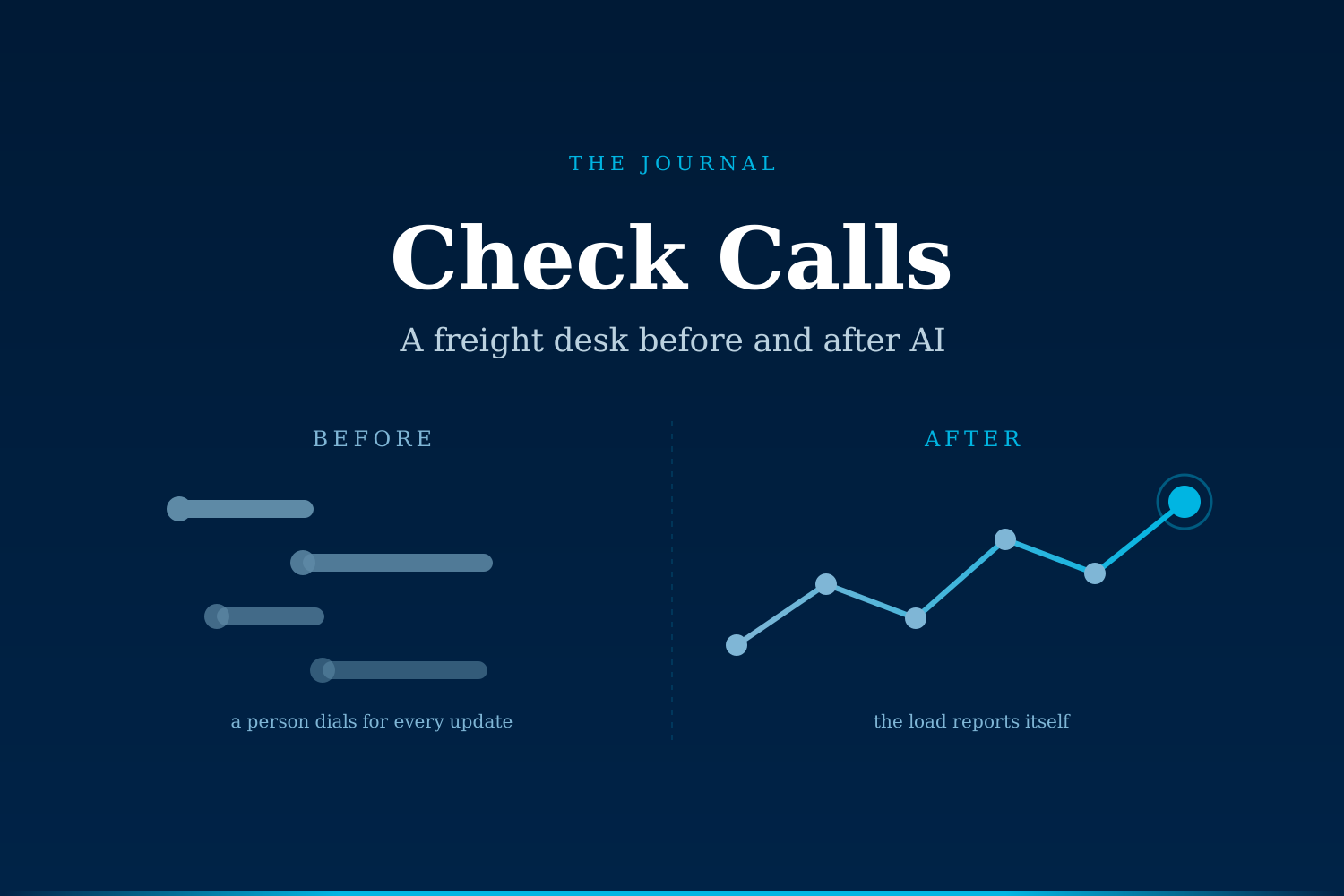
A check call is the manual status update a freight broker collects on a load in transit, usually by phone or email. On most desks, tracking a single shipment still means a person dialing for an ETA several times before delivery. The location data often already exists. The desk simply is not wired to receive it.
This article looks at why check calls still dominate the brokerage workday, what manual track-and-trace costs a desk in hours and attention, and what the same tracking work becomes once AI handles the routine updates.
What is a check call, and why does it still run the freight desk?
A check call is the freight industry's name for a routine touchpoint on a moving load: confirming pickup, getting an in-transit location, verifying the truck will deliver on time, and logging it all in the transportation management system (TMS) so the customer can be updated. A single truckload shipment moving two or three days generates several of these touchpoints, plus extra calls whenever something looks off.
The work persists for a reason that surprises people outside the industry. Most of the location data already exists. Since the FMCSA's electronic logging device (ELD) rule took full effect at the end of the 2010s, the large majority of for-hire interstate trucks carry a device that records location and hours of service automatically. Carrier telematics platforms, ELD providers, and driver GPS apps all hold the position of the truck. The broker is simply not connected to it, so the desk reconstructs by phone what a data feed could report on its own.
That is the real shape of the problem. A check call is not an information problem. It is an integration problem wearing the costume of a phone task. Every carrier runs different systems, smaller carriers may run none, and a brokerage moving freight with hundreds of carriers a month has no single place that data lands. The phone becomes the universal adapter, and a person becomes the integration layer.
What does manual track-and-trace actually cost a brokerage?
The direct cost is the one everyone can see, and it is the smallest part. Industry surveys of brokerage operations consistently rank manual load tracking among the most time-consuming recurring tasks on the desk. A completed check call is rarely just a call. It includes hold time, voicemail, callbacks for drivers who cannot safely talk while moving, and the TMS note afterward. Operators who have timed the full cycle tend to land between five and ten minutes per update.
Run the arithmetic loosely. A desk covering a few hundred active loads a month, each needing several status touchpoints across its transit, spends a meaningful share of its collective week on the phone purely to learn where trucks are. None of that time prices a lane, books a load, or strengthens a carrier relationship.
The costs underneath the labor line are larger and harder to see:
| Cost category | What it looks like | Why it is underpriced |
|---|---|---|
| Direct labor | Hours each week spent dialing for ETAs and logging them | Visible, but it understates the real total |
| Context switching | Tracking interrupts quoting, booking, and problem-solving | The interruption tax never lands on a report |
| Exception lag | A delay is found on the next scheduled call, not when it happens | Recorded as a late delivery, not a tracking failure |
| Customer trust | Shippers hear "let me check and call you back" instead of an answer | Surfaces as lost renewals, not as a desk metric |
| After-hours gaps | Trucks move overnight and on weekends; the desk does not | Shows up as a Monday-morning surprise |
| Staff churn | Check calls are the least engaging work in the building | Counted as recruiting cost, never as a tracking cost |
The category operators underestimate most is context switching. Tracking does not arrive in a tidy block. It interrupts. A rep mid-quote stops to chase an ETA, then restarts the quote cold. That broken rhythm is where the real productivity leaks, and no timesheet ever captures it.
How does a manual tracking desk compare to an AI-augmented one?
The difference between a manual desk and an AI-augmented one is not that the calls get faster. It is that the routine update stops being a call at all. AI-augmented tracking pulls position data from carrier and ELD sources, watches every active load against its planned schedule, and brings a human in only when something is genuinely off.
| Dimension | Manual tracking desk | AI-augmented tracking desk |
|---|---|---|
| Routine status update | A person dials for every ETA | Pulled automatically from carrier and ELD feeds |
| Update frequency | Whenever someone has time to call | Continuous on every load, including overnight |
| Exception detection | Found on the next scheduled call | Flagged when the truck slips behind schedule |
| Customer status request | "Let me check and call you back" | Answered immediately from current data |
| Small-carrier coverage | Phone only | A driver app or a single prompt, not a full interview |
| Ops capacity | Absorbed by tracking | Spent on exceptions, quoting, and relationships |
| Manager visibility | Reconstructed from rep notes | A live view of every load and every slip |
The point is not that AI makes the calls. It is that the desk stops reconstructing by phone what a system can watch continuously. The human stays exactly where human judgment earns its keep: on the exceptions, the recovery plan, the customer conversation. The desk steps out of the part that was only ever data entry with hold music.
We are not going to walk through the integration plumbing, because that is the actual work. Connecting a brokerage to live carrier position data means reconciling many different telematics and ELD systems, handling the carriers who run on none of them, deciding what the system is allowed to tell a customer before a human checks it, and folding all of it into the existing TMS. That is the part brokerages hand to a partner, and it is the reason the problem has survived this long.
What changes when the desk stops chasing status by phone?
A few things shift once tracking is continuous rather than manual.
Exceptions surface while there is still time to act. A truck running late is most useful to know about while the driver can still reroute or the receiver can still be warned. Discovered on a phone call hours later, the same delay is just an apology. A desk that sees the slip in near real time can manage it instead of reporting it.
Capacity reappears without hiring. The hours that went into routine dialing return to the same people. The team does not get smaller. It becomes a team that spends its day on work that prices, books, and protects margin rather than on status data entry.
Customer conversations change tone. When a shipper asks where their freight is and the answer is immediate and specific, the brokerage sounds like a partner with a firm grip on the load. The phrase "let me check and call you back," repeated across a relationship, trains a shipper to look elsewhere.
The desk gets quieter, in a good way. Check calls are widely regarded as the least engaging work in a brokerage, and they fall hardest on the newest staff. Taking that grind out of the day is one of the few practical levers a brokerage has on retention in a role that is genuinely hard to keep filled.
Managers stop flying blind. When every load reports itself, a manager can see the whole board at once: which loads are healthy, which are slipping, and which carriers and lanes generate the most exceptions. Tracking stops being a black box reconstructed from notes and becomes a live operational signal.
A desk that can answer "where is my load" without a callback is solving a conversational retrieval problem, which is the shape most AI chatbot development takes outside e-commerce. The downstream effects show up in POD lag and the DSO math, in load board tab churn, and in OTIF penalties on retail freight.
What are three signs your tracking workload is heavier than it looks?
A short diagnostic any brokerage leader can run this week, without speaking to an automation partner:
- Time one rep's tracking for a single day. Add up the calls, the callbacks, the hold time, and the TMS notes. If routine status work consumes more than an hour or two of a producing rep's day, it is competing directly with the work that grows the brokerage.
- Ask how your last three late deliveries were discovered. If the answer is "on a check call" rather than "the system flagged it," the desk is learning about exceptions too late to manage them and just early enough to apologize.
- Time a customer status request. If answering "where is my load" routinely means a callback instead of an immediate answer, the desk does not have current data. It has a phone number and a plan to use it.
None of these require software to investigate. They need a stopwatch and an honest hour. If one or more rings true, the tracking workload is almost certainly heavier, and more expensive, than the desk's own reporting shows.
Want a clear read on your tracking workload?
If check calls are a familiar part of your desk's day, we run a completely free automation audit for freight brokerages. We map how much time tracking is really consuming and what the routine portion would look like once it runs on its own. No commitment, no slide deck, no pressure to move forward. → Book the audit
Sami Raza
Software Developer & Technical Author
Sami Raza builds AI automation for logistics, DTC, and construction operations teams at ApexifyLabs, and writes about the operational failures that automation is actually worth pointing at.