Thin Sub Coverage on Mid-Size GC Bid Days
A scope reaches bid day with one number instead of five, and the estimator prices uncertainty rather than the market. The cost of that shows up at buyout.
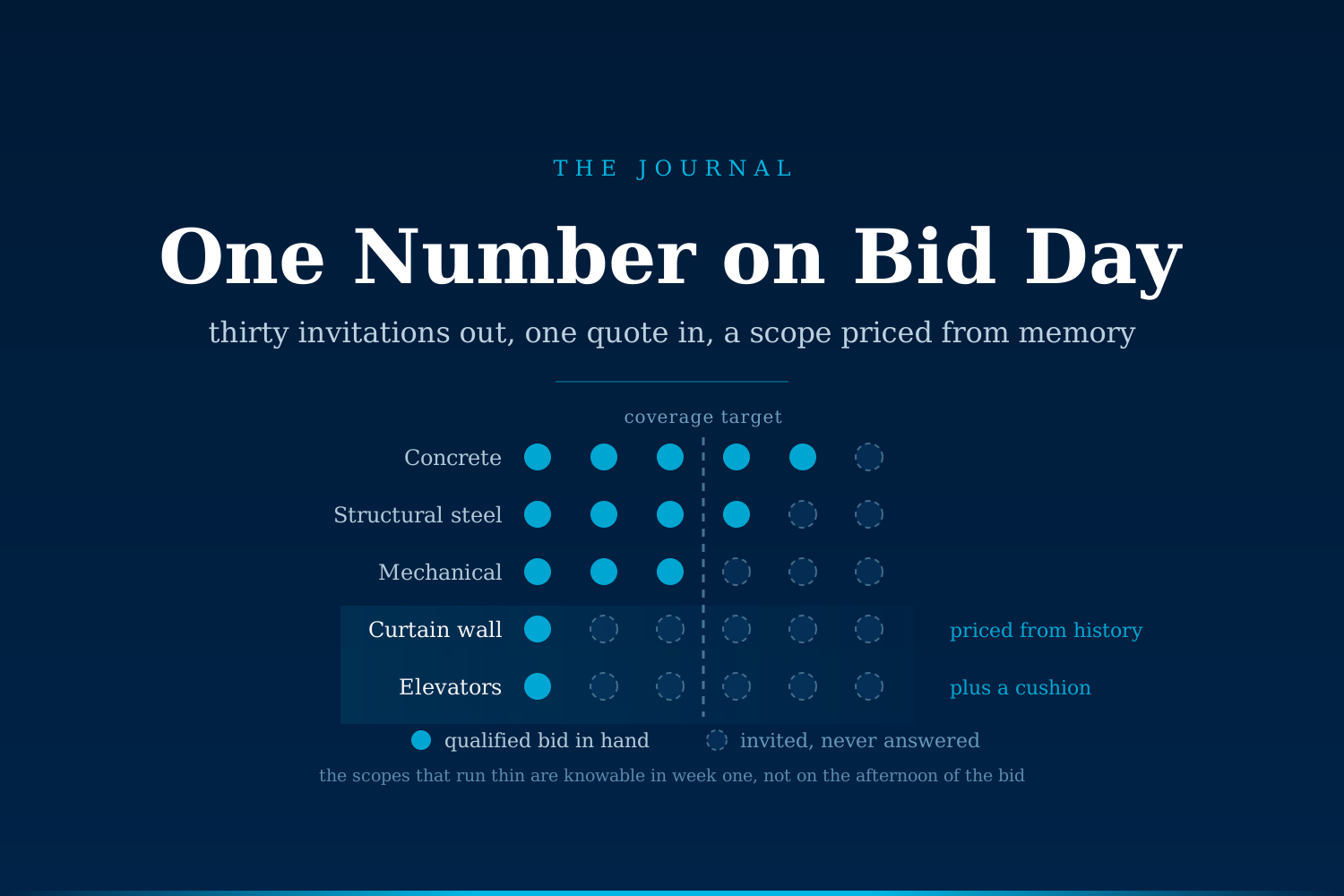
Thin sub coverage means a scope reaches bid day with too few credible quotes to price it against the market. On a mid-size general contractor's hard bid, one or two scopes usually carry the uncertainty for the whole number. The cost of that is rarely visible on bid day. It lands months later, at buyout.
What does a thin scope actually look like on bid day?
The invitation went out three weeks ago to thirty subs. Nine opened it. Four said they would take a look. Two asked for the geotech report and were never heard from again. At 4:40 p.m. on bid day, one number arrives, from a sub the estimator has used twice, and it is eleven percent above the historical unit cost carried in the estimate.
Now there is a decision to make in twenty minutes. Carry the number as bid and hope it is real. Carry the historical cost and hope the delta closes at buyout. Or split the difference and call it a cushion.
Every one of those is a guess about a market the desk did not get to see. That is the actual problem with thin coverage: not that the price is wrong, but that nobody can tell whether it is wrong, because there is nothing to compare it to.
Why do invitations and real bids diverge so far?
Because an invitation costs the GC almost nothing to send and costs the sub real estimating hours to answer.
Sub estimating desks are the constraint in this market, not sub field capacity. A regional mechanical contractor may be looking at fifteen invitations in the same two weeks and has the staff to price four of them properly. They triage by relationship, by job type, by how clean the documents look, and by whether they think the GC will actually award to them. AGC of America's annual workforce surveys have reported for several years running that a large majority of contractors have trouble filling positions, and that scarcity reaches the estimating room before it reaches the field.
There are quieter reasons too. The invitation reached a contact who left the company in March. The bid documents changed and the sub is not sure which set they are pricing. The scope letter is ambiguous at a trade boundary, so the sub is waiting on a clarification that never came back.
None of those is visible from the GC side. From the estimating desk they all look identical: silence. And silence gets counted as a maybe, which is how a scope with one real bidder can look adequately covered until the afternoon it is not.
What does a thin scope cost after the award?
It costs in one of two directions, and the direction is chosen for you.
If the estimator carries the cushion, the bid goes out heavy on that scope. Hard bids are frequently lost by less than the cushion a single uncertain trade contributes. The job is gone and nobody ever learns which line lost it.
If the estimator carries the historical cost and the sole bidder was right, the gap surfaces at buyout, when the GC is under contract at a price that no longer matches the market. From there it becomes a scope argument, a value engineering exercise, or margin the job absorbs. A sole bidder who knows they are the only number in the room is negotiating from a position the GC handed them.
There is a third cost that never gets attributed to precon at all. FMI and Autodesk estimated that poor project data contributed to roughly $1.8 trillion in global construction costs in 2020, most of it through decisions made on information that was incomplete at the moment of the decision. A scope priced without market coverage is exactly that kind of decision, made under a deadline, with the consequence deferred to a different team.
None of this is a new failure mode. McKinsey Global Institute's work on construction productivity found that the sector's labor productivity growth averaged about one percent a year over two decades, well behind the wider economy. Preconstruction is one of the places where that shows: the information needed to bid well exists, and assembling it is still mostly a person reading an inbox.
Manual pre-bid tracking vs an AI-assisted precon desk
| The pre-bid week | On a manual estimating desk | On an AI-assisted desk |
|---|---|---|
| Who intends to bid | Inferred from replies someone remembers reading | Every response classified as bidding, declined, or unanswered, continuously |
| Coverage by scope | Counted by hand a few days out, if there is time | Counted daily against the target for that trade |
| Non-responders | Chased when a coordinator gets a free hour | Surfaced the day the pattern forms, with the contact history attached |
| A scope going thin | Discovered on bid day | Flagged while there are still days to invite more subs |
| Addendum acknowledgement | Assumed unless a sub raises it | Tracked per bidder, so the GC knows who priced which set |
| The estimator's hours | Split between chasing status and reviewing scope | Spent on scope review, leveling, and the trades that carry real risk |
| After the bid | A folder of emails | A record of who bid what, and when, available to the next pursuit |
The left column is not carelessness. It is a capable person doing arithmetic on a moving target while four other bids are open on the same screen. The work is legible, it is just distributed across an inbox at exactly the moment it needs to be in one view.
Worth being clear about the boundary. Pricing a scope and choosing a sub are estimator judgments, and they stay estimator judgments. What arrives earlier is only the knowledge that a trade is running thin, delivered while the calendar still allows a response to it.
Which scopes tend to arrive thin?
Three patterns account for most of it, and they are all knowable in the first week of a bid period.
- Trades with a shallow regional bench. Curtain wall, elevators, low-voltage, specialty finishes. Four qualified firms exist within driving distance and two of them are booked. Coverage here is a market fact, not an effort problem, and it deserves a different plan than sending more invitations.
- Scopes invited late. A trade added after the bid period opened lands in a sub's queue behind everything else. Response rates on late invitations run materially lower, and the subs who do answer are often the ones with an empty backlog.
- Scopes where the invitation list is wide and the qualified list is narrow. Forty invitations feel like coverage until the prequal filter is applied and six of those firms could actually be awarded the work. The count on the spreadsheet was never the count that mattered.
Each of these is visible early to anyone counting. The reason they surface late is that nobody has the time to count while the bid is still open.
What would three past bids tell you?
This can be sized without starting anything.
- Qualified bids per scope, five days before bid day. Not invitations sent, and not replies received. Bids you could actually award. The scopes sitting at one or zero are the ones that set the risk in the number you submitted.
- Time from invitation to first response, by trade. The trades with the longest latency are the ones where a late invitation is effectively no invitation, and they are the ones worth inviting first next time.
- Sole-bid scopes and what happened to them at buyout. Pull the awarded jobs and compare the carried number to the executed subcontract on any scope that had one bidder. That spread, across three jobs, is the clearest dollar figure this problem produces.
Put those three side by side and the pattern usually resolves quickly. Coverage is fine on the trades with a deep bench and thin on a predictable handful, and the thin ones repeat from job to job because the underlying cause is structural rather than accidental.
What changes when coverage is visible every day?
The obvious change is that fewer scopes reach bid day with one number. A trade flagged as thin on day four of a three-week bid period is a problem with options: invite more subs, call the two who went quiet, clarify the scope boundary that stalled them, or make a deliberate decision to carry a cushion and price it knowingly rather than by default.
The change that compounds is what happens to the precon record. Which subs bid which trades, who responded fast, who declined and why, which scopes have historically been hard to cover in this market. That history exists today, scattered across old inboxes, and it is rebuilt from memory on every pursuit. Held in one place, it makes the next bid list better than the last one, which is the only durable way a mid-size GC improves its hit rate without adding estimators.
Nothing about the drawings or the size of the bidder pool improved here. The difference is that the desk knew where it was short while there was still a bid period left to work with.
The pitch
If your last three bids each had a scope that came down to one number on the afternoon of bid day, the constraint is probably not how many invitations went out. It is that nobody had the hours to watch coverage while the bid was live.
We map where a specific precon desk loses time to status chasing, how much of the pre-bid week is spent moving the same information between an inbox, a spreadsheet, and a bid board, and which parts of that should not be waiting on a person to notice. If that sounds like your estimating room, we run a completely free automation audit for general contractors. No commitment, no slide deck, just an honest read on where the hours are going. → Book the audit
Sami Raza
Software Developer & Technical Author
Sami Raza builds AI automation for logistics, DTC, and construction operations teams at ApexifyLabs, and writes about the operational failures that automation is actually worth pointing at.