When Estimating Capacity Caps a Mid-Size GC's Pipeline
Mid-size GCs decline 40 to 60% of bid invitations because estimating capacity caps the funnel. Here is the cost, the signals, and what shifts with AI.
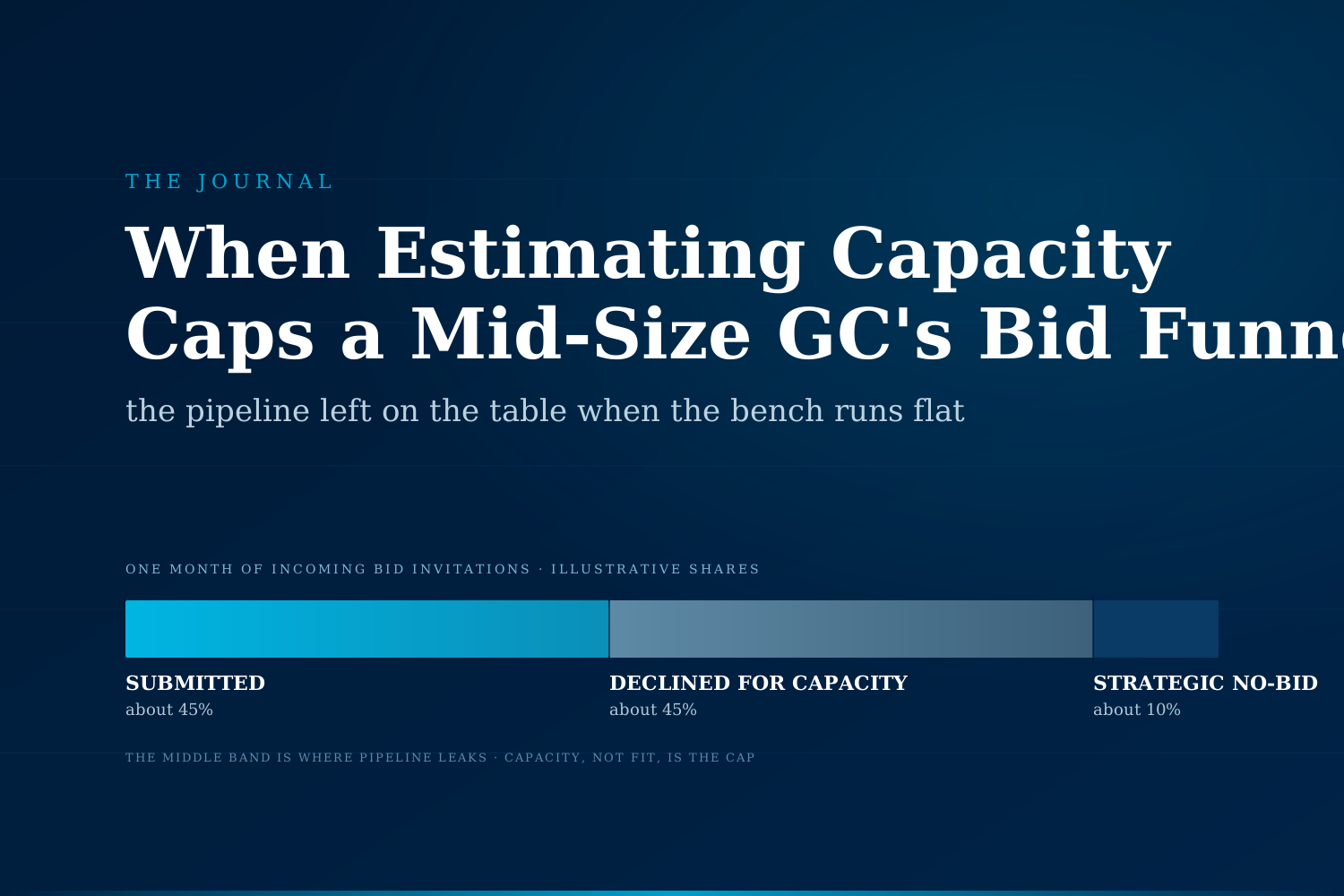
Mid-size general contractors routinely decline 40 to 60% of the bid invitations they receive, not because the projects are unattractive but because their estimating team has no slack to take them on. Bid hit rates plateau because the funnel never widens. The constraint is rarely volume of demand. It is estimating capacity, and most GCs underprice it.
What does the bid pipeline at a mid-size GC actually look like?
Most 50 to 300 person commercial GCs see steady inbound bid invitations from owners, construction managers, and design-build partners. Industry bid activity reporting from ConstructConnect and Dodge Construction Network indicates that an active mid-market GC commonly fields 200 to 600 invitations per year, depending on geography and trade mix. The pipeline is not a marketing-driven funnel. It is a fielded-volume problem.
What does each invitation cost to evaluate? A typical $5M to $15M commercial bid takes 40 to 80 estimator hours to prepare seriously: take-off, spec review, addenda tracking, sub-bid solicitation, leveling, indirect cost build-up, and the executive go/no-go conversation. Add a few more hours for proposal narrative, alternates, and clarifications. An estimator running flat out can carry maybe 6 to 10 active bids per month before quality slips.
The math is unforgiving. If a GC receives 30 invitations in a month and their estimating bench can process 12, then 18 invitations get declined by default. Some are smart no-bids. The rest are pipeline left on the table.
Why do GCs no-bid projects they could win?
It is rarely a single reason. The pattern usually looks like this:
- Deadline density. Two or three big bids fall on the same week. The team picks two and declines the rest.
- Take-off depth. The job requires careful quantity work and the team has 48 hours. A rushed take-off carries pricing risk, so the bid gets passed on.
- Spec ambiguity. The drawings are early and addenda are still trickling in. Without time to chase clarifications, the bid is too speculative.
- Sub coverage thin. The team cannot secure enough sub quotes by the deadline, so the cost basis is weak. Better to walk than to guess.
- No-bid as risk management. A senior estimator knows their hit rate goes negative on a rushed bid, so they protect the team by declining.
None of these are wrong calls in isolation. They become a problem when they happen 40 to 50% of the time. The cost is invisible because the declined bids never enter the loss-rate calculation. They are not losses; they are non-events.
How is estimating capacity typically measured?
The honest answer is that most mid-size GCs do not measure it consistently. The metrics that exist tend to be:
- Bids submitted per month. A throughput count.
- Hit rate. Wins divided by submissions. Industry benchmarks for negotiated and bid-build commercial work generally land in the 15 to 25% range, per CMAA and AGC member surveys.
- Hours per bid. Tracked sometimes during estimating productivity reviews.
What is rarely tracked: bid invitations declined per month, and the reason category behind each decline. Without that number, the conversation about adding estimating capacity is anchored to throughput, not to opportunity cost.
A useful reframing: if 50% of invitations are declined, and the historical hit rate on what does get bid is 20%, then doubling estimating capacity is not a 2x effort change. It is a 2x pipeline change with a known conversion rate behind it.
Manual estimating vs AI-augmented estimating: what changes?
The shift is not that estimators stop estimating. It is that the first 60 to 70% of the early-bid workflow, the parts that are quantity-heavy and pattern-heavy, gets compressed. The estimator's time moves up the value chain to scope risk, vendor relationships, and the bid strategy conversation.
A side-by-side view of the early-bid workflow:
| Workflow stage | Manual approach | AI-augmented approach |
|---|---|---|
| Drawing intake | Estimator opens PDFs, prints, marks up | Drawings ingested, sheets indexed, addenda tracked automatically |
| Quantity take-off | Manual on-screen take-off, 20 to 50 hours on a $10M bid | First-pass take-off generated, estimator validates and adjusts |
| Spec review | Estimator reads, summarizes, flags risks | Spec sections clustered by trade, risk clauses surfaced |
| Sub-bid solicitation | Outbound calls, emails, manual tracking | Invitations dispatched against the right sub list, response tracked |
| Bid leveling | Manual normalization in spreadsheets | Quotes parsed, line-by-line normalized, variances surfaced |
| Risk and indirects | Estimator's judgment | Estimator's judgment, unchanged |
| Go/no-go decision | Estimator and senior leadership | Estimator and senior leadership, unchanged |
The bottom of the table matters as much as the top. Judgment work stays human. The compression happens in the parts of the workflow that look like records review and pattern recognition.
McKinsey's research on construction productivity through 2020 to 2024 puts pre-construction administrative work at roughly 30 to 40% of the average estimator's day. That is the band that compresses first.
What stays human, even with AI in the mix?
Three pieces do not move:
- Pricing risk and contingency. The estimator decides how much exposure is in a scope and what to carry against it. That call rests on experience the AI cannot replicate.
- Sub relationships. Knowing which subs to trust on which scopes, which ones are overcommitted this season, which estimator at which sub returns calls. This is relationship knowledge that lives with the people.
- Strategic bid posture. Whether to chase a marquee owner at a slim margin, whether to throw a high number on a job the GC does not actually want but needs to stay on the bid list for, whether to bundle alternates. This is the senior conversation.
The point of compressing the early workflow is to give those three decisions more time and better information, not to automate them away.
What signals tell a GC their estimating capacity is the binding constraint?
A few patterns worth noticing on a quarterly look-back:
- Decline rate above 40% on incoming invitations. Not a problem if the declines are strategic. Worth investigating if they cluster around deadlines.
- Hit rate flat for two or three years. A stable hit rate at growing invitation volume means the funnel is being clipped at the entry point.
- Estimating overtime trending up. Hours per bid rising or weekends becoming routine is an early sign of fatigue, which shows up later as bid quality drift.
- Pre-bid clarifications slipping. If the team is submitting bids without chasing every RFI, the cost basis is fragile.
None of these signals are emergencies on their own. Together, they describe a desk that is doing the right work but with no room to do more of it.
A different way to think about the bid funnel
Most GCs treat estimating as a fixed-cost department. The bench is what it is, and pipeline scales when revenue justifies hiring. That logic works when invitation volume is the bottleneck. It misses the case where invitations are abundant and capacity is the cap.
When the cap moves, the next question is not "how do we close more of what we bid." It is "what does the pipeline look like when we can credibly take on 60% more invitations without adding headcount." That is a different strategic conversation, and the answer touches sales coverage, pre-construction services, and the kind of work the GC chooses to chase.
It is the conversation worth having before the next slow quarter, not after.
A note on what we leave out of this article
The specific tools, the document parsing patterns, the integration points into the existing estimating stack, the way a take-off model gets tuned to a particular GC's trade mix: those are the parts of this work that determine whether the desk actually moves. Each GC's estimating workflow bends the build differently, and the design choices that matter are not generic. Our role is to design and ship that system, then hand the estimating team a desk that opens up the funnel without breaking the way they already make decisions.
If the bid funnel at your GC feels capacity-shaped more than market-shaped, we run a completely free automation audit for mid-size GCs. We look at your invitation volume, decline patterns, and where AI-augmented workflow would actually move the needle. No commitment, no slide deck. → Book the audit
Sami Raza
Software Developer & Technical Author
Sami Raza builds AI automation for logistics, DTC, and construction operations teams at ApexifyLabs, and writes about the operational failures that automation is actually worth pointing at.