Subcontractor Prequal Cycle Time on GC Preconstruction Desks
Subcontractor prequal drags preconstruction 3 to 6 weeks per bid list at mid-size GCs. Where the cycle actually stalls, and what changes when the packet stays continuously current.
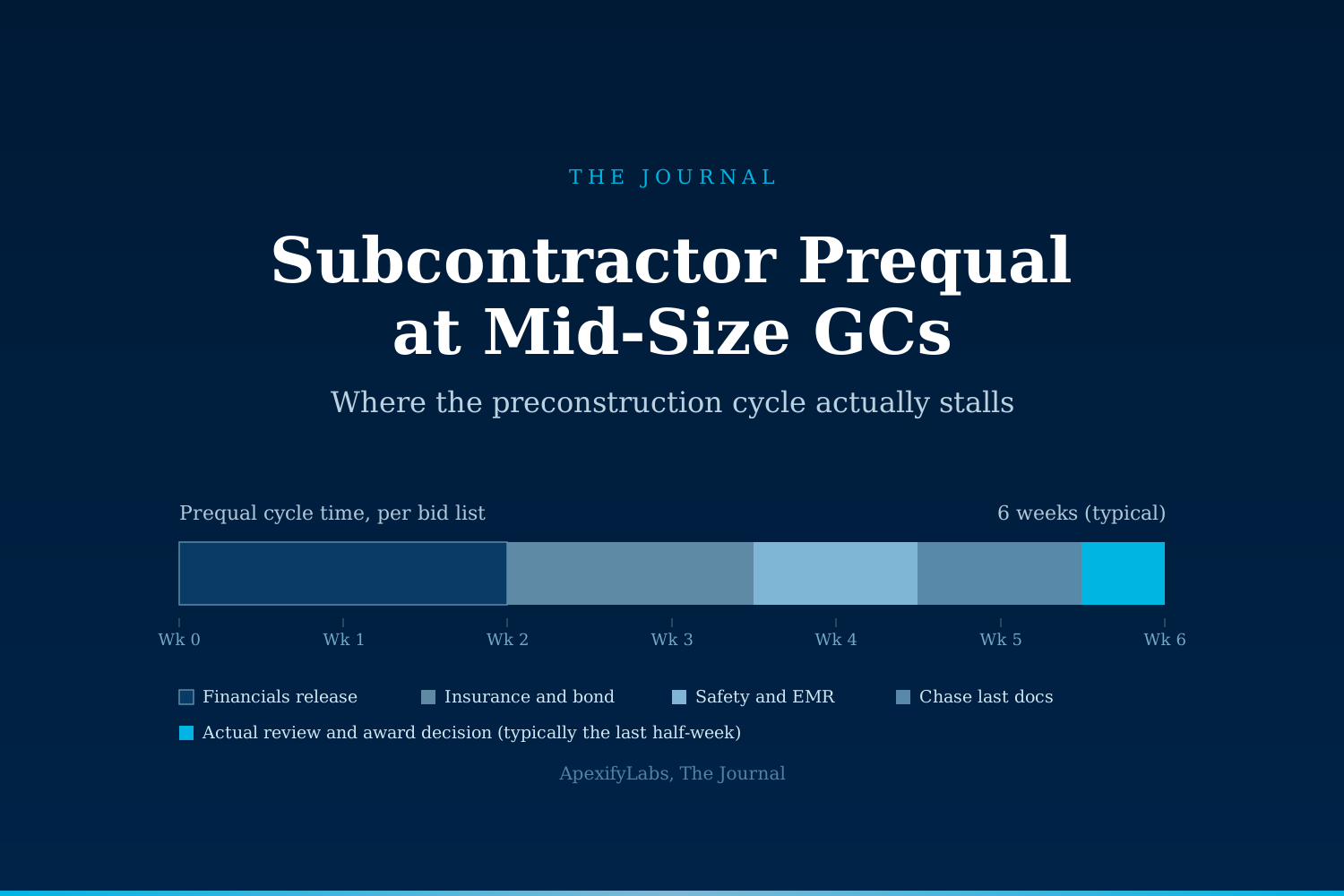
Subcontractor prequalification takes mid-size general contractors roughly 3 to 6 weeks per active bid list, and preconstruction teams often spend more of that window chasing documents than actually reviewing risk. On a portfolio of thirty open pursuits, the drag shows up as delayed invitations, expired financials that must be re-collected, and awarded scopes granted to trade partners whose files were never fully verified.
What is subcontractor prequalification, and why does it slow preconstruction?
Prequalification is the pre-bid vetting a GC runs on every trade partner before that partner is invited to bid on a project. The packet typically covers financial condition (audited or reviewed statements, WIP schedule, backlog, bank line), safety history (three-year EMR, OSHA 300 logs, DART rate), bonding capacity, insurance limits, licensing, references, and litigation history.
Every mid-size GC has a prequal form. Every subcontractor has to fill one out. But formats differ across GCs, sub controllers push back on releasing financials to a portal they distrust, safety data is fresh for only a quarter, and bonding letters expire on the surety's calendar rather than the GC's. The result: the packet is stitched together over weeks, not delivered on day one.
The AGC and CFMA have both reported for years that construction back-office work lags materially behind other industries in digitization. A 2023 CFMA benchmark of mid-size contractors placed prequalification and vendor onboarding among the top unresolved back-office bottlenecks, alongside COI collection and closeout.
Where does the prequal cycle actually stall?
The stalls are almost never in the review itself. They are in the collection.
- Sub controllers do not release financials fast. Financial statements are treated as sensitive. A subcontractor's controller may take 5 to 15 business days to send audited or reviewed statements, and often only after a signed NDA that the GC's legal team drafts on request.
- Insurance certs and bonding letters expire out of sync. A cert issued in March is stale by the time a packet is compiled in October, and the sub's broker must reissue with the GC named as certificate holder.
- Safety records are pulled from three different places. OSHA 300 logs come from HR, EMR letters come from the workers' comp carrier, and the DART calculation is done by the sub's safety director. Three humans, three inboxes.
- Every GC's form is different. A sub bidding to five GCs in a region fills out five slightly different forms and updates each one on a different anniversary.
- The prequal software has gaps. Portal-based prequal (ISNetworld, Building Connected, Textura, or a homegrown SharePoint) captures fields but rarely reconciles expirations, and does not notify the estimator that a trade partner's packet lapsed since the last invite.
Preconstruction admins spend most of the cycle chasing, not evaluating. Industry commentary from ENR and BuiltWorlds has repeatedly flagged this pattern: the review takes hours, the collection takes weeks.
Manual prequal desk vs continuously reconciled prequal desk
The two-column framing looks stark on paper. It is stark in operation too.
| Dimension | Manual prequal desk | Continuously reconciled prequal desk |
|---|---|---|
| Median cycle from invite to complete packet | 3 to 6 weeks | 3 to 5 business days |
| Preconstruction admin hours per prequal | 4 to 8 hours per sub | 45 to 90 minutes per sub |
| Chase emails per packet | 6 to 12 | 1 to 3 |
| Expired documents caught before bid invite | Sometimes | Every time |
| Financials collected under standardized NDA | Ad hoc | Standing template |
| Safety data reconciled with public sources | Rarely | Continuously |
| New trades and MBE / WBE / DBE subs vetted in time | Often skipped | Included by default |
| Prequal file audit-ready at closeout | Requires reassembly | Preserved throughout |
The manual desk is a rolling chase. The reconciled desk is a rolling ledger.
What does slow prequal actually cost mid-size GCs?
Three lines of cost that few GCs total.
1. Bid list narrowing. When the prequal admin is behind, estimators send invitations only to the trades whose packets are already current. Fresh entrants, small businesses, and MBE / WBE / DBE subs that would have expanded the bid list get skipped because their file cannot be built in time. On public-work jurisdictions with utilization targets, this is a compliance risk, not just a competitive one. Dodge Data has tracked for years that mid-size GCs invite noticeably fewer new trade partners than they intend to at the start of the year, and file staleness is a repeatedly cited reason.
2. Risk misjudgment at award. A GC that awards a subcontract to a trade partner whose bonding line was withdrawn in Q2, whose EMR climbed 0.35 points, and whose surety no longer supports work over $2 million is now carrying that risk on the job. Litigation history that was fresh at the last invite is often 8 to 14 months old at re-invite. The award decision is being made on stale data.
3. Payment application friction downstream. A prequal file that was rushed to close the invite window becomes a payment application file at pay-app time, and the missing pieces resurface as absent lien waivers, undocumented insurance amendments, or unclear signature authority. That friction lands on accounting three months later and looks like a payment problem rather than a prequal problem.
At a mid-size GC pursuing thirty to fifty jobs a year with forty to eighty subs per bid list, the prequal desk carries roughly one to two full-time-equivalents worth of chase work. FMI research has repeatedly flagged administrative rekeying and follow-up as one of the largest single productivity drags in the sector; prequal is one of its most reliable sub-buckets.
What changes when prequal runs on a continuously reconciled backbone?
The transformation is not that a robot vets the sub. The transformation is that the packet is never rebuilt from scratch.
Before. Estimating wants to release an invitation for bid on Monday. Preconstruction admin realizes three of the eight trades on the list have expired financials, one has a lapsed insurance cert, and the safety data for two more is a year stale. The admin sends chase emails, the packets trickle in through Thursday, and the invite goes out Friday afternoon with two subs still incomplete.
After. The admin opens the pursuit and sees a live view. Six of the eight trades are current. Two have expiration warnings the system flagged the week prior, and outreach for updated documents went out days ago. By Monday, only judgment calls remain: whether to accept a bonding letter with limits below the job value, whether to add an unfamiliar small business to the list, whether to escalate a rising EMR. The invite goes out Monday afternoon as planned.
The preconstruction admin's day shifts from chase to curation. Estimating gets a wider, fresher list. Risk reviewers get the time they need to actually read the financials. Nothing about the review itself is automated; the collection layer is what changed.
Three signals your prequal desk is the bottleneck
Not every GC is losing enough here to change how it works. The prequal drag matters most when a few things are true at once:
- Active pursuits exceed twenty-five a year. Below that, one preconstruction admin can hand-run the desk without much slippage. Above twenty-five, expirations start compounding across pursuits.
- The bid list is trying to grow. If leadership has asked estimating to broaden the sub pool or hit public-work utilization targets, the prequal desk is the throughput ceiling, whether or not anyone frames it that way.
- Prequal history is not audit-ready at closeout. If pulling a complete prequal file for a completed job requires reassembling records from three systems and two shared drives, the desk is already carrying invisible risk on every active job.
Two of the three, and the prequal desk is worth measuring.
What we will not cover here
We will not walk through which prequal portal to buy, how to integrate ISNetworld with a specific ERP, or how to build the reconciliation layer. The right stack depends on the GC's existing systems, its bonding relationships, its regional MBE / WBE / DBE obligations, and how estimating already works. Getting the design right is a project, not a checklist. The shape of the problem, though, is remarkably consistent from mid-size GC to mid-size GC.
If this pattern sounds like your preconstruction desk, we run a completely free automation audit for GCs that want a second read on where prequal actually stalls. No commitment, no slide deck. → Book the audit
Sami Raza
Software Developer & Technical Author
Sami Raza builds AI automation for logistics, DTC, and construction operations teams at ApexifyLabs, and writes about the operational failures that automation is actually worth pointing at.