How AI Clears the WISMO Ticket Backlog at a $10M DTC Brand
A look at why order-status tickets dominate DTC support inboxes, what the backlog really costs, and how the desk feels when AI handles the lookups.
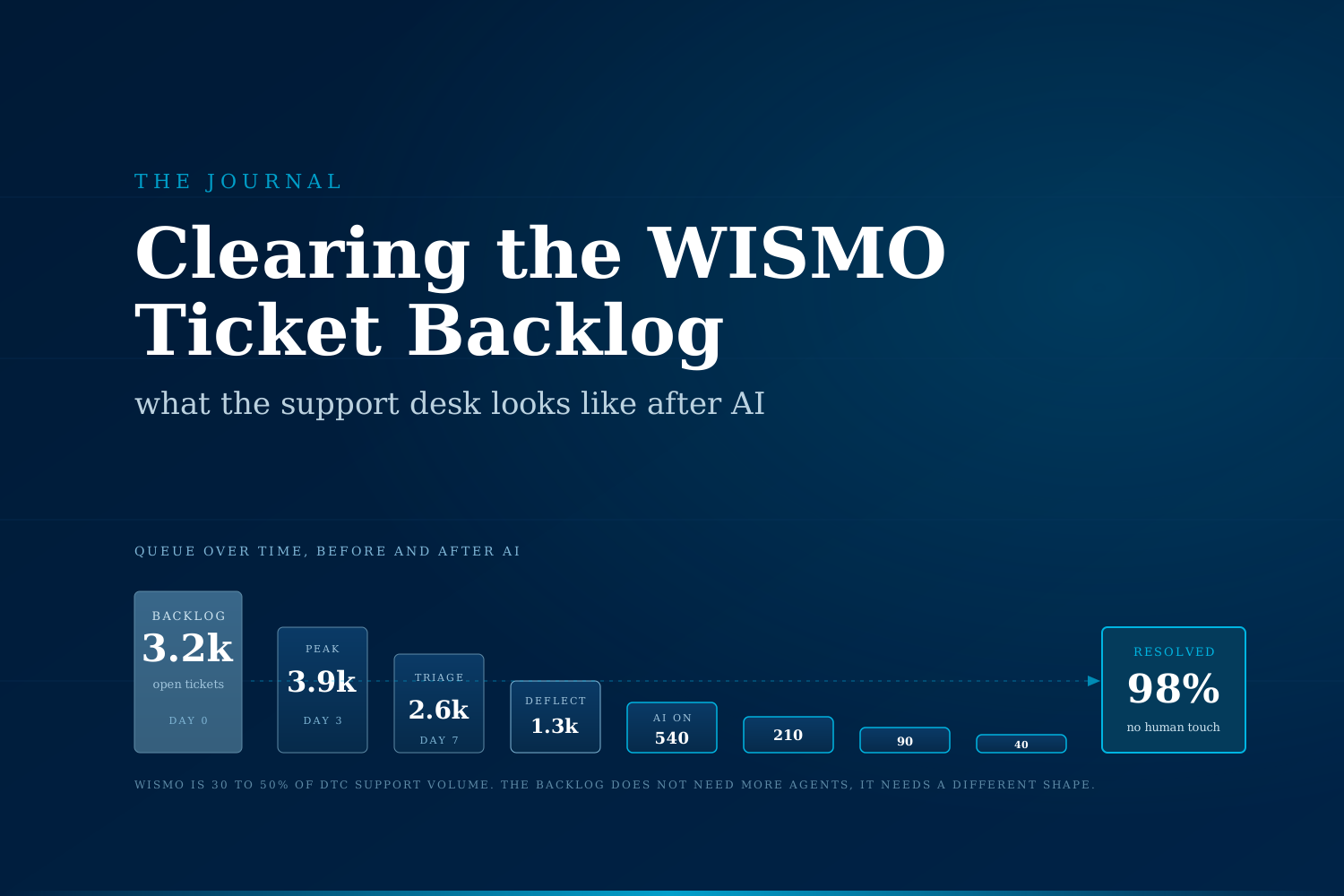
WISMO stands for "where is my order?" In most direct-to-consumer brands between $2M and $30M, WISMO tickets make up 30 to 50 percent of all support volume (Gorgias Customer Service Benchmark, 2023). They are repetitive, urgent, and structurally hard to deflect, so they consume the hours that should be going to retention and growth.
What is a WISMO ticket, and why does it dominate DTC support inboxes?
WISMO is the catch-all for any customer message that boils down to needing a status update on an order they have already placed. Per ticket, they look harmless. A customer wants a tracking link, an estimated delivery date, or reassurance that a delayed package is still on the way. The problem is volume, predictability, and timing.
Industry benchmarks have been remarkably consistent. Gorgias's 2023 Customer Service Benchmark reported that WISMO and shipping-related questions make up roughly 30 to 40 percent of all e-commerce tickets in a typical year, and the same benchmarks show that figure rising past 50 percent during holiday peaks. ParcelLab's annual State of Post-Purchase report has found that one in three consumers checks an order's status more than three times before it arrives. The pattern shows up at almost every DTC brand we look at, regardless of category.
Two things make WISMO tickets uniquely punishing. First, they cluster around carrier exception windows (a missed scan, a delayed handoff, a weather pause), which means a single supply-chain hiccup creates a wave of duplicate questions in under an hour. Second, the answer is rarely "no". Almost every ticket genuinely needs a human or a system to look something up, even if the lookup itself is mechanical.
What does the WISMO backlog really cost a $10M DTC brand?
The direct cost is the easiest to see and the smallest piece. A $10M DTC brand typically handles 6,000 to 12,000 monthly support tickets at industry-average ticket-to-order ratios (Gorgias benchmark, 2023). If WISMO is 35 percent of that, the team is fielding 2,100 to 4,200 status questions a month. At an average handle time of two minutes per WISMO ticket and a fully loaded support cost of around $25 an hour (Shopify Plus customer support benchmarks), that is between $1,750 and $3,500 of direct labor per month just on order status.
The hidden costs sit underneath:
| Cost category | What it looks like | Why it is underpriced |
|---|---|---|
| Direct labor | $1,750 to $3,500 a month at a $10M brand | Easy to track, understates the real total |
| Escalation tax | Senior agents pulled into delivery exceptions, slowing high-value tickets | Rarely measured |
| Retention blind spot | Returns, exchanges, and product complaints sit behind WISMO in the queue | Cost shows up as churn, not as a ticket metric |
| Brand sentiment | Slow replies on order status become "I'll never buy from them again" reviews | Reputation cost is delayed and invisible in dashboards |
| Repeat contacts | One delayed order produces 2 to 3 messages from the same customer over 48 hours | Inflates ticket count without inflating revenue |
The category most operators underestimate is the second one. When the queue gets deep, senior agents (the ones who understand return policies, dispute resolution, and product nuance) get pulled into rapid-response WISMO triage to keep SLA times reasonable. That is the moment a refund-window dispute gets answered 36 hours late, or a high-AOV customer with a sizing question never gets the personalised reply that would have saved the order.
Why do WISMO tickets pile up faster than headcount can keep up?
The structural reasons stay the same across brands:
- Carrier visibility is patchy. UPS, USPS, FedEx, and regional carriers report scan events on different cadences. A package that is actually moving can look "stuck" in tracking for 18 to 36 hours, which is exactly when customers panic and message.
- Order truth lives in five systems. The data is split across the storefront, the OMS, the 3PL's WMS, the carrier's API, and the brand's email automation. Agents tab between them on every ticket.
- Customers self-onboard to anxiety. Tracking links arrive instantly, but estimated delivery dates rarely update in real time. Customers see "shipped" but no movement and assume something is wrong.
- Proactive comms are usually missing. Most brands only message on the happy path (shipped, out for delivery, delivered). Exception communications, like weather delays, address ambiguity, or missed scans, are an afterthought.
- Headcount scales linearly while volume scales with promotion calendars. Black Friday, a viral TikTok, or a sold-out drop can multiply tickets 4x to 6x in 48 hours. Hiring cannot move that fast.
This is why throwing agents at the problem rarely solves it. The cost curve is unfavourable, and the senior agents who get pulled in are the ones you most need on the work that drives revenue.
What changes when AI handles the WISMO layer?
The shape of the support desk changes more than the headcount does. Roughly the same number of customer messages arrive, but the share that requires a human shrinks, and the share that requires a senior human shrinks faster.
| Dimension | Manual WISMO desk | AI-augmented WISMO desk |
|---|---|---|
| First-response time on order status | 4 to 24 hours, often longer at peaks | Under a minute on the routine majority |
| Share of WISMO that hits a human | 95 to 100 percent | 20 to 35 percent (exceptions only) |
| Proactive exception messages sent | Rare, manual | Default on stalled scans, address issues, carrier delays |
| Senior-agent time on WISMO triage | High at peaks | Near zero |
| Customer repeat contacts per delayed order | 2 to 3 | Usually 1, often zero |
| Operator visibility | Reactive dashboards | Pattern-level signal on which lanes, carriers, or SKUs cause the volume |
The row that matters most is the last one. Once the routine status answers stop dominating the inbox, the support function starts producing operational intelligence: this carrier lane is slipping, this fulfilment center is missing a cutoff, this SKU has an address-validation pattern, this region needs a different ETA model. The desk stops being a cost center that absorbs noise and starts being a signal that feeds ops and merchandising.
We are not going to walk through the integration plumbing. The reason brands hire us, rather than wiring this themselves, is that the work is less about any single tool and more about untangling the order-truth question across five systems, agreeing on what the AI is allowed to say without a human in the loop, and folding the exception flow into existing OMS and 3PL processes. That is where the time goes.
The mechanics behind that shift are the same ones behind any AI chatbot build worth doing: the assistant has to reach live order and carrier data, and it has to know when to stop and put a person in front of the customer. Two adjacent reads if you are mapping the desk properly are what the delivered-not-received reflex costs and where address errors turn into reship spend.
Three signs your WISMO load is bigger than it should be
A quick diagnostic any ops leader can run in fifteen minutes:
- Pull last month's ticket tags. If WISMO and shipping-related tags exceed 30 percent of total, you are inside the industry average but probably leaving margin on the table. Past 40 percent, the cost is meaningful.
- Look at repeat-contact rate on delayed orders. If the same customer messages twice or more on a single delayed shipment, the proactive communications are off, not the agents.
- Track senior-agent time on WISMO triage during peaks. If the most experienced people spend more than two hours a day on status questions during high-volume weeks, the retention queue is being starved.
Any one of these is solvable in isolation. The combination is what makes the desk feel constantly behind.
Closing
WISMO is not glamorous, but it is where a meaningful slice of DTC margin and retention leak out of the business. The brands we work with rarely set out to "automate customer service." They set out to stop senior agents from being pulled into status questions, to stop refund tickets from sitting overnight, and to give ops a real signal on which lanes and SKUs are causing the friction.
If that sounds like your desk, we run a completely free automation audit for DTC ops teams. No commitment, no slide deck, just a clear read on where the WISMO load is sitting and what is worth automating first. → Book yours
Sami Raza
Software Developer & Technical Author
Sami Raza builds AI automation for logistics, DTC, and construction operations teams at ApexifyLabs, and writes about the operational failures that automation is actually worth pointing at.