AI Chatbots for Final-Mile Delivery Scheduling
Furniture, appliances, fitness gear. When a two-person delivery needs someone home, the scheduling conversation decides whether the truck's stop succeeds.
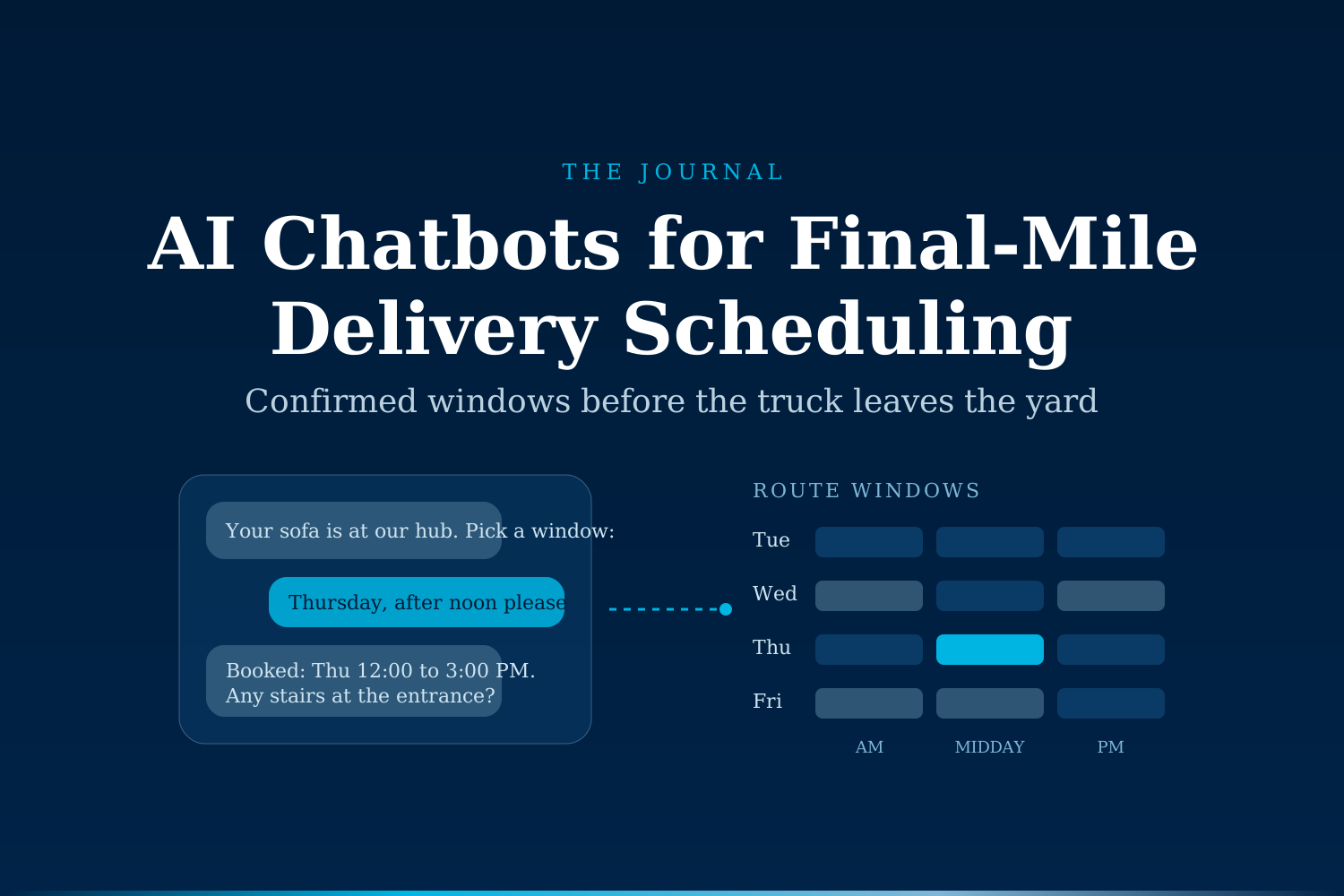
An AI chatbot for final-mile delivery scheduling texts the consumer, offers real delivery windows from the route plan, confirms the appointment, handles reschedules and access questions, and hands anything unusual to a dispatcher. For big and bulky carriers, that means fewer phone calls, fewer failed stops and a delivery day built on confirmed appointments.
Why is scheduling the hardest part of big and bulky delivery?
A parcel can be left on a porch. A sectional sofa, a refrigerator or a treadmill cannot. Two-person and white glove deliveries need an adult at home, a clear path inside, sometimes an elevator booking or a haul-away of the old unit. Every one of those details is settled in a conversation with the consumer before the truck leaves the yard.
For most regional final-mile carriers and retailers running their own fleets, that conversation still happens by phone. A scheduling team works through tomorrow's manifest, calls each customer, leaves voicemails, takes callbacks, and rebuilds routes as answers come in. When the answers come late, the route is built on guesses.
The consumer data shows how often this goes wrong. In DispatchTrack's survey of 1,606 US adults on big and bulky home delivery, 58% of deliveries were rescheduled at least once, and 44% arrived outside the scheduled window. Of the reschedules, 24% required the consumer to call the retailer and sit through an excessive hold time. Six in ten respondents said they were unlikely to buy from a retailer again after a missed delivery window.
That survey dates from 2022, but the stakes have not softened. Ryder's 2025 consumer study, based on 1,000 US consumers buying furniture and appliances, found that 96% of shoppers with a positive delivery experience were more likely to buy from that retailer again, and that nearly one in three now schedule deliveries online.
What does a final-mile scheduling desk actually spend its day on?
Sit with a scheduling team at a mid-size final-mile operation and the work falls into a familiar set of tasks:
- First contact. Calling or texting each consumer once freight arrives at the hub to offer a delivery date.
- Window confirmation. Calling again the day before to confirm a time window, often two or three attempts per stop.
- Reschedules. Taking inbound calls from consumers who can no longer be home, then finding a new slot that fits a route.
- Access and prep questions. Stairs, elevators, gate codes, whether the old washer is ready to go, whether the doorway fits.
- Day-of "where is my driver" calls. Consumers who took the day off and want to know if the truck is an hour away or four.
Almost all of this is relaying details between the consumer, the route plan and the driver. Very little of it requires judgment. Yet it consumes the same people who are supposed to be handling damaged freight, missing parts and the customer who is genuinely upset.
How does an AI chatbot handle delivery scheduling for final-mile carriers?
An AI chatbot built for this job works over text message first, because that is how consumers prefer to hear from delivery companies. In the DispatchTrack survey, 70% of respondents favored text for status updates, ahead of email at 50% and phone at 38%.
The chatbot is connected to the systems the operation already runs: the order or manifest feed from the retailer, the dispatch and routing software, and driver status. When freight lands at the hub, it reaches out with the delivery windows that routing can actually support for that ZIP code. The consumer picks one by replying in plain language ("Thursday works, but not before noon"), and the chatbot books it.
The day before, it confirms the appointment and asks the questions that cause failed stops: Is someone 18 or older going to be there? Are there stairs? Is the old unit disconnected for haul-away? If the answer is "no" or "I need to move it," the chatbot offers a new window on the spot rather than waiting for the driver to discover it at the door.
On delivery day, it answers "where is my driver" from live route data and sends a heads-up when the truck is a few stops away. When something sits outside its lane (a damage claim, a wrong item, an angry customer, a commercial delivery with a dock appointment), it passes the conversation to a dispatcher with the full thread and order details attached.
This is a different tool from the parcel-style WISMO bot many DTC brands use. We covered that pattern in how AI clears the WISMO ticket backlog at a DTC brand. Final-mile scheduling is harder because the chatbot is not only reporting status. It is making commitments that a two-person crew has to keep.
Phone-based scheduling vs an AI chatbot: what changes?
| Scheduling task | Phone-based desk | With an AI chatbot for last-mile delivery |
|---|---|---|
| Offering a delivery date | Outbound calls and voicemails, worked down a list | Text sent when freight is received, with windows routing can support |
| Day-before confirmation | Two or three call attempts per stop | Automated confirmation with a reply prompt, escalated only if no answer |
| Reschedules | Consumer calls in, waits on hold, desk rebuilds the route | Consumer replies by text and picks a new slot at any hour |
| Access and haul-away details | Often discovered by the driver at the door | Asked and recorded before the route is finalized |
| "Where is my driver?" | Inbound calls on delivery day | Answered from live route data, with an arrival heads-up |
| Damage, wrong item, escalations | Mixed in with routine calls | Routed to a dispatcher with the full conversation attached |
Each row moves routine contact away from the phone queue. Dispatchers still own the route, the exceptions and the decisions. They just stop spending the morning dialing.
What does a failed stop actually cost a final-mile operation?
For a parcel carrier, a failed first attempt is an inconvenience. For a big and bulky operation it is expensive, because the cost of a stop is two people, a box truck and a slot on a tightly built route. When nobody is home, or the doorway is too narrow, or the old dishwasher is still plumbed in, the crew drives the freight back to the hub and the stop has to be sold again.
Industry figures for parcel give a floor, not a ceiling. Delivery platform OneRail has put the cost of a failed delivery at $17.20, with roughly 8% of last-mile deliveries failing on the first attempt, according to FreightWaves reporting. Two-person deliveries carry far heavier crew and vehicle costs per stop, so each failure lands harder. The same reporting noted that when consumers were told in advance a delivery would be late, the retailer earned a 20% higher Net Promoter Score than when no warning was sent.
The less visible cost is the call volume each failure creates: the consumer calls to ask what happened, the retailer calls to ask why its customer is upset, and the desk calls to rebook. For final-mile carriers paid per stop by retail clients, that rework rarely appears on an invoice. It shows up in overtime and in client scorecards, the same way proof of delivery lag shows up in DSO for freight brokers.
Where does an AI chatbot fit best, and where should people stay involved?
The strongest fit is high-volume residential work with repeatable questions: furniture and mattress retailers, appliance dealers, fitness equipment brands and the 3PLs and regional carriers that deliver for them in the US, Canada, the UK and Australia. Operations running a few hundred stops a day or more tend to feel the change first, because scheduling headcount scales almost linearly with stops.
A few questions help an owner or COO judge readiness:
- How clean is the manifest feed? If retail clients send orders by spreadsheet with missing phone numbers, that needs attention first. A chatbot cannot text a consumer it cannot reach.
- Can routing expose real availability? The chatbot should only offer windows the route plan can keep. Offering windows that dispatch later overrides recreates the problem.
- Which conversations must stay human? Damage claims, high-value white glove installs and commercial accounts often warrant a person from the first message.
Many retail clients also ask final-mile partners how they handle consumer communication when renewing contracts. A text-based scheduling record, with response times and reschedule rates by client, is a useful answer to have ready. For a wider look at where chatbots fit compared with scripted tools, see our comparison of AI chatbots and rule-based chatbots.
The pitch
Every final-mile operation schedules a little differently: different retail clients, different routing software, different rules for white glove and haul-away. We start by reviewing how your desk works today and which conversations take the most time, then design a chatbot around your systems and your rules. You can see the kind of work we do on our AI chatbot development page and our logistics industry page.
If your schedulers spend more of the day dialing than solving problems, we offer a completely free automation audit for final-mile and home delivery teams. We will look at a sample week of scheduling calls and texts with you and show which ones a chatbot could take, and which should stay with your dispatchers. → Book your free audit
Sami Raza
Software Developer & Technical Author
Sami Raza builds AI automation for logistics, DTC, and construction operations teams at ApexifyLabs, and writes about the operational failures that automation is actually worth pointing at.