POD Lag and the DSO Math Every Freight Broker Ignores
Slow proof of delivery capture stretches a freight broker's DSO by 4 to 7 days. Here is what the lag actually costs in working capital, and what changes when it closes.
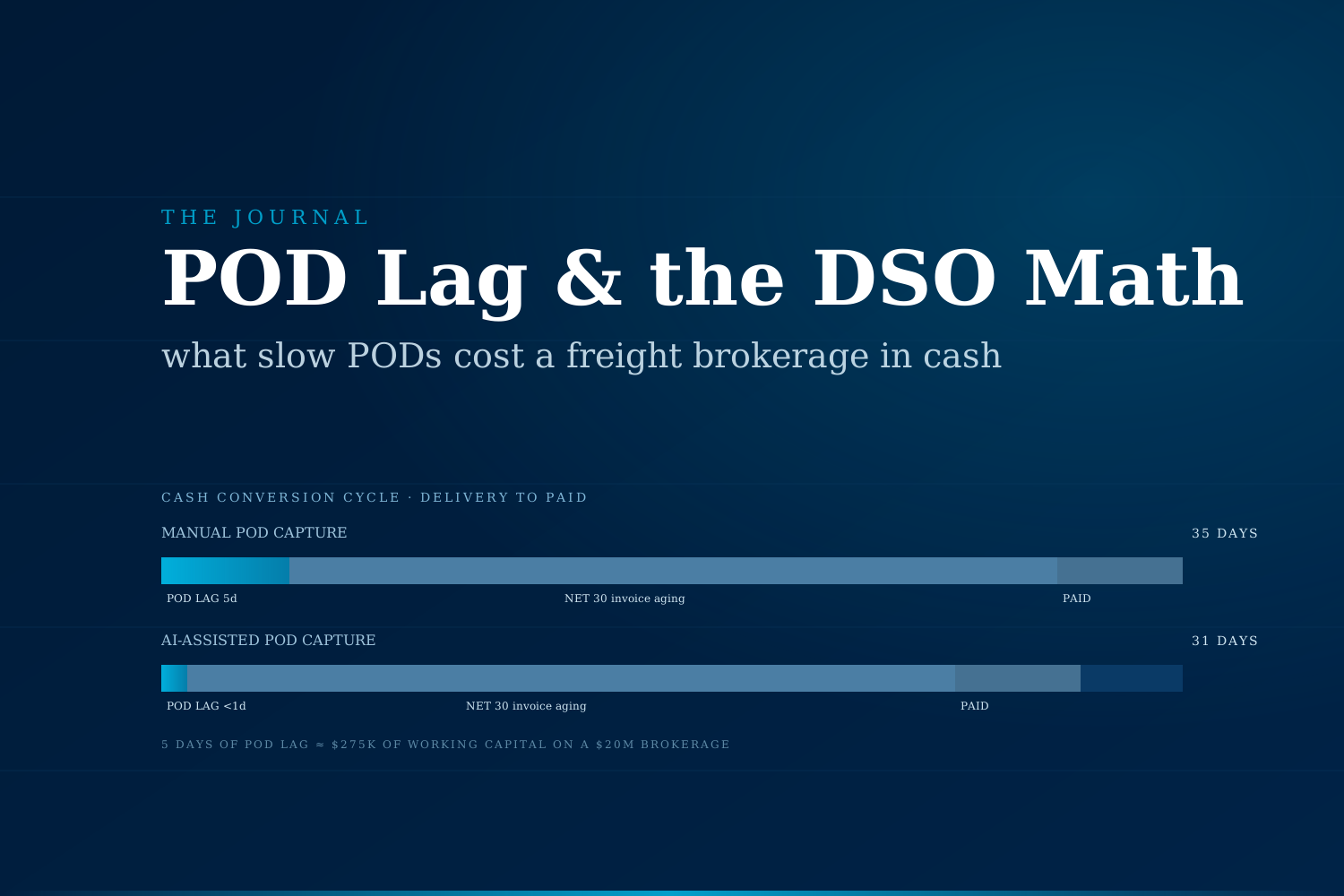
Proof of delivery (POD) lag is the gap between when a load is delivered and when a broker captures the signed POD needed to invoice. Most freight brokerages run 4 to 7 days of POD lag. That lag stretches DSO, inflates factoring fees, and rations the working capital available for sales hires, marketing, and reinvestment.
This article looks at what POD lag is, why it shows up on almost every brokerage's accounts receivable aging report, the cash math behind it for a typical $20M FTL operation, and what changes when capture happens at the dock instead of the back office.
What is POD lag in freight brokerage?
POD lag is the elapsed time from the moment a driver delivers a load to the moment the broker has a clean, signed POD on file and ready to invoice the shipper. It is not the same as DSO, but it is one of the largest controllable inputs into DSO.
The mechanics are simple. A brokerage cannot send an invoice without a POD. Most shippers will not start their payment clock without one. Many shipper portals reject invoices that arrive without the POD attached, or kick them back into an exception queue for the broker's AR team to clean up later. Until the POD lands, the load is revenue on paper and capacity on the balance sheet.
A useful way to think about it: every day a POD sits in a truck cab, a glove box, or an office inbox is a day of free credit the brokerage is extending to its customer.
Why does POD lag widen DSO?
Days Sales Outstanding (DSO) is the average number of days a brokerage waits between earning revenue and collecting cash. Cass Information Systems and other industry reports have for years put freight brokerage DSO somewhere in the 35 to 50 day range, depending on customer mix and contract terms. The headline number is shaped by three things: customer payment terms, invoicing speed, and POD lag.
The first is mostly fixed. A shipper that pays net 45 will not pay net 30 because the broker asked nicely. The second is where most desks focus when they want to tighten cash, which is fair: invoicing the day POD lands is table stakes. The third, POD lag, is where the largest overlooked leak usually lives, and the one a broker has the most leverage over.
Here is the rule of thumb that surprises operators when they actually run the numbers. Five days of POD lag on a $20M brokerage with industry-average margins is roughly equivalent to one extra sales hire's worth of working capital sitting unproductively in receivables. The cash is earned. It is just stuck.
What does the math actually look like for a $20M brokerage?
Walk a $20M FTL brokerage through the cash conversion cycle.
| Lever | Value |
|---|---|
| Annual revenue | $20,000,000 |
| Average receivables per day | ~$55,000 (revenue divided by 365) |
| Typical POD lag | 5 days |
| Cash parked in POD lag alone | ~$275,000 |
| Factoring cost (1.5% to 3% of advanced receivables) | $4,100 to $8,250 per year, per day of lag |
That last row is the number that matters. For a brokerage using a factoring line or asset-based lender to fund payroll between invoice and payment, every day of POD lag costs real interest. Five days of lag at a 2% factoring rate works out to roughly $27,000 a year for a $20M operation, before counting the cost of bad-debt write-offs on PODs that get lost entirely.
For brokerages not on factoring, the cost is opportunity rather than interest. That $275,000 sitting in receivables is a sales hire, a load-board upgrade, a quarter of paid lead generation, or six months of a new account manager. It just does not show up in the financials as a missed opportunity, which is part of why POD lag rarely makes it onto the leadership team's quarterly priority list.
Where does POD lag actually come from?
Five sources, in roughly descending order of impact.
- Driver capture. The POD is signed at the receiver, then sits with the driver until end of shift or end of week. On smaller carriers without a driver app, the POD may not move until the truck is back at the yard.
- Carrier office handoff. Once at the carrier, the POD is scanned (or photographed, or faxed) and emailed to the broker. This step often adds 24 to 72 hours by itself, and routinely 5+ days on weekend deliveries.
- Inbox triage. PODs land in a shared mailbox, attached to messages that often do not reference the load number cleanly. Someone has to match the file to the load in the TMS.
- Manual data entry. A person opens the PDF, reads the BOL number, weight, delivery date, and signature, and rekeys those values into the invoicing system. Any mismatch, missing field, or illegible signature kicks the load into an exception queue.
- Shipper-side rejection. A clean POD lands, but the shipper's AP portal rejects the invoice for a reason no human flagged earlier (missing reference number, wrong accessorial code, blurry image). The clock resets.
Most brokerages have visibility into source one but not into the cumulative effect of two through five. The total wait time is buried across three teams: operations, AR, and whoever runs the customer portals.
What does an AI-assisted POD workflow look like?
The point of automating POD capture is not to remove people. It is to move them from data entry to exception handling, and to shorten the cycle from delivery to invoice by a multiple, not a percentage.
| Step | Manual workflow | AI-assisted workflow |
|---|---|---|
| POD arrival | 1 to 5 days after delivery | Minutes to hours via driver app, email parse, or carrier portal pull |
| Document parsing | Person reads PDF and rekeys fields | System extracts BOL, weight, signature, exception notes automatically |
| Load matching | Person matches file to load in TMS | Auto-matched against tendered load, flagged if no match found |
| Exception handling | Caught at invoicing, days later | Flagged at intake with a clear reason and a suggested fix |
| Invoice generation | Manual, batched weekly or daily | Triggered same day, with POD attached in the shipper's required format |
| AR follow-up | Reactive after the aging report | Cadence triggered automatically when invoices cross age thresholds |
The exact toolchain varies. The shape of the work, however, is consistent across every brokerage that has done this well: a single intake pipeline, automated extraction with human review on low-confidence files, and invoices that go out the same day the POD lands.
What changes when POD lag closes?
A brokerage that takes POD lag from 5 days to under 1 day sees four things change at once.
- Lower factoring usage. The same revenue cycles through the line faster, so the average outstanding balance drops and the monthly interest bill drops with it.
- Tighter AR aging. The 31 to 60 day bucket shrinks, because invoices start aging from delivery date plus one rather than delivery date plus six.
- Earlier dispute visibility. Disputed loads surface in the first week, while drivers and dispatchers still remember the load. Disputes raised three weeks later are almost impossible to win.
- Headcount reallocated, not removed. AR clerks stop rekeying PDFs and start working the exception queue, recovering accessorials, and chasing slow payers. Same headcount, very different output.
None of these is a productivity gain in the traditional sense. They are working capital gains, which is the right way for a brokerage CFO or COO to think about the spend.
Three questions to ask before automating POD capture
Before any tooling decision, three questions tell a brokerage whether POD lag is worth their attention this quarter.
- Where does our POD actually live the moment it is signed? Driver phone, carrier office, shipper portal, or all three? The capture path determines the entire automation design.
- What share of our invoices today bounce or age past 45 days because of POD problems? If it is under 5%, POD lag is probably not the largest cash leak on the desk. If it is over 15%, it is almost certainly the biggest single fixable line item.
- What does one day of DSO cost us, in interest and opportunity, at current volume? The answer turns POD lag from an operations annoyance into a board-level conversation in roughly ten minutes.
If the answers point to a real number, the work is worth doing. If they do not, there are usually larger leaks elsewhere on the desk.
How does this usually look from inside a brokerage?
Cash conversion problems rarely look like cash conversion problems from inside the operation. They look like inbox triage, missing signatures, and a Monday morning AR meeting where someone says "we are still waiting on PODs from Friday." The aggregate cost only becomes visible when someone runs the DSO math against the factoring statement.
That is the conversation worth having before any tooling decision.
If your AR aging report has a stubborn 31 to 60 day bucket, or your factoring line is creeping up faster than revenue, we run a completely free automation audit for ops-heavy brokerages. We will map where POD lag is actually originating on your desk and what closing the gap would be worth at your current volume. No commitment, no slide deck. → Book the audit
Sami Raza
Software Developer & Technical Author
Sami Raza builds AI automation for logistics, DTC, and construction operations teams at ApexifyLabs, and writes about the operational failures that automation is actually worth pointing at.