Where Inbound ASN Errors Cost DTC Brands at the 3PL
Bad inbound ASNs sit upstream of oversells, mis-stows, and 3PL reconciliation drag. Here is where the cost lands and what AI validation shifts.
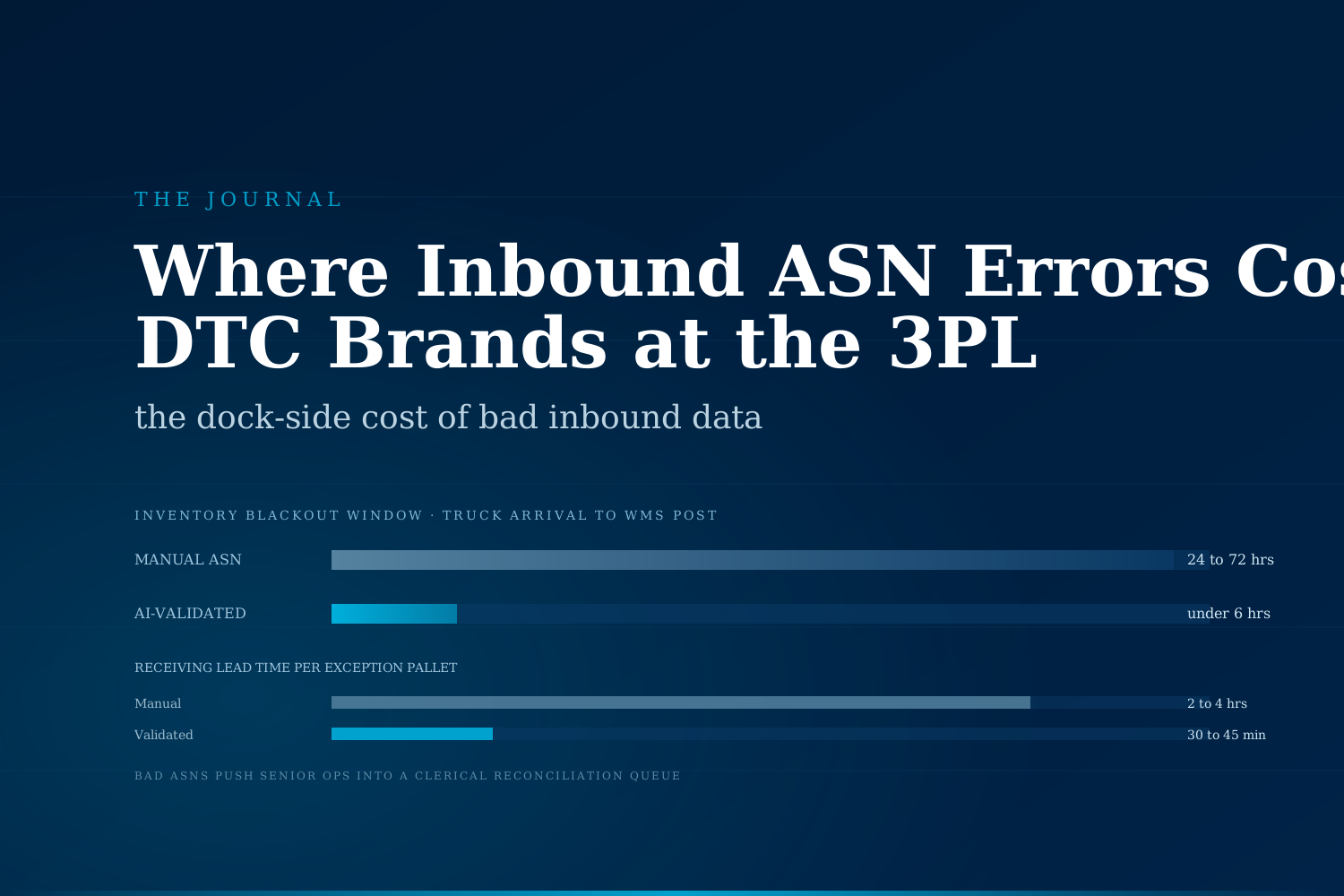
Bad inbound ASNs rarely show up on a DTC ops dashboard, yet they shape nearly every downstream metric on the receiving side. Misaligned line items, missing SKU codes, and unannounced carton splits force 3PLs to fall back on physical recount, which costs hours per inbound and resurfaces later as oversells, shrinkage, and reconciliation drag.
What is an inbound ASN, and why does its quality matter so much?
An inbound ASN, the EDI 856 Advance Shipment Notification, is the electronic message a supplier or freight forwarder sends to a 3PL before a shipment physically arrives. In its clean form it lists every carton, every SKU, the quantity per unit, lot or serial detail where relevant, and the expected truck or container ID. When that data matches what shows up on the dock, receiving teams pre-allocate slots, scan-and-stow in a single touch, and post inventory to the WMS within minutes of the truck pulling away.
When it does not match, none of that happens.
For DTC brands in the $5M to $30M revenue range, the consequence is not just a slower receiving team at the 3PL. It is an upstream data debt that compounds across the catalog. Shopify, Amazon, the brand's wholesale ERP, and every paid channel expect inventory to appear in real time. When an ASN error stalls a receipt by 24 to 72 hours, every system downstream is operating on stale numbers. That delay is where oversells, dropped Amazon listings, and over-aggressive backorder emails begin.
How do bad ASNs actually cost DTC brands money?
The losses are distributed across four categories, which is exactly why most operators never trace them back to ASN quality.
- Receiving labor variance. A clean ASN takes the 3PL roughly 30 to 45 minutes per pallet to receive and post. A bad ASN can take two to four hours. The 3PL bills back this excess time as a receiving exception fee, often line-itemed on the monthly invoice in language the brand's finance team rarely flags.
- Oversell risk during inventory blackout. Between the truck arriving and the WMS posting, on-hand inventory shows zero or stale on the storefront. Flash promotions in this window create cancellation cascades that show up later as CX tickets and chargebacks, not as inbound-related costs.
- Mis-stows that surface weeks later. When a SKU is received under the wrong code because the ASN was wrong, it sits in the wrong slot. Pickers cannot find it, the WMS shows it as available, the customer waits, and the brand reships from a different facility at full freight cost.
- Reconciliation overhead at month-end. Every mis-receipt becomes an open exception in the 3PL portal. Brand-side ops teams spend two to six hours per week clearing them. This labor never shows up as inbound cost on the P&L.
Recent third-party logistics benchmarks reported in publications such as DC Velocity and Modern Materials Handling consistently put receiving exception costs at two to four times the per-touch cost of a clean inbound receipt. GS1 US, the standards body behind the EDI 856 spec, has also flagged ASN accuracy as a leading indicator of downstream WMS exceptions for mid-market brands.
What does manual inbound reconciliation look like at most DTC brands?
A typical 3PL receiving workflow without ASN validation looks like this. The brand's purchase order goes out to the supplier. The supplier ships when ready and emails a packing list, often a PDF, sometimes an Excel export, occasionally just a screenshot of the carton manifest. The freight forwarder generates its own paperwork. The 3PL receives whatever lands on the dock and reconciles it against whichever document arrived first.
When the documents disagree, a receiving lead pauses the truck, calls or emails the brand's ops contact, and waits.
The brand's ops contact, usually a Head of Ops or a senior coordinator, then opens three windows: the original PO in the ERP, the supplier email thread, and the 3PL's exception report. They reconcile by eye, decide what to receive against what, and respond. The 3PL receives the corrected version, and the inventory finally posts.
That single workflow, repeated across dozens of inbounds per month, is where senior ops talent gets absorbed into a clerical reconciliation queue. None of it is unskilled work, which is precisely the problem.
What changes when AI validates ASNs before the truck hits the dock?
AI-augmented inbound does not replace the 3PL receiving team. It validates the data before the truck arrives, so the receiving team is operating on numbers already known to match.
A few patterns are now possible without the brand learning a new piece of software:
- ASN documents from any source format (EDI 856, PDF, spreadsheet, free-text email) are parsed and normalized into a single canonical structure before the shipment leaves origin.
- Discrepancies between the PO, supplier packing list, freight forwarder paperwork, and historical receipt patterns surface as ranked exceptions, not as a flat queue.
- The brand's ops contact sees a single inbound dashboard with confidence scores per shipment, instead of a flood of email and PDF attachments.
- The 3PL receives the validated ASN. Receiving lead time drops back toward the clean-inbound baseline.
The point is not that this is glamorous. The point is that senior ops talent stops being bottlenecked by reconciliation, and the inventory blackout window collapses from days to hours.
Manual vs AI-augmented inbound ASN handling, side by side
| Dimension | Manual reconciliation | AI-augmented validation |
|---|---|---|
| ASN format handling | Whatever lands in the inbox | Normalized to canonical structure |
| Discrepancy surface | Flat 3PL exception report | Ranked confidence scores per shipment |
| Brand-side labor per inbound | 45 to 90 minutes | 5 to 15 minutes, exception cases only |
| 3PL receiving lead time | 2 to 4 hours per pallet on exceptions | 30 to 45 minutes baseline |
| Inventory blackout window | 24 to 72 hours | Often under 6 hours |
| Where errors surface | Month-end invoice and CX tickets | Pre-shipment, before truck leaves origin |
| Senior ops load | Reconciliation queue | Strategic exceptions only |
Three signs your DTC brand is absorbing the ASN tax
You do not need a full audit to spot the pattern. Three observations usually do it.
- The receiving exception line on the 3PL invoice has its own column. If your monthly 3PL bill carries a recurring "receiving variance" or "exception handling" charge that nobody on the finance team is questioning, that is the ASN tax in plain sight.
- The ops team uses the phrase "waiting on the dock to clear" more than once a week. That means a real, recurring inbound blackout has been folded into the operating cadence and stopped being treated as an exception.
- Oversells spike around supplier inbound days, not promotional days. If your CX team can predict cancellation surges by which container is hitting the dock, the receiving workflow is materially upstream of the customer experience problem.
Any one of these is enough signal to investigate. All three together usually mean the brand is paying meaningfully more in distributed losses than it would cost to fix the root data problem.
What we will not detail in this article
We are not going to walk through the field-by-field EDI 856 mapping logic, the specific anomaly detection thresholds for confidence scoring, or the integration patterns that hand normalized ASNs back to a 3PL's WMS. Those choices depend on the brand's supplier base, the 3PL's intake stack, and the channel mix, and they are precisely what an audit is for.
What is worth saying publicly: every mid-size DTC brand we have looked at had at least one structural ASN blind spot whose downstream cost they were absorbing into other line items. None of them had it labeled as an inbound problem.
What an AI-augmented inbound program looks like, at a glance
The goal is not to make the 3PL faster. They are usually already fast when the data is clean. The goal is to make the data clean before it reaches them. The integration typically takes two to four weeks of work, lives in the background once it is wired in, and shows up to the ops team as fewer fires and a clearer dashboard rather than as a new system to learn.
If your inbound exception reports keep filling up and the variance on your 3PL invoice keeps creeping up, the cheapest first move is probably to look at the data, not the dock. We run a completely free automation audit for DTC ops teams that want a second opinion on what their inbound workflow is actually costing them. No commitment, no slide deck.
Sami Raza
Software Developer & Technical Author
Sami Raza builds AI automation for logistics, DTC, and construction operations teams at ApexifyLabs, and writes about the operational failures that automation is actually worth pointing at.