How Do AI Agents Cut Distributor Quote Turnaround?
Quote requests arrive as emails, PDFs and photos of part lists. Here is how AI agents change the quote desk at a wholesale or industrial distributor.
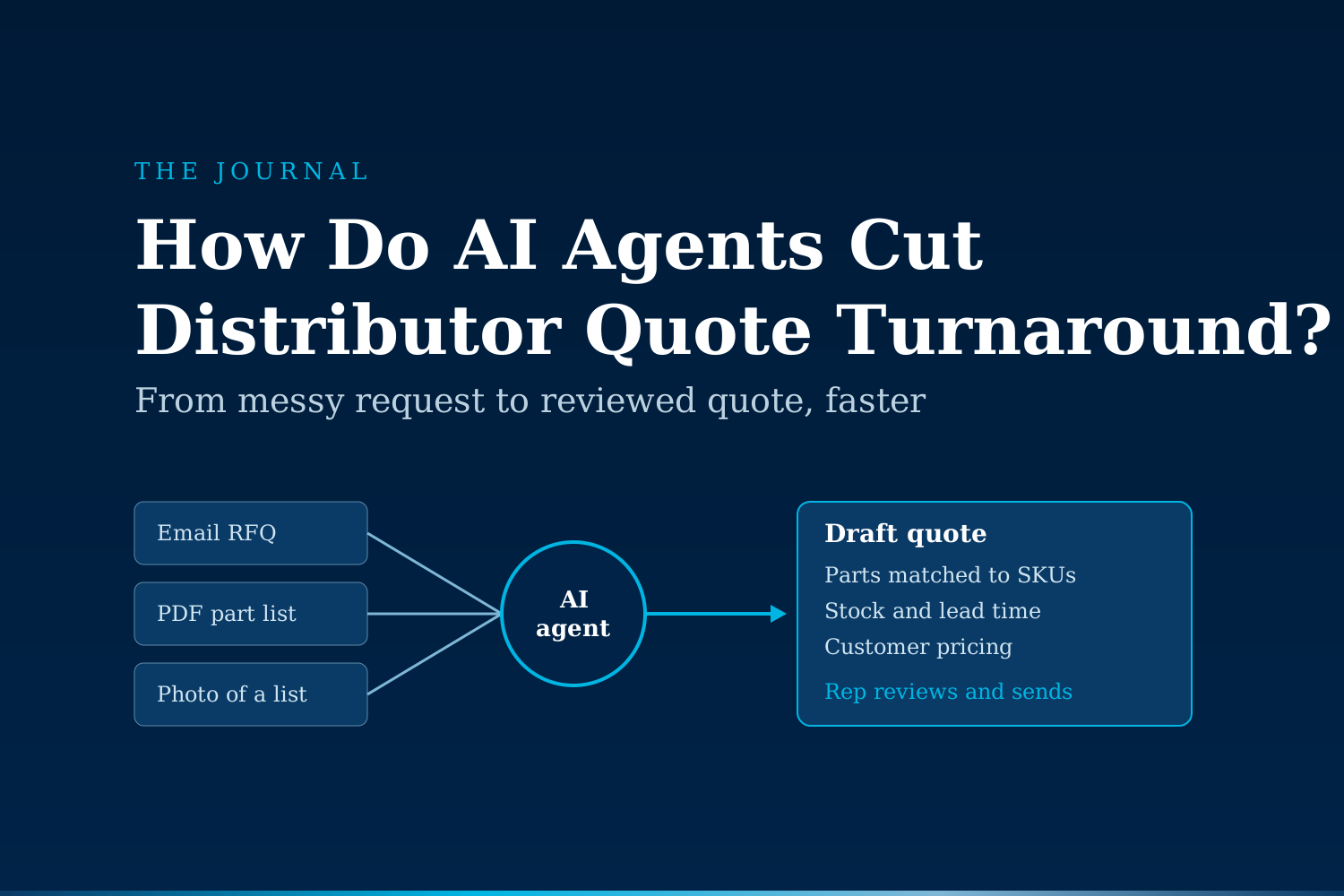
AI agents cut distributor quote turnaround by doing the slow middle of every quote: reading the request, matching each line to a SKU, checking stock and the customer's pricing, and assembling a draft. Inside sales reps still review, adjust margin and send. Quotes that sat in a queue for a day can go out the same morning.
Why do distributor quotes take so long?
Ask an inside sales manager at an electrical, plumbing, industrial MRO or packaging distributor where the day goes, and the answer is rarely "selling." It is reading. A contractor emails a photo of a handwritten list. A plant buyer sends a 40-line spreadsheet with their own part numbers. A procurement team attaches a PDF RFQ with a competitor's catalog numbers on half the lines. Someone has to turn each of those into clean line items in the ERP before a single price can be set.
That translation work is where turnaround stretches. A rep matching "1/2 in. brass ball valve, threaded, lead free" to the right SKU among a dozen near-identical options is doing real expert work, but they are doing it one line at a time, between phone calls, with the next request already waiting. Long requests get pushed to the afternoon. Afternoon requests become tomorrow's. By the time the quote goes out, the buyer has often heard from someone else.
This is not a staffing failure so much as the shape of the work: the judgment needed per line is small, but the volume of lookups is large, and both are tangled together in the same person's inbox.
Why does quote speed matter more for distributors now?
Buyers' expectations have moved, and the data is clear on the direction. In McKinsey's June 2026 research on distribution, 57 percent of buyers ranked digital as their primary purchasing channel, up from 33 percent in 2022. The same research found that 49 percent of customers now rank value-added services among their top three buying criteria, and that "reliability, transparency, and responsiveness now define service quality."
That matters for quoting in a specific way. A buyer who can get a price on a website in seconds starts to judge every other channel by that standard, including the email RFQ that still carries most of a distributor's complex, high-margin business. The quote desk is where a distributor proves it is responsive, or does not.
There is also a competitive edge in being early. McKinsey notes that while 90 percent of distributors report active AI initiatives, only 11 percent have fully adopted the technology. For a $10M to $100M regional distributor, that is an opening: the national players have not finished this work either.
What does an AI agent actually do on a quote desk?
An AI agent is software that can read unstructured requests, look things up across your systems, and prepare work for a person to approve. On a quote desk, that means it handles the steps between "request received" and "draft ready for review." Here is how the two versions of the desk compare:
| Step | Manual quote desk | Quote desk with AI agents |
|---|---|---|
| Intake | Rep opens each email, PDF or photo when they get to it | Every request read on arrival and logged with customer, due date and line count |
| Part matching | Rep searches the ERP line by line, often guessing at customer or competitor part numbers | Lines matched against your catalog, cross-references and the customer's own order history, with low-confidence matches flagged |
| Stock and lead time | Rep checks availability per branch, sometimes by phone | Availability and lead time pulled for every line before the rep opens the draft |
| Pricing | Rep looks up contract pricing, matrix price or last price paid | Customer-specific price proposed with margin shown, outliers highlighted |
| Missing information | Discovered halfway through, then emailed back to the buyer | Clarifying questions drafted as soon as the request arrives |
| Follow-up | Depends on the rep remembering | Open quotes tracked, follow-up drafted before the buyer goes quiet |
The rep's role in the right-hand column is still the important one. They decide on substitutions, set margin on strategic accounts, and handle the relationship. What they stop doing is the lookup work that fills the hours around those calls.
Where do AI agents fit for distributors in the US, UK, Canada and Australia?
The pattern holds across markets, with local wrinkles. A US industrial distributor may be quoting against contract pricing on hundreds of accounts. A UK builders' merchant handles trade counter requests alongside larger project quotes. A Canadian distributor quoting cross-border work needs pricing and lead times that reflect where stock actually sits. An Australian wholesaler serving regional customers may be quoting freight as part of the line. In each case, the agent works from the distributor's own catalog, pricing rules and history, so it reflects how that business sells rather than a generic template.
Distribution is also where AI automation tends to pay back early, because the same request types repeat. Once an agent has seen how your team matches a customer's part numbers, that knowledge stays put, even when the rep who built it moves on.
Is AI quoting accurate enough to trust with customer pricing?
It is accurate enough for a draft, and it should never be the last word. A well-built setup earns trust in a few specific ways.
- It shows its reasoning. Every matched line shows why: an exact catalog match, a cross-reference, or a past order from the same customer. A rep can confirm a confident match in seconds and spend their attention on the uncertain ones.
- It flags instead of guessing. When a line could be three different SKUs, the agent says so and leaves the choice to a person rather than picking one.
- It respects pricing rules. Contract prices, floors and approval thresholds come from your systems. The agent does not invent discounts, and anything outside the rules goes to a manager.
- It keeps a record. Each quote carries a trail of what was matched, priced and changed, which helps when a customer disputes a price months later.
What an agent should not do is send quotes on its own for complex or high-value requests. The aim is a rep who reviews ten clean drafts an hour instead of building three from scratch.
If you have read our piece on AI pricing engines for freight broker quote desks, the principle is the same: software prepares the number, a person owns it.
How is this different from a chatbot or a self-service portal?
A portal or website search works well for buyers who know the exact SKU and want list or contract price. A chatbot can answer stock and order status questions. Neither handles the messy request: the photographed list, the competitor part numbers, the 60-line spreadsheet with half the columns blank. That is the work that still lands on inside sales, and it is often the most valuable work a distributor does. Our comparison of AI chatbots and rule-based chatbots covers where each type of tool fits.
AI agents sit behind the inbox rather than in front of the customer. The buyer keeps emailing the way they always have. What changes is how fast a complete, correct quote comes back.
Brands that sell both direct and wholesale will recognize a related problem from our article on the wholesale order entry tax on DTC brands: once a quote turns into an order, the same retyping starts again unless intake is handled end to end.
What should a distribution leader look at first?
Before talking to any vendor, it helps to know what your quote desk is actually carrying. These questions usually make the picture clear:
- What is the median time between a quote request arriving and the quote going out, and how different is it for requests over 20 lines?
- What share of quote requests arrive as attachments, photos or free-text emails rather than through a portal?
- How many quotes last quarter went out after the customer had already placed the order elsewhere, and does anyone track that?
Most teams have never measured the first one. The number is often longer than leadership expects, because the clock starts when the email lands, not when a rep opens it.
The pitch
Quote turnaround at a distributor is mostly a reading and lookup problem wrapped around a small number of judgment calls. That makes it a strong fit for AI agents, as long as they are built around your catalog, your pricing rules and the way your reps already work. We build these as custom agents connected to your ERP and inbox, with your team approving every quote that matters. You can see more about how we approach this on our custom AI software page.
If your inside sales team is spending more time matching part numbers than talking to customers, we offer a completely free automation audit. We will look at a sample of your recent quote requests with you and show where an agent would save time, and where your reps should keep full control. → Book your free audit
Sami Raza
Software Developer & Technical Author
Sami Raza builds AI automation for logistics, DTC, and construction operations teams at ApexifyLabs, and writes about the operational failures that automation is actually worth pointing at.