What Does AI Automation Do for Distributor Cash Application?
Payments arrive in one place and remittance details in another. Here is how AI automation changes cash application for wholesale and industrial distributors.
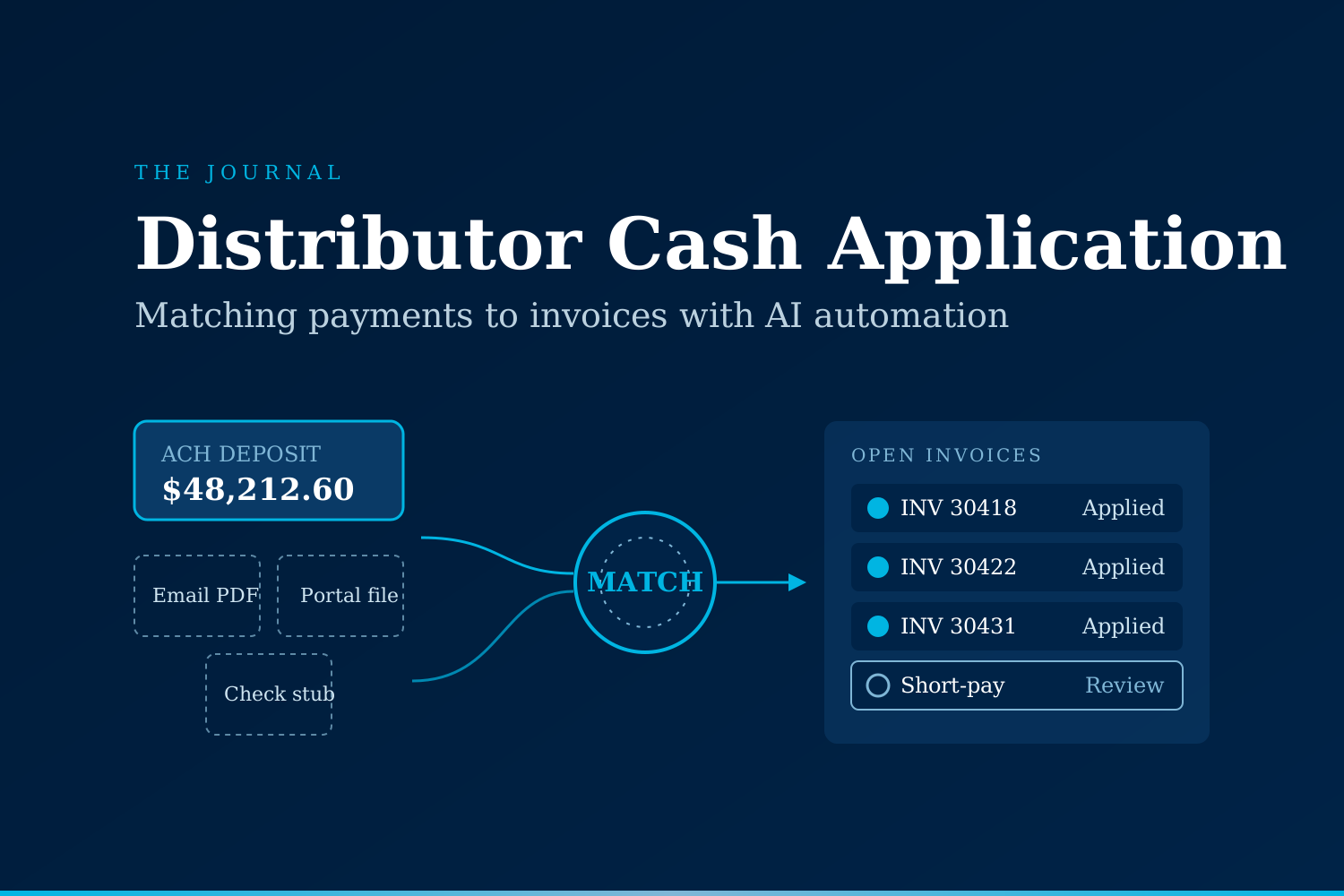
AI automation for cash application reads every incoming remittance, wherever it arrives, matches each payment to the right open invoices, and codes short-pays and deductions for review. For a wholesale or industrial distributor, that means payments post the day they land, unapplied cash shrinks, and good customers stop landing on credit hold by mistake.
Why is cash application so slow at distributors?
Distribution is a high-invoice, low-margin business. A $40M regional distributor can easily issue thousands of invoices a month, many of them small, to customers who pay in batches. A contractor sends one ACH covering 37 invoices. A national account pays through its own supplier portal and posts the remittance there, not to you. A plant buyer mails a check with a stub that lists three invoice numbers and a credit memo nobody on your side recognizes.
The money and the explanation of the money arrive separately. The bank deposit shows an amount and a payer name. The remittance detail sits in an email attachment, a portal download, a check stub image or, sometimes, nowhere at all. Someone on the AR team has to bring the two together, invoice by invoice, before the cash can be applied in the ERP.
That work has grown. Paper checks used to carry their remittance with them. According to the AFP Digital Payments Survey, as reported by Nacha in September 2025, checks now account for just 25% of incoming B2B payments, down from 75% in 2004. Electronic payments are faster and safer, but for many distributors they also mean more payments that show up without the detail needed to apply them.
What does unapplied cash actually cost a distributor?
Unapplied cash looks harmless on a balance sheet because the money is in the bank. Operationally, it causes three problems that land well outside the finance office.
- Credit holds on customers who already paid. If a payment is not applied, the ERP still shows those invoices open. The customer's next order trips a credit limit or past-due rule, and someone in sales spends the morning apologizing to a buyer who paid last week.
- Collections calls that should never happen. AR specialists chase invoices that were settled, which wastes their time and irritates customers who expect their supplier to know who paid what.
- Deductions that age out of reach. Short-pays for damaged goods, pricing disputes or freight allowances sit unexplained. The longer they wait, the harder they are to research and the more likely they get written off rather than recovered.
There is useful benchmark data on how wide the gap is between teams. In The Hackett Group's 2025 evaluation of cash application software, the median auto-match rate among assessed users was 70%, and 61% were matching payments on the same day they arrived. Hackett contrasted that with organizations still accepting automation rates below 40%, taking up to three days to post payments, and carrying up to 6% of cash unapplied. Most mid-size distributors we talk to sit much closer to the second group than the first, usually because their tools were never built for messy remittances.
How is AI automation different from bank lockbox matching?
Many distributors already have some automation: a bank lockbox file, or ERP rules that match when the payment amount equals a single invoice total. Those rules work well for the easy payments and stop at the first exception. The hard cases, which are the ones eating the AR team's week, still fall through to a person.
AI automation handles the reading and reasoning that rules cannot. It can open a PDF remittance, a spreadsheet from a portal or a scanned stub, pull out invoice numbers even when the customer writes them in their own format, and propose a match when the amounts do not line up neatly. The comparison below shows where that changes the day.
| Step | Manual cash application | Cash application with AI automation |
|---|---|---|
| Finding the remittance | AR specialist searches the inbox, downloads from customer portals, checks stub images | Remittances gathered from email, portals and scans as they arrive and linked to the matching deposit |
| Reading it | Invoice numbers retyped or copied line by line | Invoice numbers, amounts and credit memo references extracted automatically, including customer-specific formats |
| Matching | Exact matches only; anything else goes to a worklist | Partial payments, multi-invoice batches and payments with no remittance matched against open AR and payment history, with confidence scores |
| Short-pays and deductions | Left unapplied or parked in a suspense account | Coded with a likely reason (pricing, damage, freight, early-pay discount) and routed to the right owner |
| Posting | Often one to three days after deposit | Same day for confident matches; exceptions queued for a person with the evidence attached |
| Credit holds | Released after someone notices the payment | Account status refreshed as soon as the payment posts |
None of this removes the AR team. Their work shifts from finding and typing to deciding: approving a suggested match, accepting or disputing a deduction, calling a customer about a payment that genuinely does not fit.
Which payments still need a person?
A well-built system is clear about its limits. Payments that do not match any open invoice, deductions above a threshold you set, payments from a new or unknown payer, and anything touching a customer in active dispute should always go to a human. So should any change to a customer's remittance or bank details, which is a common route for payment fraud.
What matters is that the person reviewing these exceptions gets them with context: the deposit, the remittance, the open invoices that nearly fit, and the customer's recent payment pattern, all in one view. A review that used to take twenty minutes of searching becomes a two-minute decision. That is where most of the time comes back, more than from the easy matches alone.
How do faster payments help sales and operations, not just finance?
Cash application feels like a back-office task, but for a distributor it sits directly in the order flow. Credit status decides whether an order ships today. Inside sales reps answer "why is my account on hold?" calls. Branch managers wait on releases before trucks load.
When payments post the same day, those interruptions mostly stop. It is the same pattern we described in how AI agents cut distributor quote turnaround: the slow part is rarely the decision, it is the reading and lookup before the decision. Brands selling into big-box retail will recognize the deduction side of this from our piece on vendor chargebacks and wholesale margin, where the money lost is often the money nobody had time to dispute. And if orders still arrive by email and get retyped, our article on the wholesale order entry tax covers the front end of the same cycle.
What should a distribution leader check first?
You do not need a new system to size the opportunity. Your controller can usually answer these in an afternoon:
- How much cash is sitting unapplied or in suspense today, and how much of it is more than 30 days old?
- On average, how many days pass between a deposit hitting the bank and the payment posting to the customer's account?
- How many orders last month were held for credit on accounts that had already paid?
The third number is often the one that gets attention, because it turns an accounting metric into lost sales and frustrated customers. Distributors in the US, UK, Canada and Australia all run into it the same way: the cash was there, and the system did not know.
Where we fit
Cash application at a distributor is a document reading and matching problem with a small number of real judgment calls at the end. That makes it a strong candidate for AI automation, provided it is built around your ERP, your customers' remittance habits and your team's approval rules rather than a generic template. We build these as custom systems that work alongside your AR staff, so confident matches post on their own and every exception reaches the right person with the evidence ready. You can read more about that approach on our custom AI software page.
If your AR team spends more time hunting for remittances than talking to customers, we run a completely free automation audit. We will review a sample of last month's deposits with you and show which ones could have posted on day one, and which should stay with your people. → Book your free audit
Sami Raza
Software Developer & Technical Author
Sami Raza builds AI automation for logistics, DTC, and construction operations teams at ApexifyLabs, and writes about the operational failures that automation is actually worth pointing at.