The Wholesale Order Entry Tax on DTC Brands
Wholesale order entry becomes the largest manual workflow on a DTC ops desk past $1M wholesale. Here is where the tax lands, and what AI drafting changes.
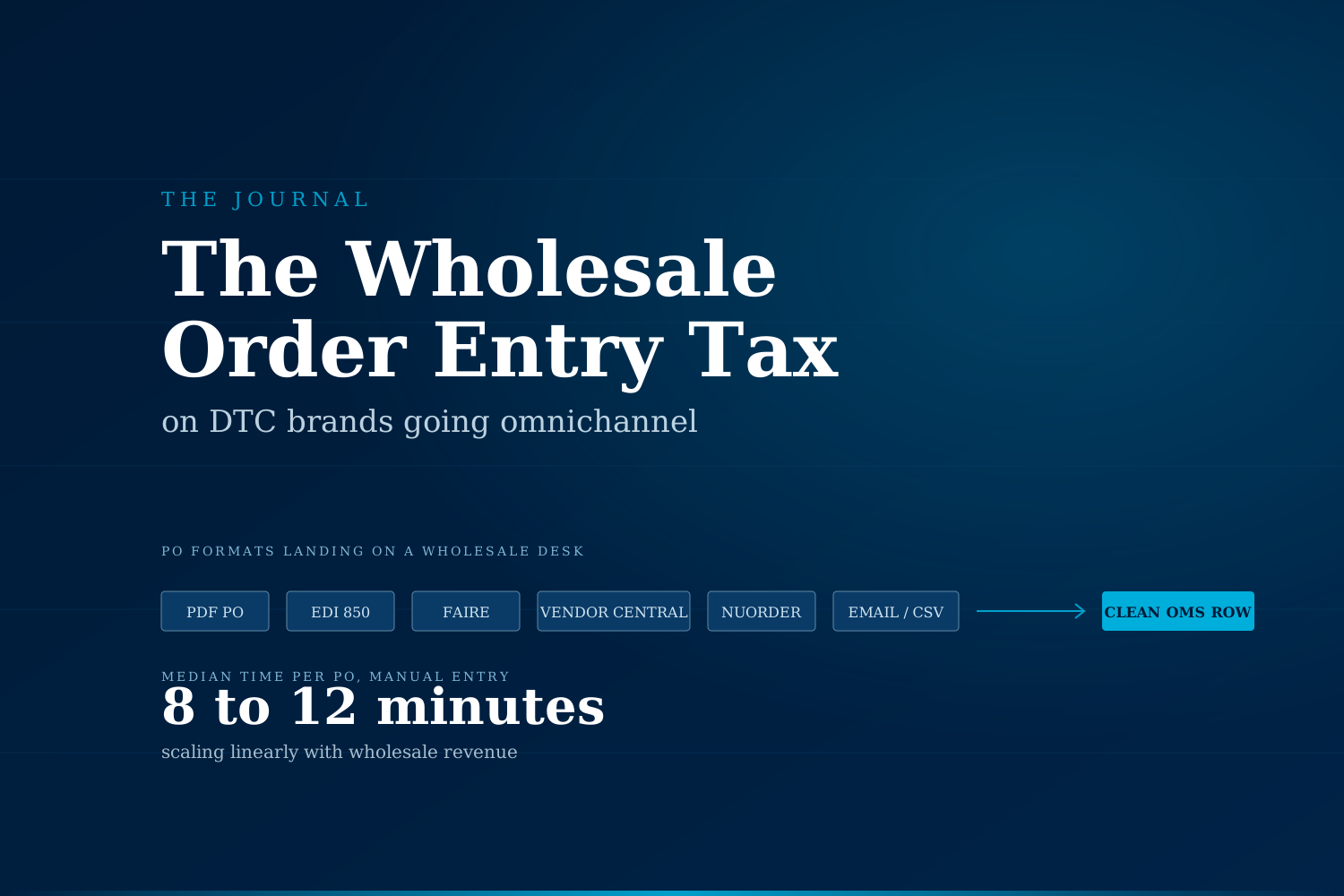
When a DTC brand starts selling through Faire, Amazon Vendor Central, and retail partners, wholesale order entry becomes the largest manual workflow on the ops desk. Each PO arrives in a different format, each one needs to land in the OMS without errors, and the work scales linearly with wholesale revenue. That work is a tax.
What is "wholesale order entry" in a DTC stack?
In a pure DTC stack, every order is already structured. A customer checks out on Shopify, the order arrives in the OMS as a clean row, and inventory and fulfillment downstream consume that row without anyone retyping it. The Shopify checkout doubles as the order entry layer.
The moment the same brand picks up wholesale, that assumption breaks. A wholesale order is not a checkout. It is a buyer at a retailer typing line items into their own purchasing system, then sending that PO out as a PDF, an EDI 850, a Faire order, an Amazon Vendor Central feed, a NuOrder confirmation, or a plain-text email. Each one carries the same intent (ship me units of these SKUs by this date to this location) wrapped in a completely different envelope.
Wholesale order entry is the work of unwrapping every one of those envelopes and creating the equivalent of a clean row in the OMS. SKU mapping, account mapping, terms validation, ship-to validation, line item normalization, pricing tier confirmation, MOQ enforcement, label and ASN routing. Every step a human keystroke.
Why does it become a tax once a DTC brand crosses $1M in wholesale?
Below $1M in wholesale, the work hides. A founder or a fractional ops lead handles the trickle of POs in between other work, the volume is low, the formats are familiar, and any errors are correctable inside the same week. The tax does not feel like a tax.
Past $1M, three things happen at once.
The first is volume. Wholesale orders show up in waves tied to retailer reorder cycles and Faire placement quarters, not to a smooth daily checkout pattern. A brand that does $300 in wholesale on a Tuesday and $40,000 on a Thursday cannot staff against the daily mean. It has to staff against the spike.
The second is format heterogeneity. Each retailer's PO template is different. Each EDI 850 is technically a uniform document, but compliance varies wildly by trading partner. Faire orders look like ecom orders but route differently. NuOrder is its own platform. Amazon Vendor Central drops POs at a cadence the brand cannot control. Even within a single buyer, a routine PO and a "drop ship for a new store" PO look different.
The third is the downstream cost of an entry error. A wrong SKU on a DTC order is a single CS ticket. A wrong SKU on a wholesale PO is a chargeback, an ASN that fails compliance, a carton labeled with the wrong UCC-128, and a retailer scorecard ding that compounds for the next two quarters. The penalty per error is an order of magnitude higher.
Where does the cost actually land on a $20M DTC brand?
Five surfaces, none of them rolling up cleanly under "wholesale operations" on the P&L, which is part of why the tax stays invisible.
| Cost surface | What it looks like in practice | Order of magnitude on a $20M brand |
|---|---|---|
| Order entry labor | One to two ops people converting POs to OMS rows | $80K to $160K per year, fully loaded |
| Compliance chargebacks | Late ASN, mis-labeled cartons, missing routing data | 1% to 3% of wholesale revenue, per EDI compliance benchmarks |
| PO acknowledgment latency | Days between PO receipt and 855 acknowledgment | Buyer scorecard impact, slower reorder consideration |
| Reconciliation hours at month-end | Matching wholesale invoices to POs, resolving partial fills | 20 to 40 finance hours per month |
| Stock allocated to wrong channel | DTC oversells caused by wholesale POs not yet visible to inventory | Compounds the inventory drift problem |
Treat the table as a floor, not a ceiling. Every brand we see at this size has at least one of these surfaces under-counted in their own internal view. The most common one is chargebacks, because they show up on retailer remittance statements weeks after the original PO and get categorized as "the cost of doing business with that retailer" instead of as a fixable ops-process leak. SPS Commerce and Retail Value Chain Federation publications have placed compliance-driven chargebacks between 1% and 3% of wholesale revenue on small-to-mid-size suppliers, with peaks above 5% on suppliers new to a major retailer.
What does the work actually look like, hour by hour?
Watch a brand's wholesale entry desk on a typical Tuesday.
The ops lead opens the inbox at 8:50 AM. Eleven new POs have landed overnight. Three are Faire orders, already structured. Four are PDF POs from independent retail accounts, in four different layouts. Two are 850s that landed in the EDI VAN, but one of them references three SKUs the brand discontinued last quarter and substituted. One is a plain-text email from a buyer at a regional chain saying "please add 12 of the new launch to our standing PO 4429." One is a CSV export from a NuOrder show.
Each of the eleven needs a different unwrap. Each goes through SKU mapping (does this SKU on the buyer's PO map to our internal SKU after the spring renumbering?), account mapping (does this PO charge net 30 against the account, or are they on net 60 since the new MSA?), and ship-to validation (the buyer wrote the warehouse address from memory and dropped the suite number).
Two hours in, the ops lead has cleared seven of the eleven and is on the phone with the EDI VAN about the discontinued-SKU 850. By 11:30 AM, three new POs have arrived. The queue is treadmilling, not draining.
That is the rhythm, every weekday. The cost is not in any one PO. It is in the cumulative drag of a workflow that scales linearly with wholesale revenue but cannot be neatly delegated, because each unwrap requires judgment.
What changes when an AI layer drafts the entry first?
The shape of the day changes more than the headcount. Each PO still arrives in its own format. The difference is that an agentic layer reads the PO first, extracts the structured fields (PO number, ship date, ship-to, line items, terms, special instructions), maps them against the brand's current SKU list and account ledger, and drops a draft order into the OMS with every exception flagged.
The ops lead opens the OMS in the morning to a queue of drafts, not a queue of envelopes. Tuesday's eleven becomes eleven drafts to review, not eleven documents to interpret from scratch. The four that match cleanly clear in seconds. The seven that have an exception (a discontinued SKU, a new ship-to address, an unusual term, a quantity outside the buyer's normal range) surface with the exact reason flagged.
Headcount does not necessarily fall. Capacity does. A two-person desk that was running at the edge of its volume now runs comfortably at three to five times the volume, and the people on the desk spend their hours on the genuinely ambiguous cases (a new buyer onboarding, a custom T&C, a quantity that needs a credit-team conversation) instead of on the mechanical unwrap.
The chargeback line moves the most. Compliance errors that come from a tired ops lead miskeying a SKU at 4:45 PM on a Friday largely disappear, because the draft layer does not get tired. The ones that remain are the genuine edge cases the buyer themselves got wrong, and a clean exception flag at intake catches most of those before the carton ships.
Three signs the wholesale entry tax is already eating margin
- Wholesale grew past 20% of revenue, but the ops headcount supporting it is the same one or two people who did it at $1M wholesale. The work compounded, the team did not.
- Chargebacks from at least one major retail partner appear on monthly remittance statements with no clear root cause inside the brand's own systems. That is the entry-error tax made visible months after the fact.
- The team cannot tell you, today, the median time between PO receipt and OMS entry. If the answer requires checking five inboxes and a NetSuite export, the workflow is invisible to its own owners, which is exactly when invisible costs accumulate.
Curious what your wholesale entry tax actually adds up to?
We run a completely free automation audit for DTC ops teams that want a second opinion on where wholesale order entry is leaking margin before committing to anything. No slide deck, no procurement gauntlet. We look at the formats coming in, the entry surfaces, and the chargeback pattern, and show you where an agentic draft layer would shift the workload.
Sami Raza
Software Developer & Technical Author
Sami Raza builds AI automation for logistics, DTC, and construction operations teams at ApexifyLabs, and writes about the operational failures that automation is actually worth pointing at.