Vendor Chargebacks: Where DTC Wholesale Margin Slips
Retail vendor compliance chargebacks from Target, Walmart, and other accounts can compress a DTC brand's wholesale margin by 1 to 3 percent of invoice. Here is where it leaks and what changes.
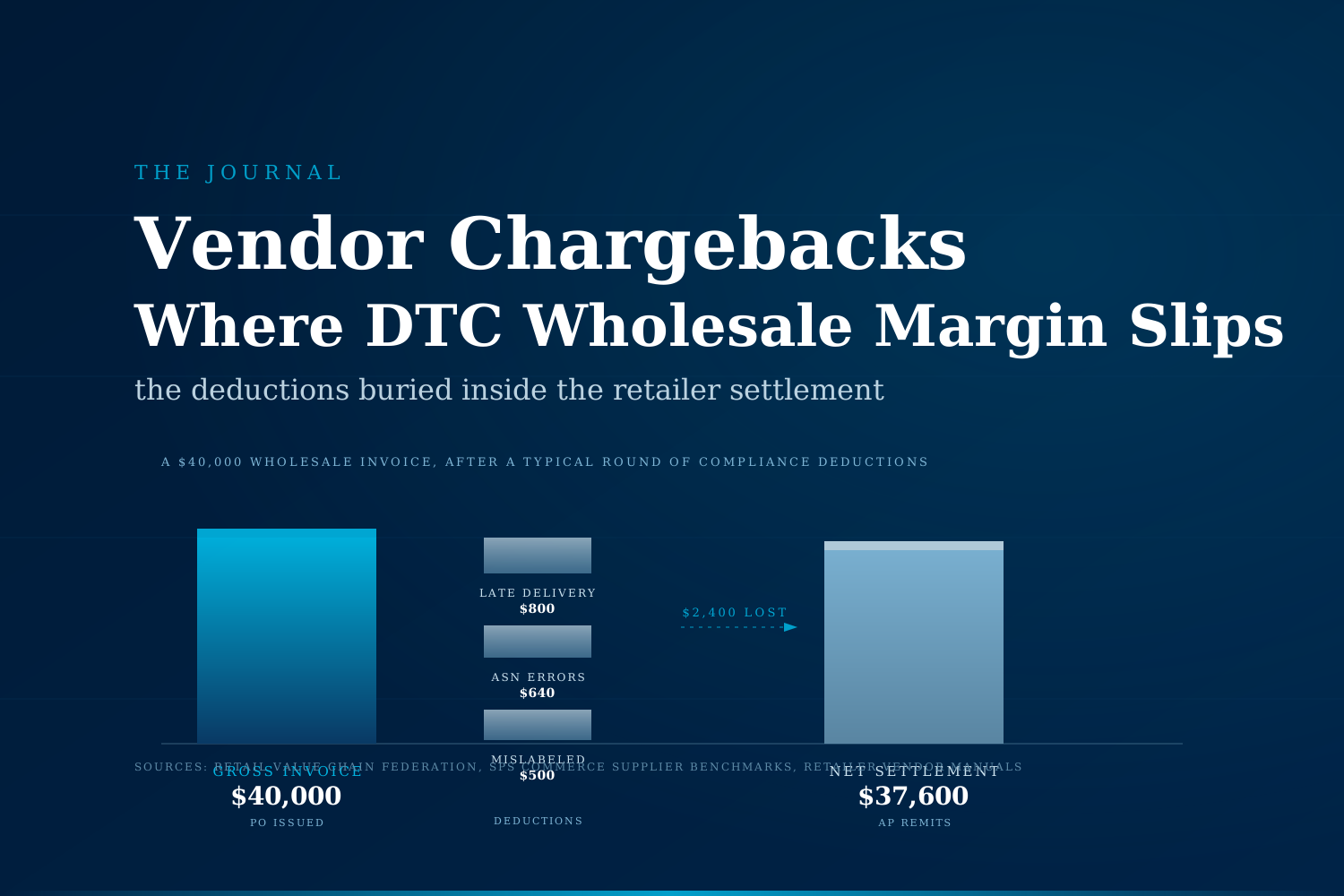
When a DTC brand expands into wholesale through retailers like Target, Walmart, or Whole Foods, vendor compliance chargebacks slowly compress the new margin. These are operational fines the retailer deducts for late shipments, mislabeled cartons, wrong ASN data, or missing barcodes. Industry data puts non-compliance at 1 to 3 percent of invoice value across most consumer-goods categories.
What is a vendor compliance chargeback?
A vendor compliance chargeback is a fine a retailer applies to its supplier's invoice when an operational requirement in the vendor agreement is missed. It is distinct from a credit card chargeback, which is a payment dispute filed by a consumer through their card network. Vendor chargebacks never touch the consumer at all. They live in the relationship between the brand and the retailer's accounts payable team.
Mechanically, the supplier sends an invoice for, say, $40,000. The retailer's AP system flags problems on the inbound shipment and the supplier receives a settlement of, say, $37,600. The $2,400 shortfall is the chargeback. The detail of why often arrives in a vendor portal weeks later, sometimes never.
Why do DTC brands underestimate them entering wholesale?
The first wholesale program at a DTC brand is usually treated as additive revenue. The team has spent years tuning Shopify, parcel fulfillment, and customer support around individual-order economics. Selling pallets into a major retailer is a different operating model: routing guides, advance ship notices, GS1-128 case labels, custom carton specs, retailer-specific UCC marks, delivery appointment windows.
Each retailer publishes its own vendor compliance manual, often more than a hundred pages, and updates it without much warning. The ops team that runs DTC fulfillment cleanly is suddenly responsible for memorizing several overlapping rulebooks. According to the Retail Value Chain Federation, the average supplier surveyed manages compliance against six or more retailer programs simultaneously. Each program has its own fine schedule.
The cost rarely shows up on a single line in the P&L. It is buried inside "deductions" or "trade allowances" and looks like noise until the first quarterly reconciliation.
Which categories drive the most fines?
Industry benchmarks from the Retail Value Chain Federation and supplier surveys published by SPS Commerce consistently rank the same compliance categories at the top:
| Category | Typical fine | Common root cause |
|---|---|---|
| Late delivery (missed appointment) | 1 to 5 percent of PO value | Carrier scheduling gap, warehouse pick lag |
| Incorrect ASN (advance ship notice) | $1 to $2 per carton | Manual data entry, missing fields |
| Mislabeled cartons or pallets | $250 to $500 per occurrence | Wrong GS1-128 barcode or SSCC sequence |
| Short or over shipment | 1 to 3 percent of invoice | Pick errors, inventory mismatch |
| Wrong carton dimensions or weight | $1 to $2 per carton | Master data drift after packaging updates |
| Missing required documents | $250 and up per PO | BOL, packing list, certificates |
| Routing violation (wrong carrier or lane) | $200 to $500 flat | Routing guide change missed during peak |
Most brands learn about these one at a time, after the first wave of fines hits and the operations lead reverse-engineers what the deduction codes mean.
Why does manual reconciliation break down?
The standard DTC ops response is to assign one person, usually the head of operations or a senior coordinator, to log into each retailer's vendor portal weekly, pull the chargeback report, match it against the original PO, decide whether to dispute, and file the dispute within the retailer's deadline (often 30 to 90 days).
In practice, several things go wrong:
- The portals each behave differently. Some export CSV, some only display web tables. None of them speak to the brand's ERP without custom plumbing.
- Disputes require evidence. A signed BOL, a labeled-carton photo, a fulfillment timestamp. Pulling that evidence per dispute often takes 20 to 45 minutes.
- Dispute windows are short and unforgiving. A missed window is the same as conceding the fine.
- Trend data is invisible. The brand sees individual disputes but rarely sees that, say, more than two thirds of mislabel fines originate at one DC.
- The coordinator triages by deadline, not by dollars. Easy small disputes get filed; the largest disputable lines die unread.
Supplier benchmarking work published by SPS Commerce suggests dispute win rates on disputable chargebacks usually land between 30 and 50 percent when handled this way, while the same data set indicates disputable fines are typically 60 to 75 percent winnable when contested with evidence inside the window.
What changes when AI handles the compliance loop?
The shift is not that AI argues better with the retailer. The shift is that the brand sees the whole landscape continuously instead of reacting to weekly portal pulls.
A capable AI-augmented compliance layer reads new chargeback line items as they post (across every retailer portal the brand sells into), reconciles each to the originating PO and shipment record, assembles the evidence file when one exists, and surfaces the disputes worth fighting (ranked by win probability and dollar value) to the human coordinator. The coordinator approves; the dispute is filed inside the window.
Equally important, the same layer flags emerging patterns. When mislabel fines from a particular distribution center start trending up, the team sees it within days, not at end-of-quarter reconciliation. When a routing guide updates and a recurring late-delivery fine starts appearing on Walmart POs, the system catches the pattern before it compounds into six figures of unrecoverable margin.
The compounding effect is operational, not just financial. A senior coordinator who used to spend half a week chasing portals is back on growth work, vendor onboarding, or contract negotiation.
What does it look like across a year?
Consider a DTC brand running $8M of wholesale revenue across four retail accounts.
| Metric | Manual loop | AI-augmented loop |
|---|---|---|
| Chargebacks logged per month | ~120 | ~120 |
| Disputes filed within window | ~40 percent | ~95 percent |
| Dispute win rate when filed | 30 to 50 percent | 55 to 75 percent |
| Ops hours per week on compliance | 12 to 20 | 2 to 4 |
| Time-to-pattern detection | 60 to 90 days | 5 to 10 days |
| Recovered margin per year | low six figures | mid six figures |
The headline number is recovered margin, but the operational story is bigger. The compliance function stops being a quarterly fire drill and becomes a continuous signal feeding the supply chain, the 3PL relationship, and the master data team.
Where should a brand start?
Most teams do not need a full compliance overhaul on day one. The right starting point is usually the single retailer with the highest fine volume, the most disputable categories, and the most accessible portal data. From there, the loop extends to the next retailer once the pattern is proven.
A useful first question to ask internally: what percentage of last quarter's deductions did the brand actually dispute, and what was the win rate on the ones that got filed? If either number is materially below the 60 to 75 percent winnable benchmark, the dollar gap is the size of the opportunity.
A note on what we will not cover here
This article is not a build guide. We are not publishing the retailer-portal parsers, ASN-matching logic, evidence-assembly prompts, or dispute templates that make a closed-loop compliance system actually work. That is the engineering, and it is meaningfully different for every retailer relationship. What this piece is for: clarifying what the operational shift looks like, what the recoverable dollars typically are, and whether the underlying problem is worth solving on your desk.
If wholesale chargebacks have started showing up at your DTC brand and you want a second opinion on where the margin is leaking, we offer a completely free automation audit that maps your current compliance loop and flags the two or three categories where a recovery system pays for itself in under a quarter. No commitment, no slide deck. → Book yours
Sami Raza
Software Developer & Technical Author
Sami Raza builds AI automation for logistics, DTC, and construction operations teams at ApexifyLabs, and writes about the operational failures that automation is actually worth pointing at.