How AI Pricing Engines Change Freight Broker Quote Desks
AI pricing engines compress freight quote response time from hours to seconds, shift desk capacity toward judgment loads, and tighten win/loss math for mid-size brokers.
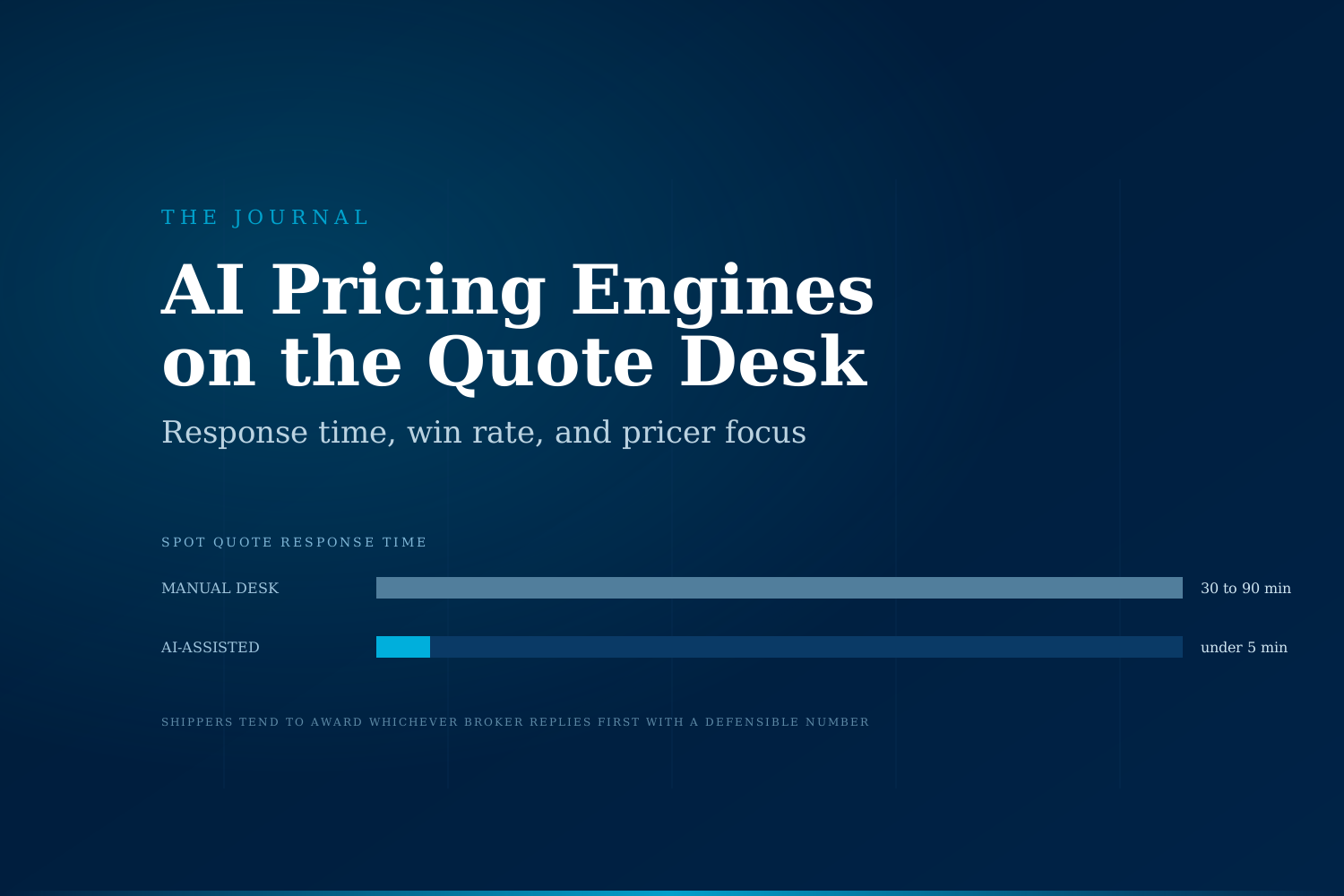
AI pricing engines for freight brokers ingest historical lane data, current market rates, and load-specific attributes to produce spot quotes in seconds rather than hours. They do not replace the human pricer. They shrink the desk's response time, normalize win/loss math, and free brokers to spend time on the loads that genuinely need judgment.
What is an AI pricing engine in a freight brokerage?
An AI pricing engine is a system that recommends a buy rate and a sell rate for a spot freight quote, by combining lane history, posted board rates, fuel index, equipment type, accessorials, and a confidence band. It runs inside (or alongside) the broker's TMS or quoting tool. The human pricer keeps the override.
For mid-size brokerages, the practical impact lands in three places: how fast a shipper hears back, how often the desk wins at the rate it intended, and how much pricer time goes to the small share of quotes that actually need a phone call.
The shift is not new in the abstract. Greenscreens, Sleek, Loadsmart, and similar tools have been pushing rate intelligence into brokerage workflows for several years, and the FreightWaves market data layer (SONAR) has been normalizing how everyone benchmarks lanes. What is new is that the same intelligence is now reachable for a 40-pricer brokerage, not only for top-20 3PLs with in-house data science teams.
Why does a manual spot quote take so long?
A manual spot quote is not really "one quote." It is a stack of micro-tasks the pricer does for each shipper request, often inside ten browser tabs.
A typical mid-size brokerage pricer working a spot RFQ touches:
- The shipper's tendered load and lane details (origin, destination, equipment, pickup window).
- DAT, Truckstop, or Greenscreens for posted spot rates.
- Internal lane history in the TMS for cost benchmarks.
- Fuel index, accessorials (drops, tarps, layovers), and any shipper-specific contract overrides.
- A judgment call on margin given the carrier capacity outlook for the next 24 hours.
Industry reporting from FreightWaves and DAT has repeatedly noted that the median spot-quote turnaround at a mid-size brokerage runs in the 30 to 90 minute range during peak hours, and that response speed correlates closely with quote-win rate. Shippers tend to award the load to whichever broker replies first with a defensible number, especially on lanes where the rate band between competitors is narrow.
The compounding problem is the queue. At a mid-size desk with three or four pricers and 200 inbound quote requests in a shift, the last quotes of the day get the least attention. A pricer who has been quoting for seven hours is not the same pricer who started at 8 a.m. The desk gets slower and more error-prone as the day stacks up, which is exactly when many shippers are most rate-sensitive.
What changes when an AI pricing engine joins the desk?
The cleanest way to see the shift is side by side.
| Step in the quote | Manual desk today | AI-assisted quote desk |
|---|---|---|
| Initial price suggestion | Pricer pulls from 4 to 6 tools and forms a number | Engine returns a buy/sell band in seconds with a confidence score |
| Response time to shipper | 30 to 90 minutes during peak | Under 5 minutes for the bulk of requests |
| Lane history lookup | Manual TMS search per quote | Auto-attached to every recommendation |
| Win/loss tracking | Spreadsheet or absent | Logged by lane, customer, and rate band |
| Pricer time per quote | 10 to 20 minutes average | 2 to 4 minutes for routine, full time on exceptions |
| Exception handling | Same desk, same urgency | Routed to a senior pricer with full context attached |
| Late-shift quote quality | Drops with fatigue | Consistent through the queue |
The result is not "no humans on the desk." It is a desk where the pricer's attention becomes the rare resource, and the engine handles the volume that does not need that attention.
Where does the margin actually shift?
Three places, in order of how often we see them inside mid-size brokerage audits.
Quote-to-award conversion rises
When response time drops below the shipper's mental cutoff (somewhere in the 10 to 15 minute window for most spot RFQs), the broker is more often in the first two replies. Public 3PL case studies and FreightWaves SONAR analyses have shown award rates lifting noticeably when reply latency falls under five minutes on spot RFQs. We are not citing one universal number because the lift varies by shipper segment, lane, and contract structure, but the directional pattern is consistent across published case studies.
Underpriced loads stop slipping through
Tired pricers underquote. A pricer running 200 quote requests in a shift, mostly at the end of the shift, is statistically going to leave dollars on the table on some of them. An engine quoting against historical lane cost plus a margin floor catches the ones the human would have shaved. Over a quarter, this is real money for mid-size brokerages running thousands of quotes a week.
Pricer capacity bends toward the exception loads
Most quotes do not need a senior pricer. They need a defensible answer fast. The exceptions (multi-stop, oversized, temperature-sensitive, hot-shipper, hot-lane) are where pricer judgment matters most. When the engine handles the routine quotes, the pricer's time concentrates on the loads where one good call is worth a hundred routine quotes. The same pricer headcount handles meaningfully more volume without meaningfully more burnout.
What an AI pricing engine does not replace
The Cardinal Rule still applies. The engine is not a strategy. It will not negotiate a shipper RFP. It does not handle the relationship call when a customer is unhappy about a quote. It does not know that one specific lane is about to spike because of a weather event in the next 12 hours, unless a human told it.
The shift is in volume handling, not in judgment. Brokerages that try to remove the pricer entirely tend to discover that the bottom 15 percent of quotes (by lane noise) need a human eye, and that the top 15 percent (by shipper value) deserve one. The middle 70 percent is where the engine earns its keep.
A pricing engine is business logic written down as software, which is why it usually arrives as a custom AI software build rather than a subscription: the rules that make your pricing yours are exactly the ones no vendor models. Related margin mechanics sit in fuel surcharge update lag, the annual lane RFP crunch, and agentic carrier sourcing.
When should a mid-size brokerage consider one?
A pricing engine usually pays back fastest at brokerages where:
- The quote desk is replying to more than 100 RFQs a day.
- Win rate is plateauing despite competitive carrier costs.
- Pricers are working past close to clear the queue.
- Quote-win analytics live in a spreadsheet, or do not exist at all.
- The TMS exposes lane history and shipper-specific contracts through an API.
If two or three of those describe the operation, an engine paired with workflow changes inside the desk is usually worth piloting on one lane segment before any larger commitment.
The brokerages that get the least value from a pricing engine, in our experience, are the ones that bolt it on without changing how pricers work. The technology sits next to the same workflow, and pricers keep double-checking it against the same six tools. The lift only shows up when the desk genuinely trusts the recommendation for the routine band and the workflow re-routes exceptions cleanly.
If this sounds like your quote desk, we offer a completely free automation audit for mid-size freight brokerages that want a second opinion before committing to anything. We will map your quote desk workflow, find the two or three places where minutes are leaking, and tell you whether a pricing engine is the right next move (or whether something simpler comes first). → Book the audit
Sami Raza
Software Developer & Technical Author
Sami Raza builds AI automation for logistics, DTC, and construction operations teams at ApexifyLabs, and writes about the operational failures that automation is actually worth pointing at.