Why GC Backcharges Rarely Get Recovered in Full
On most mid-size GCs' books, only a portion of issued subcontractor backcharges survive closeout. Here is what disappears between the field event and the final pay app.
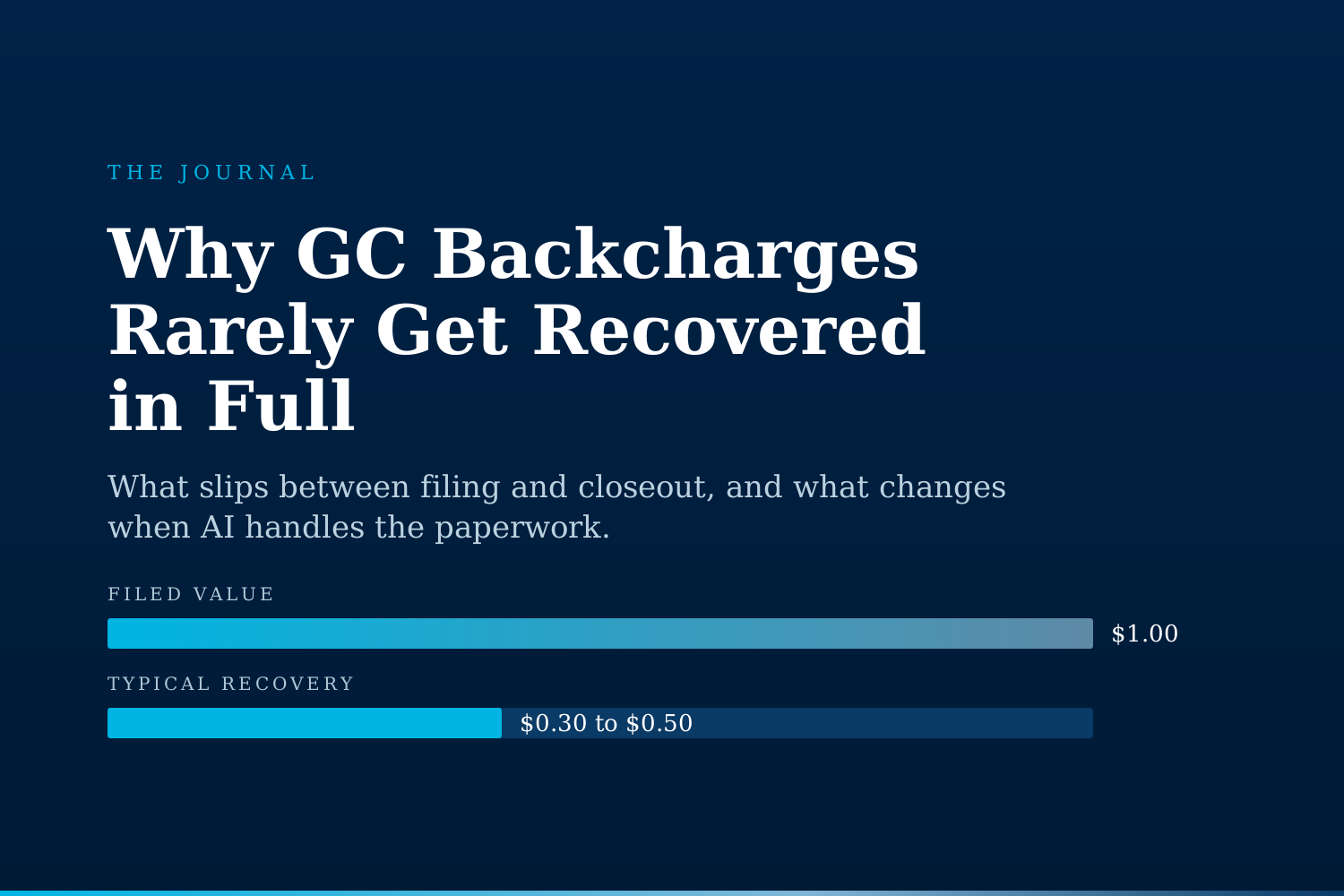
On most mid-size general contractors' books, only a fraction of issued subcontractor backcharges are recovered at filed value. The rest gets disputed, reduced at closeout, or quietly written off when the documentation cannot keep up with the dispute. AI is starting to change which dollars are recoverable and which still slip.
What is a subcontractor backcharge, and why does the dollar value erode?
A backcharge is the cost a general contractor passes back to a subcontractor when that sub's work causes additional expense for the project. The trigger could be a missed milestone, rework on a finished assembly, damage caused to another trade's installation, cleanup the sub left behind, or labor the GC had to backfill. The dollar amount usually shows up as a deduction on the next pay application or as a deferred line at retention release.
The mechanic is simple. The bookkeeping is not. Backcharges sit at the intersection of the prime contract, daily field records, subcontract notice provisions, and the human relationships with subs the GC plans to use again. That tension is the reason so few of them survive intact through closeout.
The Construction Financial Management Association has noted in its annual benchmarking that disputed deductions, including unbilled or contested backcharges, are among the most common contributors to retention-release delays on commercial projects. The dollars rarely disappear in one dramatic write-off. They erode in small, defensible-looking concessions.
Why does so much of a backcharge bill quietly disappear?
A few patterns repeat across project after project. None look dramatic in isolation. Stacked together, they explain why most project managers assume a backcharge will collect at roughly thirty to fifty cents on the dollar rather than full value.
Documentation built after the fact
Most backcharges get documented at the moment the GC needs to file them, not at the moment the field event happened. By then the daily logs have moved on, photos are buried in a shared drive without job-cost tags, and the superintendent who saw the issue has rotated to another site. When the sub disputes the charge two months later, the GC's evidence is whatever the PM can scrape together in an afternoon.
Disputes that outlast the project
A backcharge raised in month three is still open in month nine. The PM has switched projects. Accounting only sees the open dispute when retention release is on the table. At that point, closing the dispute usually means splitting the difference, because keeping the issue open delays the GC's own closeout. The sub knows this, and the negotiation goes accordingly.
Subjective dollar amounts no one wants to defend
Cleanup labor, schedule impact, rework supervision. These costs feel real to the team on site and feel arbitrary to the sub being charged. Without a defensible breakdown that ties each line to a labor rate, an equipment day, or a vendor receipt, the dispute slides toward whichever side is more patient. The patient side, as a rule, is the side that does not need the retention check to fund payroll.
Notice windows missed before the conversation starts
Most subcontracts require written notice of a backcharge within a defined window after the triggering event, often five to ten business days. Manual workflows miss this window routinely, because no one is watching a calendar against field events. A late notice does not always void the charge, but it weakens the GC's position before the dispute opens, and a smart sub knows to lead with that argument.
Manual versus AI-assisted backcharge recovery
| Step | Manual workflow | AI-assisted workflow |
|---|---|---|
| Spotting the issue | Super notes it on a daily log, sometimes | Field reports, photos, and schedule deltas surface candidate events automatically |
| Building the file | PM reconstructs evidence weeks later | Evidence is auto-bundled with timestamps the day the issue occurs |
| Pricing the cost | Estimator's gut number, no audit trail | Pulled from actual labor codes, equipment hours, and vendor receipts on file |
| Hitting the notice window | Often slips past the contract deadline | Draft notice is prepared inside the contract window |
| Tracking the dispute | Email thread the PM chases between projects | Status visible to PM and accounting in real time, tied to the pay app cycle |
| Closeout outcome | Filed value reduced through retention negotiation | Closer to filed value, because the file holds up |
The recovery improvement is not because AI is a better arbitrator. It is because the file is built well enough that splitting the difference stops being the path of least resistance for either side.
What changes for the PM team once AI handles the paperwork?
The PM stops being the bottleneck. Three things shift quickly.
- Notice windows stop slipping. The contract clock starts when the event happens, not when the PM finally has a free Friday afternoon, so the procedural defense the sub used to lead with disappears.
- The cost basis becomes defensible. When every charged hour ties to a known labor rate, every charged delay ties to a scheduling event, and every charged material to a vendor invoice, the conversation stops being about whether the number is fair and starts being about whether the underlying event is even in dispute.
- Closeout speeds up. Open backcharge disputes are one of the larger drivers of retention release delay on mid-size projects. Closing them on filed value, rather than negotiated value, reclaims margin that would have leaked at the finish line.
When is the manual workflow still good enough?
For a single backcharge of a few thousand dollars on a small project, the cost of building a tighter workflow is not worth the recovery. The pattern that changes the math is volume. A GC running six to twelve active projects, each generating a handful of backcharge events per month, will routinely have a six-figure annual recovery gap waiting in plain sight on the books.
That gap is what AI captures. The technology does not replace PM judgment about which events warrant a charge or how to handle the relationship with the sub. It removes the part of the job where the PM is reconstructing the past from scattered records, badly, under time pressure.
A few questions PMs ask before going further
How much of a backcharge does a mid-size GC typically recover?
Industry benchmarking consistently shows recovery rates well below filed value. PMs we speak with land in roughly the 30 to 50 percent range, with the gap concentrated in disputed labor and schedule-impact charges where the documentation is thinnest.
Does AI replace the project manager on backcharge decisions?
No. The PM still decides which events become charges and how to handle the ongoing relationship with the sub. AI handles the evidence assembly, the notice timing, and the dispute tracking that the PM no longer has time to do well across a portfolio of active jobs.
What about subs we use repeatedly?
Backcharge recovery and a healthy ongoing relationship are not mutually exclusive. Subs respect a GC who documents fairly and files on time, even when the conversation is uncomfortable. What erodes the relationship is surprise charges built from thin records two months after the fact, then quietly negotiated away when retention is on the line.
What does this look like on your books?
The first signal is usually quiet. The closeout retention check on a recent project came in lighter than expected, and no one on the team can fully explain where the deductions came from. The second signal is louder. Open backcharge disputes have been carrying across two reporting periods, the PM associated with the original event is on a different project, and accounting is starting to ask whether to write the balance off.
If either signal sounds familiar, we run a completely free automation audit for general contractors that want a clear read on where their recoverable margin actually lives before committing to anything. No slide deck, no commitment, just an honest look at the recovery math and the next move. → Book the audit
Sami Raza
Software Developer & Technical Author
Sami Raza builds AI automation for logistics, DTC, and construction operations teams at ApexifyLabs, and writes about the operational failures that automation is actually worth pointing at.