Why Fleets Are Putting AI Agents on Driver Recruiting
A CDL driver applies to several carriers in one evening and usually signs with whoever calls back first. That race is lost or won long before the road test.
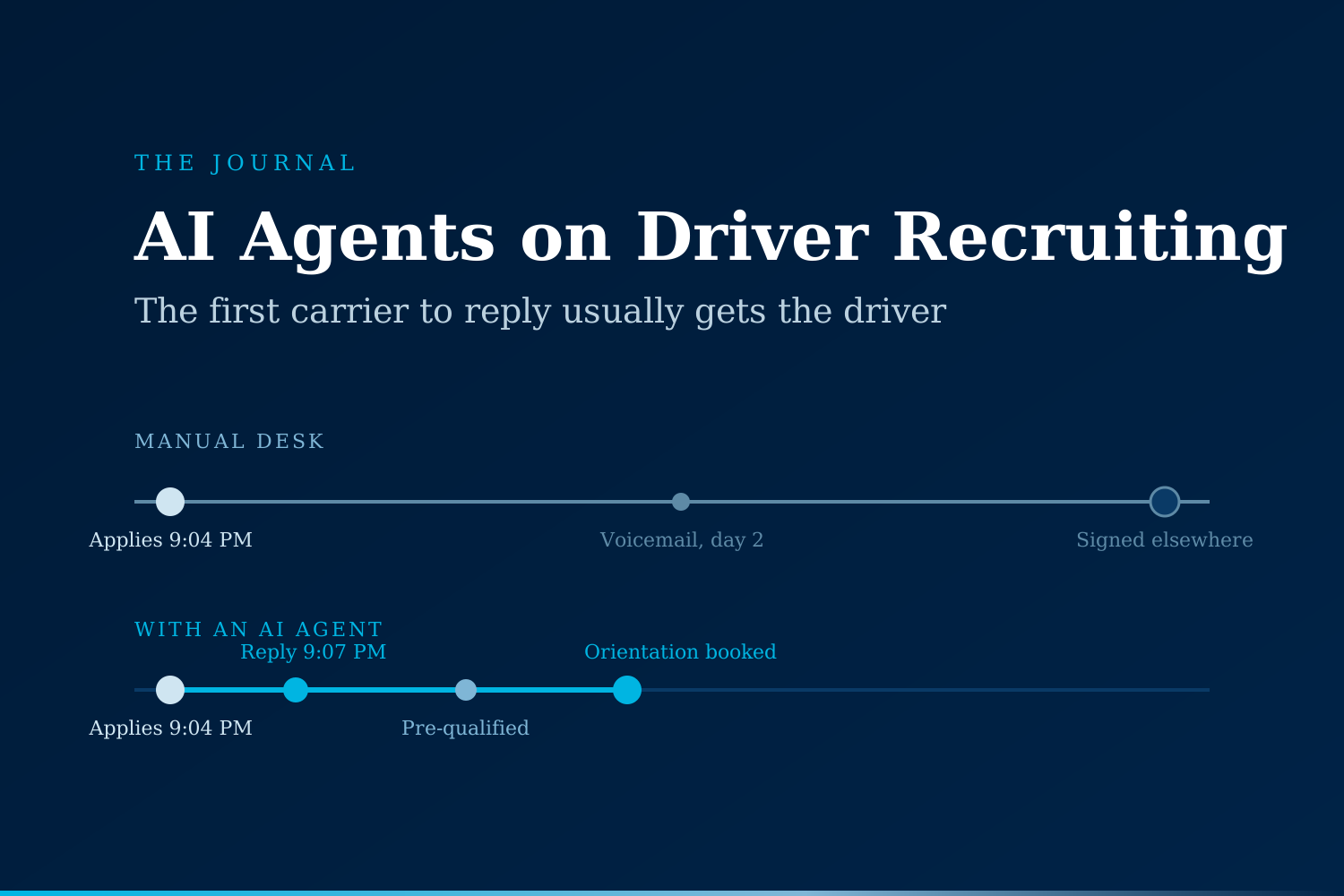
AI agents for trucking driver recruiting answer every CDL applicant within minutes, day or night, ask the qualifying questions your recruiters would ask, book phone screens and orientation seats, and chase the documents a driver qualification file needs. Recruiters keep the judgment calls and the relationships; the agent removes the waiting that costs fleets their best applicants.
Why do fleets lose qualified driver applicants before anyone calls them?
Most fleet owners already know the shape of the problem. A driver finishes a run, sits in the cab at 9 p.m., and fills out three or four applications from a job board. By the next morning, at least one of those carriers has called. The fleets that call on day two or day three often reach someone who has already booked orientation somewhere else.
The data backs up what recruiters feel. In a June 2025 analysis covering more than 1.5 million drivers, Tenstreet reported that carriers responding to driver applications within five minutes saw a 6.2% hiring rate, nearly double the platform average of 3.7%. The same analysis found that when the hiring process ran past the typical 10 to 15 days, hiring rates dropped by up to 50%.
Five minutes is a hard target for a two-person recruiting team. Applications arrive in bursts after ad spend goes live, on weekends and late at night. Recruiters are also running background checks, calling previous employers, scheduling drug tests and answering questions from drivers already in orientation. Speed slips not because anyone is careless, but because the inbox never empties.
What does a slow recruiting desk actually cost a trucking company?
Every applicant who goes cold is paid-for traffic that never turned into a seat. Each unfilled truck is also revenue the fleet does not book that week. The Truckload Carriers Association's profitability program once put the average fully loaded expense per new hire at about $10,900, with most member results between $10,000 and $12,000. That figure dates from 2018 member data, and advertising costs have not gotten cheaper since.
The pressure is not limited to the US. In Canada, Trucking HR Canada reported that driver job openings eased in Q3 2025, yet still sat above the national average for the broader workforce. UK hauliers and Australian line-haul operators describe the same dynamic: fewer applicants than they would like, and those applicants have options.
When the pool is tight, response time becomes one of the few levers a fleet fully controls. Pay and home time take board meetings to change. Answering faster does not.
What do AI agents do in trucking driver recruiting?
An AI agent is software that can hold a conversation, follow your hiring rules, take actions in your systems and hand off to a person when it should. Applied to driver recruiting, it covers the work that sits between "application received" and "recruiter makes a decision":
- First contact in minutes. The agent texts or emails every new applicant right away, in a friendly, plain-spoken tone that matches your brand, and confirms they are still looking.
- Pre-qualification. It asks the questions your recruiters ask on every first call: CDL class and endorsements, years of verifiable experience, recent moving violations, preferred freight and home-time expectations, and whether they live inside your hiring area.
- Honest answers to common questions. Pay structure, equipment, home time, benefits, orientation location. Approved answers only, written by your team.
- Scheduling. Qualified drivers get offered a phone screen with a recruiter or a seat at the next orientation, booked straight onto the calendar.
- Document chasing. The agent follows up on missing items (license copies, medical certificate, signed release forms) and tells the recruiter when a file is complete.
- Re-engagement. Drivers who stalled mid-process or went to another carrier six months ago get a respectful check-in when you have a lane or schedule that fits them.
What the agent does not do is decide who gets hired. Final hiring decisions, safety judgment and the relationship with the driver stay with your people.
Manual recruiting desk vs AI agent support: what changes?
| Recruiting step | Typical manual desk | With an AI agent alongside recruiters |
|---|---|---|
| First contact after application | Hours to days, depending on workload | Within minutes, including nights and weekends |
| Basic qualification questions | Repeated by a recruiter on every call | Collected in a short text conversation, summarized for review |
| Phone screen and orientation booking | Back-and-forth calls and voicemail | Offered and booked in the same conversation |
| Missing documents | Tracked in spreadsheets and memory | Chased automatically, with status visible to the team |
| Drivers who go quiet | Usually forgotten after one or two tries | Followed up on a set schedule, then closed out politely |
| Recruiter time | Mostly spent on admin and phone tag | Mostly spent on qualified drivers and hiring calls |
The point of the right-hand column is not fewer recruiters. It is recruiters spending their day with drivers who are qualified and interested, instead of chasing people who stopped answering two days ago.
How do AI agents fit with DOT compliance and DQ files?
US motor carriers carry real obligations here, and an agent has to respect them. Under 49 CFR 391.51, each carrier keeps a driver qualification file with items such as the employment application, motor vehicle records, the road test certificate or equivalent, and the medical examiner's certificate. Previous-employer safety performance inquiries and the pre-employment Drug and Alcohol Clearinghouse query have their own rules and timelines.
An agent is well suited to the administrative side of this: requesting documents, checking that what came back is the right document type and still in date, logging what is missing and nudging the driver until it arrives. It is not a substitute for your safety or compliance manager signing off a file. The best setups make that sign-off faster by putting a complete, organized file in front of the person who approves it.
Fleets in Canada, the UK and Australia have their own licensing and record rules, and the same principle holds there. The agent handles collection and follow-up; your team owns the decision.
Is this worth it for a fleet with 30 to 300 trucks?
Mid-size fleets often feel the gap most. They spend real money on job boards and referral bonuses but rarely have a dedicated after-hours recruiting team. A few questions usually settle whether an AI agent would make a difference:
- How fast do applicants hear from you today? Pull a month of applications and compare the submit time with the first recruiter touch. Weekend and evening applications are often the slowest.
- How many applicants never get a real conversation? If a meaningful share of paid leads are only ever called once, the agent pays for itself in recovered traffic before anything else.
- How long does a file sit waiting for documents? Days lost between "conditionally approved" and "file complete" stretch the hiring cycle past the window where drivers stay committed.
If those answers look familiar, the fix is less about hiring another recruiter and more about making sure no qualified driver waits for a reply. The same approach works on the brokerage side of trucking; see how we think about carrier onboarding backlogs and expired carrier documents, and how AI agents handle a 3PL's client email backlog.
How do we build a recruiting agent for a fleet?
Every fleet hires a little differently: different applicant tracking system, different hiring criteria by division, different tone with drivers. We start from a real sample of your applications, recruiter notes and drop-off points, then build an agent around your rules, your systems and your compliance process rather than a generic script. Our logistics industry page and custom AI software service show the kind of operations work we take on.
If good drivers are slipping away between the application and the first call, we offer a completely free automation audit for trucking fleets. We will look at your current recruiting flow and show you where an agent would answer faster and where your recruiters should stay hands-on. → Book your free audit
Sami Raza
Software Developer & Technical Author
Sami Raza builds AI automation for logistics, DTC, and construction operations teams at ApexifyLabs, and writes about the operational failures that automation is actually worth pointing at.