Freight Order Entry Is the First Job for AI Automation
Shipper tenders arrive as emails, PDFs and spreadsheets. Someone rekeys every one into the TMS. That queue is where a brokerage's speed is decided.
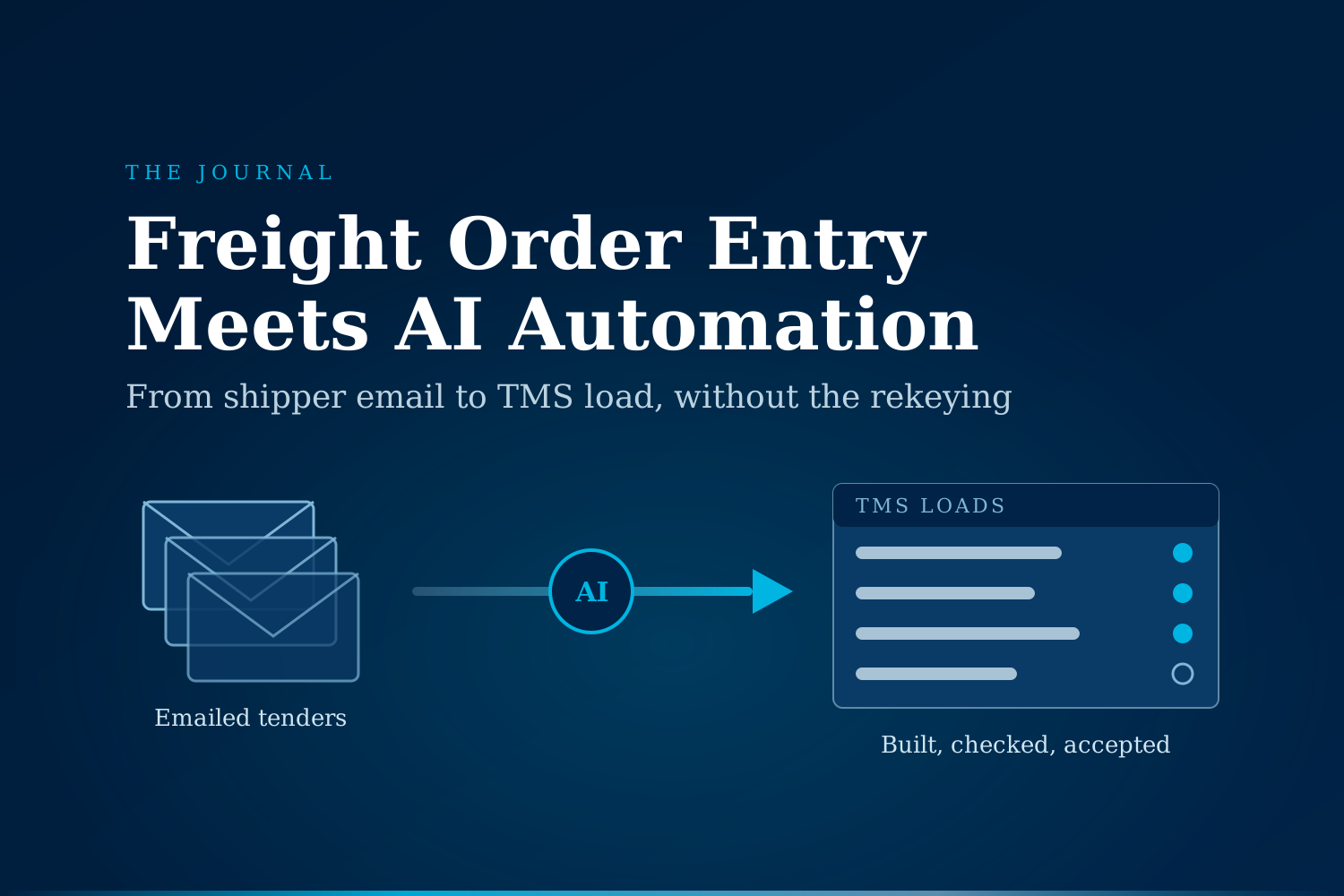
AI automation for freight order entry reads shipper tenders as they arrive by email, PDF or spreadsheet, extracts the shipment details, builds the load in the TMS and sends back an acceptance, usually within minutes. People review only the tenders that are unclear or unusual, so the order desk stops rekeying and starts handling exceptions.
Why is freight order entry still so manual?
Large shippers tender through EDI or a TMS integration. Most of the freight a mid-size brokerage handles does not come that way. It comes from a plant manager's email, a weekly spreadsheet of 30 loads, a PDF bill of lading with handwritten notes, or a one-line message that says "need a truck Tuesday, same as last week."
Each of those has to become a structured load: pickup and delivery addresses, appointment windows, commodity, weight, equipment type, reference numbers, special instructions, rate. Someone on the desk reads the message, opens the TMS, and types it in field by field. When a shipper sends 20 loads in one attachment, that person enters them one at a time.
C.H. Robinson, one of the largest freight brokers in North America, described this exact bottleneck when it announced its own AI work. Before automating, it reported that an emailed load tender could wait as long as four hours for a person to get to it, and that manual entry of the shipment details took an average of seven minutes per load. Those are numbers from a company with thousands of employees and a large technology team. A brokerage with 15 people on the floor usually feels the same queue more sharply.
What does manual order entry cost a brokerage?
The obvious cost is time. Seven minutes per load does not sound like much until you multiply it. A desk entering 120 emailed loads a day is spending around 14 hours of skilled labor on typing, before anyone has called a carrier.
The less obvious costs tend to matter more:
- Slower acceptance. Shippers notice when a tender sits. A load that gets confirmed in minutes feels different from one that gets confirmed after lunch, and that impression follows the account into the next bid. We covered the routing-guide side of this in what manual tender acceptance costs a routing guide.
- Coverage starts late. Every minute a load spends in the inbox is a minute it is not posted or offered to carriers. On tight spot freight, that delay shows up in the buy rate.
- Keying errors travel. A wrong zip code, a dropped reference number or a missed liftgate note does not stay in the TMS. It flows into the rate confirmation, the carrier's dispatch and eventually the invoice. Small entry mistakes are behind many of the disputes we described in how rate confirmation errors shrink freight broker margin.
- Capacity caps on growth. When order entry scales with headcount, a new account with heavy email volume means hiring before it means margin.
- After-hours tenders wait for morning. Emails that land at 7 PM sit until someone logs in, which is a pattern we explored in why off-hours loads slip through mid-size freight brokerages.
How does AI order processing automation work at a brokerage?
The idea is simple: the automation does the reading and the typing, and your team does the judging.
An AI automation layer watches the inboxes and portals where tenders arrive. When a message comes in, it identifies whether it contains one load, twenty loads, a change to an existing load or a cancellation. It pulls the shipment details out of the email body, the PDF or the spreadsheet, checks them against what your TMS already knows (the shipper's facilities, their usual equipment, their contract rates), and builds the load.
If everything lines up, the load is created and the shipper gets an acceptance. If something is missing or does not match, such as a delivery address that has never appeared before or a weight that would not fit the equipment requested, the tender goes to a person with the question already flagged. That person spends their time on the one detail that needs a decision, not on retyping the other 14 fields.
At C.H. Robinson's scale, the company reported in 2025 that more than 5,200 customers were getting loads accepted in under 90 seconds, against the up-to-four-hour email queue it described before. The same approach is now practical for brokerages a fraction of that size, because the hard part (reading messy, unstructured tenders reliably) no longer requires a proprietary research team.
Manual order entry vs AI automation: what changes on the desk?
| Step | Manual order desk | With AI automation |
|---|---|---|
| Tender arrives by email | Waits in a shared inbox until someone is free | Read as soon as it lands, day or night |
| Multi-load spreadsheet or PDF | Entered one load at a time | All loads extracted together |
| Shipper and facility details | Retyped or copied from past loads | Matched to existing TMS records |
| Missing or odd details | Often caught later by dispatch or the carrier | Flagged up front for a person to resolve |
| Acceptance back to shipper | Sent after entry is finished | Sent once the load is created and checked |
| Desk time | Mostly typing | Mostly exceptions, shipper relationships and coverage |
The table describes a shift in where people spend their attention. The order desk still owns the account. It simply stops being the bottleneck between a shipper's email and a carrier's truck.
Is AI automation reliable enough for freight orders?
This is the right question to ask, and the answer depends on how the automation is built rather than on AI in general.
A well-built system does not guess. It extracts what it can read with confidence, compares it with what your own data says should be true, and routes anything uncertain to a person. Industry sentiment supports that design. In the Capgemini Research Institute's 2026 supply chain agentic AI report, 84% of surveyed executives said humans must retain authority to validate AI-generated decisions, while only 22% of organizations had piloted or implemented AI agents at all. That survey covers companies above $1 billion in revenue, which suggests the adoption gap is wider still among mid-size brokerages.
That gap is also the opportunity. Order entry is one of the safest places to start because the work is high volume, the rules are already known by your team, and every load can be checked before it is accepted. It also feeds everything downstream: coverage, tracking, billing. Clean data at the front of the load makes every later step easier.
Which brokerages benefit most from order entry automation?
The pattern tends to show up most clearly in a few situations:
- Shippers who will not or cannot integrate. Regional manufacturers, distributors and growers who tender by email and have no plans to change.
- Heavy multi-load tenders. Weekly or daily spreadsheets that take one person a full morning to load.
- Cross-border and mixed-mode accounts. Freight between the US and Canada, for example, where tenders carry extra references and customs details that are easy to miss when typed by hand.
- Thin order desks. Teams where one sick day or one new account pushes entry into the evening.
If two or more of these describe your brokerage, the order queue is likely costing more than it appears to on a payroll report.
Where should a brokerage start?
A useful first look takes about a week. Count how many tenders arrive by email versus EDI or portal. Note the time between when each email lands and when the load exists in your TMS. Pull the last month of billing disputes and see how many trace back to a detail that was entered wrong. Those three numbers usually tell you whether order entry is a minor annoyance or the main thing slowing your desk down.
What those numbers will not give you is the design: how to handle each shipper's format, which details to trust automatically, which to flag, and how to connect it all to your specific TMS without disrupting the people who run it every day. That is the part that decides whether automation sticks. We build that layer for brokerages as part of our custom AI software work, and you can see how we think about freight operations more broadly on our logistics industry page.
If your team spends the first hours of every day turning emails into loads, we would be glad to look at it with you. We run a completely free automation audit for brokerages: we review a sample of your real tenders and show what could be automated and what should stay with your people. → Book your free audit
Sami Raza
Software Developer & Technical Author
Sami Raza builds AI automation for logistics, DTC, and construction operations teams at ApexifyLabs, and writes about the operational failures that automation is actually worth pointing at.