How Rate Confirmation Errors Shrink Freight Broker Margin
Rate confirmation errors compress freight broker margin on almost every load. Here is where they come from and what shifts when AI reviews them before dispatch.
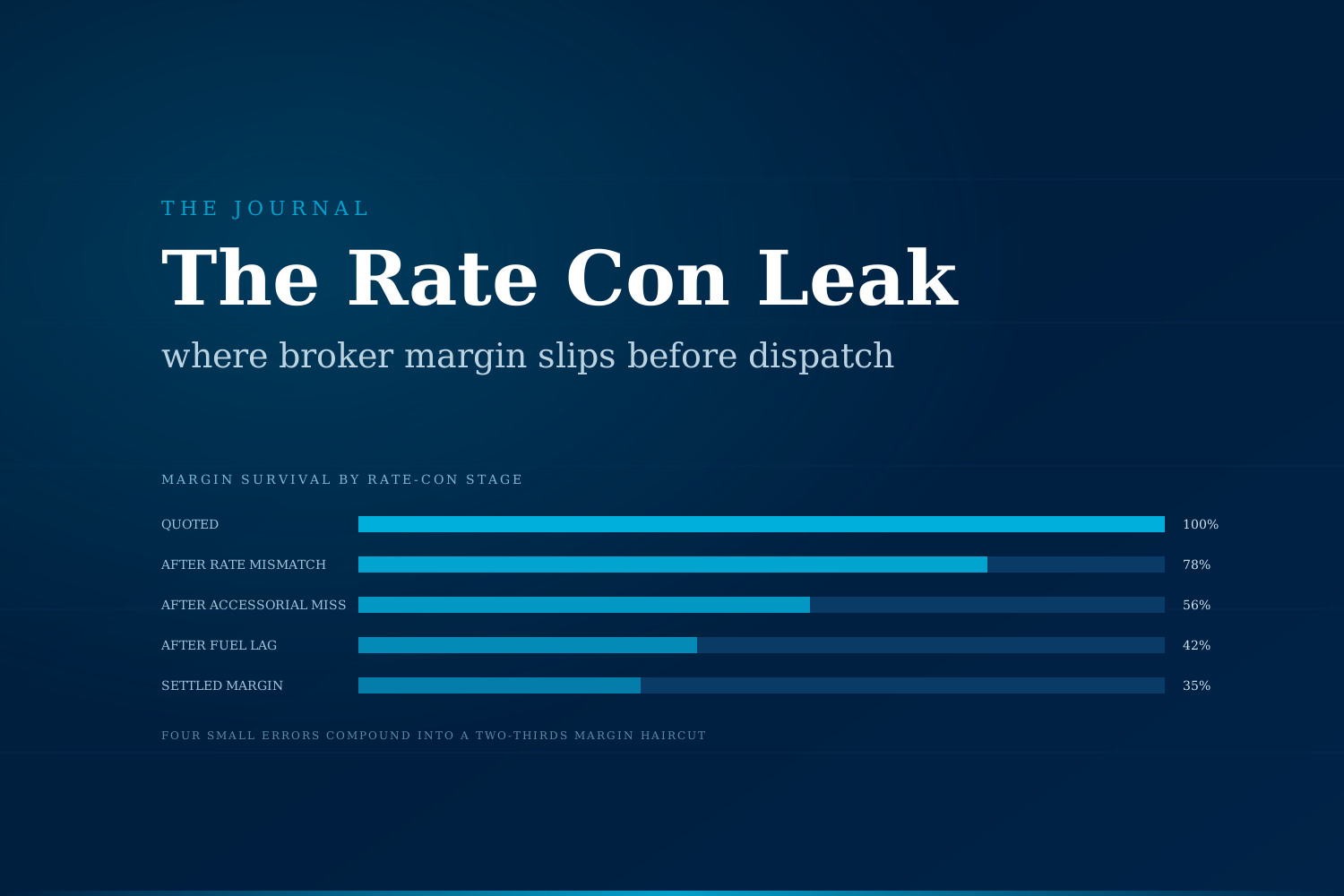
Rate confirmation errors chip away at freight broker margin on almost every load, sometimes a few dollars, sometimes hundreds. Miskeyed rates, missing accessorials, wrong reference numbers, and stale fuel schedules turn a clean quote into a delayed invoice or a short pay. On a busy brokerage desk, the cumulative cost is significant even when no single error looks alarming.
What is a rate confirmation error?
A rate confirmation is the document a brokerage sends a carrier once a load is tendered: rate, pickup and delivery windows, commodity, weight, reference numbers, accessorial rules. It is the source of truth for what will be paid at settlement.
An error is any mismatch between what was quoted to the shipper, what was agreed with the carrier, and what is memorialized on the rate con. The common shapes:
- Rate on the rate con is $50 to $200 higher or lower than what was booked in the TMS.
- Accessorials (detention, layover, tarps, lumper) are omitted or listed at last quarter's numbers.
- Fuel surcharge is applied at a stale index.
- Reference number, PO, or BOL number is transposed and creates a POD mismatch at settlement.
- Delivery window is off by a business day.
Each one is small on its own. Together, they force a downstream chain: settlement disputes, short payments, chargebacks from the shipper, extra time from the accounting team, and sometimes a strained carrier relationship.
Why do rate confirmation errors persist on manual desks?
Because the rate con is usually the last piece of paperwork before the load leaves the yard. On a manual freight desk, it is generated by a dispatcher who is negotiating three other loads at the same time. There is rarely a second set of eyes before it goes out.
Industry commentary consistently points to speed as the trade-off. TMS platforms like McLeod, MercuryGate, and Tai TMS all support rate con templates, but the last-mile fields (accessorials, references, notes) are still typed manually. Trade coverage in FreightWaves and the Journal of Commerce has repeatedly documented manual data entry as a leading source of settlement disputes on brokerage desks.
Another factor: rate cons are often reused as templates. A dispatcher copies last week's rate con for the same lane, updates the top line, and forgets that the shipper's accessorial schedule changed on the first of the month. Nothing about the workflow flags the discrepancy until an invoice lands.
How much does one rate confirmation error cost a brokerage?
The per-load cost varies, but the pattern is consistent:
| Error type | Typical cost per occurrence | Where it shows up |
|---|---|---|
| Rate mismatch ($50 to $250) | Direct margin loss on settlement | Shipper short pay or carrier bill increase |
| Missing accessorial | Full accessorial value ($75 to $500) | Carrier bills, shipper refuses to pay |
| Stale fuel surcharge | 2 to 5 percent of linehaul | Fuel line discrepancy at settlement |
| Wrong reference number | Delayed POD match, aged receivable | DSO extension, cash flow drag |
| Off-by-a-day delivery window | Detention or missed appointment fee | $150 to $400 in accessorial exposure |
On a brokerage running 400 loads a month, even a 3 to 5 percent error rate on rate cons translates to 12 to 20 disputed settlements per month, each one requiring accounting cycles and often ending in a partial write-down. The Transportation Intermediaries Association has long observed that billing and settlement issues sit among the top time drains for brokerage back offices, ahead of customer service and behind only carrier procurement.
What kinds of desks show the highest error rate?
Three patterns tend to appear on desks where rate con error rates are highest:
- High spot-market mix. Every load is a fresh quote, so rate cons are less templated and more error-prone.
- Growing headcount without a documented QA step. New dispatchers inherit habits, not checklists.
- Multi-location operations where the sales rep, dispatcher, and settlement team sit in three different offices. Handoff friction masks the error until it lands with accounting.
None of these signal a poorly run brokerage. They signal a growing brokerage where the paperwork workflow has not caught up with the volume. That is normal, and it is where AI leverage tends to compound the fastest.
What changes when AI reviews rate confirmations before dispatch?
An AI-augmented brokerage desk treats the rate confirmation like a contract review, not a form fill. Before the rate con is emailed to the carrier, an AI layer compares it to three sources of truth: the TMS quote, the current accessorial matrix for that shipper, and the live fuel index. Anything that does not match is surfaced to the dispatcher in seconds.
The dispatcher still owns the decision. But the eye test is no longer the last line of defense. Here is what shifts on the desk itself:
| Workflow step | Manual desk | AI-augmented desk |
|---|---|---|
| Rate con generation | Template plus manual field entry | Auto-drafted from TMS and accessorial matrix |
| Rate validation | Dispatcher's memory | Cross-check against quote and shipper schedule |
| Accessorial review | Optional, depends on dispatcher | Enforced on every rate con |
| Fuel surcharge | Manual paste from spreadsheet | Live index at time of tender |
| Reference numbers | Retyped from shipper email | Copied programmatically from tender payload |
| QA before send | Rare | Every rate con, in under 5 seconds |
The dispatcher's day feels the same. The settlement team's day feels very different. Disputes drop. Short pays drop. DSO tightens because POD matches happen on the first try. The accounting team gets its afternoon back.
What is the compounding effect on cash flow?
Rate con accuracy is a leading indicator of settlement speed, and settlement speed is the direct input into brokerage DSO. Industry consultants and TIA member data have documented DSO ranges of 35 to 55 days for mid-size freight brokerages, and rate con errors sit inside that number more than most operators realize.
A brokerage that reduces its rate con error rate from 5 percent to under 1 percent typically sees:
- 5 to 8 days off DSO within one quarter.
- 20 to 40 percent fewer settlement adjustments.
- A measurable drop in carrier friction, because carriers push back less on brokers whose rate cons match their bills.
None of that requires new sales, new lanes, or a bigger back office. It is trapped margin that was already earned.
Signs your rate con workflow is due for a second look
Three quick observations from a desk visit:
- Accounting keeps a private spreadsheet of "known bad" rate cons to catch at settlement.
- Dispatchers copy last week's rate con more often than they draft from the TMS.
- Shippers push back on accessorial invoices more than once a quarter.
If any of these are true, the workflow is not broken. It is leaking margin that a modest AI layer would recover.
Where the pattern is heading
Rate confirmation review is one of the higher-leverage places to introduce AI on a brokerage desk. It sits inside a document that already exists, it uses data the TMS already stores, and the improvement is visible on the next settlement cycle. Brokerages that move first tend to keep the margin. Brokerages that wait tend to normalize the leak.
The interesting shift is not the technology. It is the conversation that becomes possible when the settlement team stops chasing errors and starts pricing new lanes.
Closing
If your desk shows any of the patterns above, we run a completely free automation audit for freight brokerages. No commitment, no slide deck. We spend an hour walking your last thirty days of settlement adjustments with you and show you where an AI layer would have caught the errors before they left the desk. → Book yours
Sami Raza
Software Developer & Technical Author
Sami Raza builds AI automation for logistics, DTC, and construction operations teams at ApexifyLabs, and writes about the operational failures that automation is actually worth pointing at.