What Manual Tender Acceptance Costs a Routing Guide
Slow tender responses move loads off your guide. Here is what manual tender acceptance actually costs brokerages over a quarter and a full bid cycle.
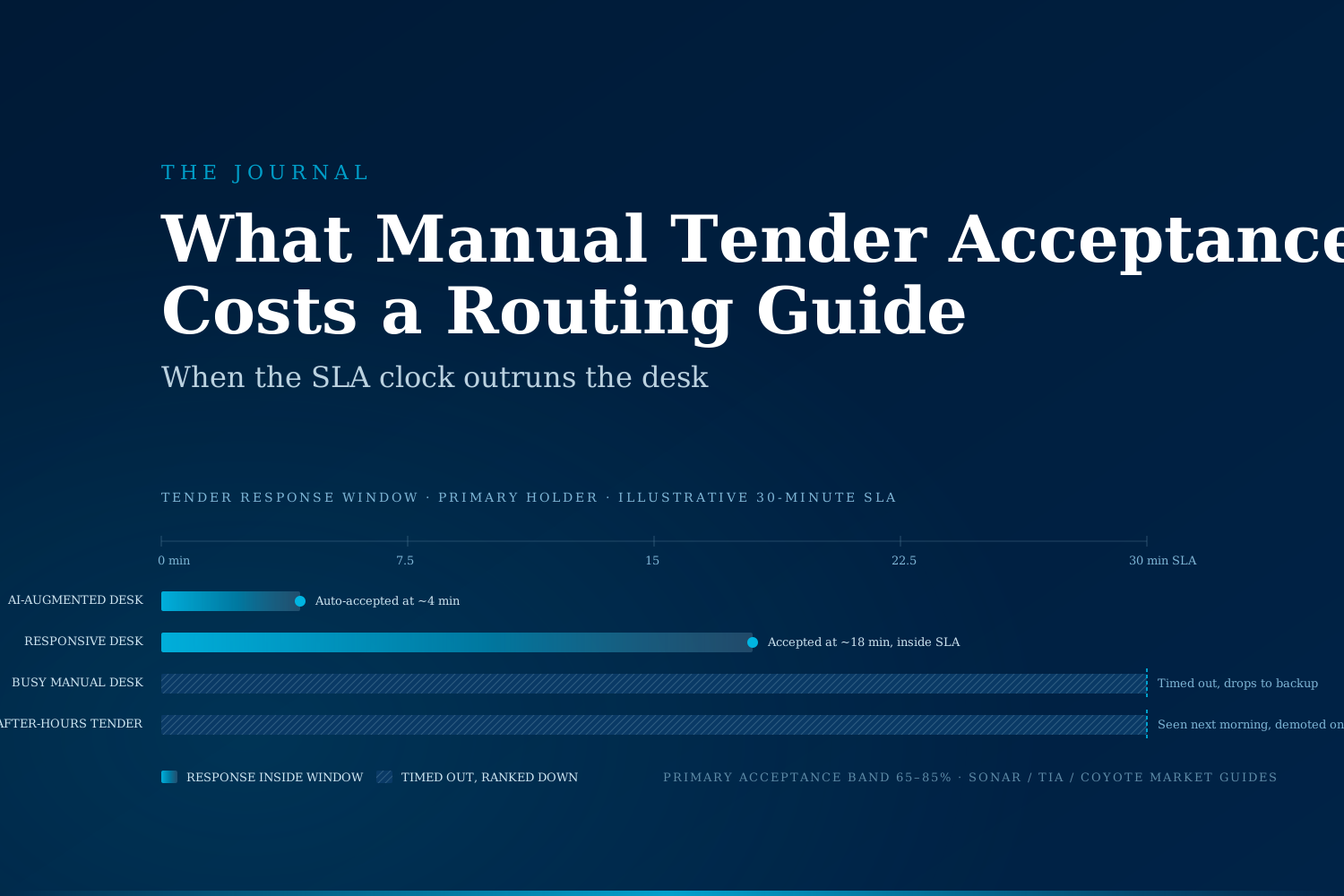
When a shipper sends a load tender to a brokerage's primary slot on a routing guide, the response window is often measured in minutes. Brokerages that screen and respond manually slip down the guide as response times drift, lose committed lane volume to backup carriers, and forfeit primary status on lanes they bid hard to win.
What is a routing-guide tender, and why does response time matter?
A routing guide is the ordered list of carriers and brokerages a shipper assigns to each lane, set during the annual or quarterly bid. The primary holder gets first call on every tender. If the primary accepts within the contracted response window, the freight is theirs. If they reject, time out, or respond late, the load drops to the backup, then the secondary, and onward down the guide.
Most enterprise shippers run tender response SLAs between 15 minutes and a few hours, depending on lane priority and mode. Some retail shippers tighten this further inside seasonal peaks. The mechanic is invisible from the outside, but it determines whether the brokerage actually realizes the committed lane volume it sold against in the bid.
Why does manual tender acceptance create drag?
A tender hits the TMS, the EDI inbox, or a load-board portal. Someone on the desk has to see it, pull the lane rate from the awarded book, check available capacity (or carrier coverage probability), confirm appointment fit, and accept. Each step is bounded by the brokerage's actual staffing.
The brokerage does not drop the lane because the desk is bad. It drops because the desk is human:
| Failure mode | What happens | Where the cost shows up |
|---|---|---|
| Tender arrives during a lunch hour, overnight, or weekend | No one accepts inside the window | Tender drops to backup, primary acceptance rate falls |
| Sales rep tied up on another account | Tender sits in the queue for 20 to 40 minutes | Response time SLA breached, shipper scorecard penalty |
| Capacity check requires multiple carrier calls before accepting | Decision lags the window | Brokerage rejects safely rather than gamble, lane volume drifts to secondary |
| Tender misrouted to a wrong inbox or rep on PTO | Days pass before notice | Shipper deprioritizes the brokerage on the next bid |
None of these are exotic. They are the everyday texture of an operating freight desk that has not automated the tender-acceptance loop.
What does the cost look like over a quarter?
Industry coverage of contract freight performance (FreightWaves SONAR data, TIA member benchmarks, Coyote Logistics market guides) points to three recurring patterns worth pricing in:
- Primary acceptance rates on healthy brokerage routing-guide positions tend to sit in the 65 to 85 percent range. Once a brokerage drops below the mid-60s on a lane, shippers begin demoting them in the next bid cycle.
- Tender response times are a leading indicator. SONAR's Outbound Tender Reject Index has historically been tracked alongside response times, because shippers feel slow responses before they feel rejections.
- Secondary and tertiary fallback rarely matches contract pricing. The shipper either takes a spot rate or activates a more expensive backup, then logs the gap. Multiple quarters of this and the lane goes out to rebid.
Translating to the brokerage P&L: on a primary lane awarded at, say, 12 loads a week at $1,800 revenue, a slip from 85 percent to 65 percent acceptance is roughly 2.4 loads a week walking away. Across a 25-lane book of business, that compounds into mid-six-figure annualized revenue exposure, before counting the harder-to-recover damage to the shipper relationship.
What changes when AI handles first-look on tenders?
The desk does not shrink, but the bottleneck moves. Instead of a rep watching the EDI inbox between calls, an AI-augmented workflow does the first pass on every inbound tender:
- Reads the tender against the awarded rate book and the lane profile.
- Checks carrier coverage probability from historical lane patterns.
- Auto-accepts the clean cases (in-rate, in-pattern, in-capacity) inside the SLA.
- Routes only the edge cases to a human (out-of-pattern weight, off-network destination, unusual accessorials, lane-rate exceptions).
What the shipper sees: response inside the contracted window, even at 2 a.m. on a Saturday. What the broker sees: a routing-guide position that holds through the quarter and a desk freed from inbox-monitoring duty.
We are not describing the build. The mechanics of EDI 990 response handling, awarded-book exception surfacing, and carrier-coverage modeling are non-trivial and depend on the brokerage's TMS, awarded book structure, and operating cadence. The point is what is possible: an acceptance rate that reflects the brokerage's actual capacity to cover the lane, not its staffing pattern during the tender's arrival window.
A different way to read the routing-guide scorecard
Brokerages tend to read their shipper scorecards through the rejection lens: "we rejected because capacity was tight." That is often true. But for desks that have not automated, a meaningful share of "rejections" are timeouts dressed up as rejections. The tender expired before the desk got to it.
Three signs the timeout half is bigger than the brokerage thinks:
- Tender response time averages drift up week over week, especially on Friday afternoons and Monday mornings.
- Acceptance rate falls more on long-haul tenders sent with multi-day notice than on same-day spot tenders, because long-notice tenders are harder to triage in real time.
- Quarterly business reviews surface responsiveness comments from the shipper before they surface pricing comments.
These are the patterns worth checking before the next bid cycle. The rebid is when the cost actually crystallizes: lanes lost, routing-guide demotions, and primary positions the brokerage spent twelve months earning.
First-look automation on tenders is narrow and well bounded — the kind of engagement the AI automation services menu is written around, where the scope is one decision and the acceptance criteria fit on a single page. The compounding effects are covered in OTIF penalties on retail freight, receiver appointment portals, and off-hours loads slipping through.
How does this compound across a bid cycle?
Routing-guide performance is sticky in both directions. A brokerage that consistently accepts inside the window for two or three quarters tends to be awarded more lanes, more weight, and better margin on the next bid. A brokerage that drifts on response time tends to see the opposite. Shippers, especially in retail and CPG, have moved toward awarding additional lanes to carriers and brokers who behaved well on the existing book, rather than running every lane to open RFP.
That means the cost of manual tender acceptance is not just the in-quarter loads that walked away. It is also the lanes the brokerage will not be invited to bid on next time, the harder-to-quantify reputation drag inside the shipper's logistics team, and the extra discounting the brokerage has to do on the next bid to win back what it used to hold. Those second-order costs rarely get attributed back to tender response time inside the brokerage, which is exactly why they keep recurring.
What this looks like on your operation
If your brokerage runs a routing-guide-heavy book and the tender desk currently lives inside an email queue or a TMS inbox with humans-in-the-loop on every tender, the cost is likely showing up in your acceptance rate report already. The harder question is what share of that cost is fixable inside the brokerage's existing TMS and rate-book setup, versus what would need a separate layer.
That is the question we run free automation audits to answer. We look at your tender flow, your awarded lane book, and where your desk actually loses minutes against the SLA, then give you a written read on what is worth automating and what is not. No commitment, no slide deck.
Sami Raza
Software Developer & Technical Author
Sami Raza builds AI automation for logistics, DTC, and construction operations teams at ApexifyLabs, and writes about the operational failures that automation is actually worth pointing at.