Cross-Border Freight: The Paperwork Dwell Brokers Absorb
A truck does not clear at the border. It clears in the hours before it, while the invoice, the manifest and the customs entry are still being emailed around.
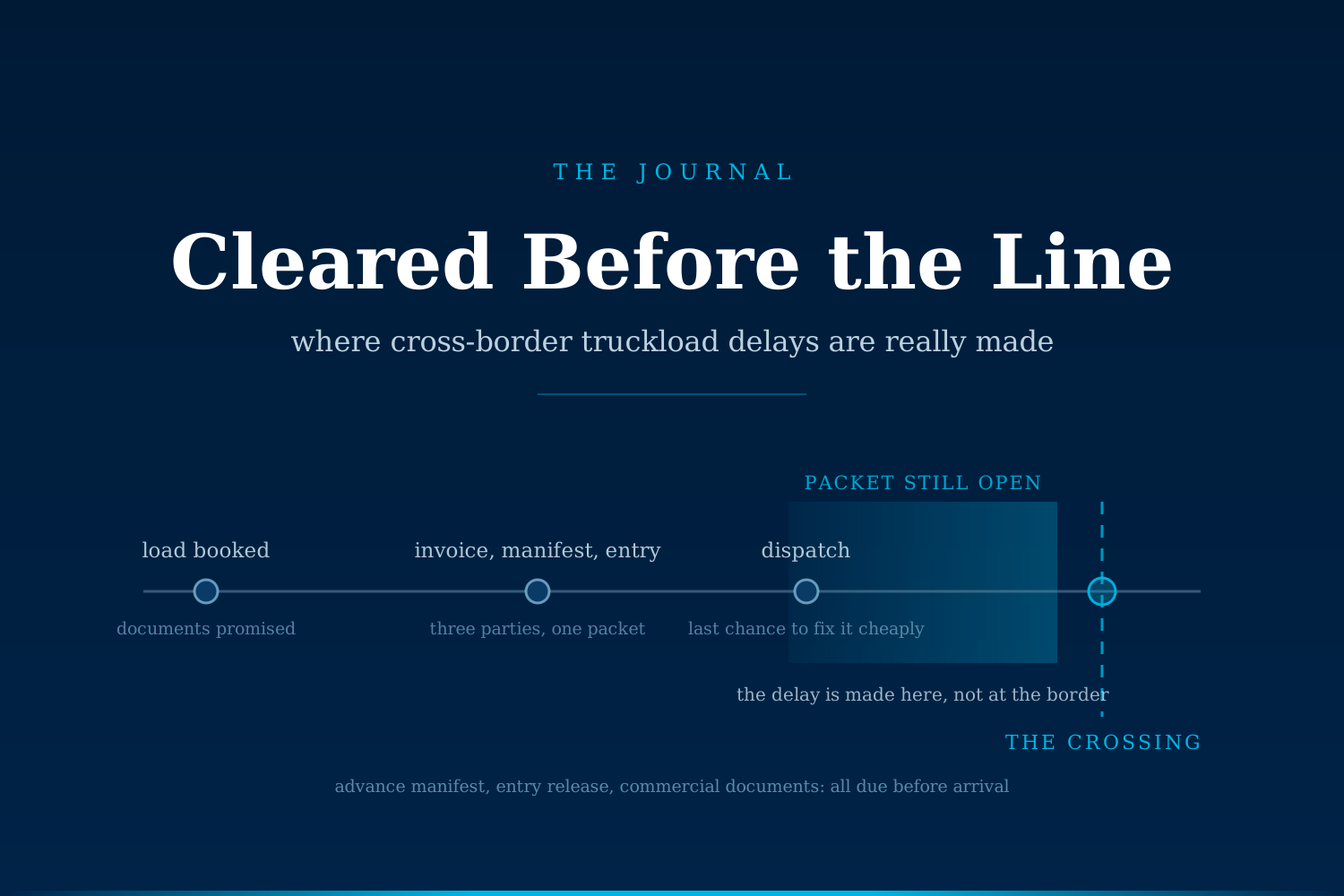
A cross-border truckload does not clear at the border. It clears in the hours before it, when the manifest, the customs entry and the commercial documents all describe the same shipment. When one of those pieces is late or inconsistent, the problem surfaces at the crossing, where the cheap fix has already expired and the delay lands on the brokerage.
What has to be true before a cross-border truck reaches the line?
Three things, assembled by three parties who do not share a system.
The carrier needs an electronic manifest transmitted in advance. Under U.S. Customs and Border Protection's ACE truck manifest rules, the filing has to reach CBP before the truck arrives, with a shorter window for FAST-approved carriers. Arrival is not supposed to be the first time the government hears about the load.
The importer's customs broker needs an entry filed and moving toward release, tied to the shipment by a reference the driver carries: PAPS for U.S.-bound freight, PARS for Canada-bound. Southbound into Mexico, the pedimento and the SAT Carta Porte complement carry the equivalent weight on the domestic leg.
And the commercial documents (invoice, packing list, certificate of origin where a USMCA claim is being made) need to agree with the entry on goods, value, and parties.
None of that is complicated. The complication is that a freight brokerage owns none of those filings and is still the party everyone calls when the truck sits.
Why does the chain break on the brokerage desk and not at the customs broker?
Because the brokerage is the only participant that can see every piece and the only one whose view of them lives in an inbox.
The volume makes this a standing condition rather than an occasional one. Bureau of Transportation Statistics TransBorder data consistently shows trucks moving the majority of U.S. surface trade value with both Canada and Mexico, which means cross-border truckload is a mainstream freight product, not a specialty. A mid-size brokerage with a handful of border lanes is running this document choreography several times a day.
The customs broker's job starts when they receive a complete, coherent packet. Everything before that point, chasing the shipper for a final invoice, noticing that the value changed after the packing list was issued, confirming the entry actually released, is unowned work that gravitates to whoever booked the load. It is rarely written down as a responsibility and it is almost never measured.
Where does the delay actually originate?
The failure is usually upstream of the border by many hours. Six origins account for most of it:
- Documents that arrive after dispatch. The shipper emails the final commercial invoice once the truck is already loaded, so the packet is being assembled against a moving deadline rather than before it.
- Values and descriptions that disagree. The invoice, the packing list and the entry describe the same goods slightly differently, and the discrepancy is only visible if someone compares all three side by side.
- An origin claim nobody confirmed. A USMCA preference is assumed on the rate but the certification is missing or unsigned, which turns a duty question into a hold.
- Entry status treated as fire-and-forget. The packet goes to the customs broker and nobody watches for release. The absence of news is read as good news until the driver reports otherwise.
- Reference mismatches at the truck. The driver carries a barcode or reference that does not match what was filed, which is a two-minute fix at the yard and a multi-hour one at the crossing.
- Delivery appointments set against border optimism. The receiver appointment is booked on a clean crossing. Border timing is a distribution, not a number, and a missed appointment often costs more than the crossing delay itself.
Each of these has an innocent explanation on any single load. Across a quarter of border volume, they behave like a fixed tax.
Manual border document handling vs an AI-assisted desk
The point is not to take customs judgment away from customs professionals. It is to stop making a human the only mechanism that notices a packet is incomplete.
| Step | Typical manual desk | AI-assisted desk |
|---|---|---|
| Packet assembly | Documents collected by email as they arrive | Required document set tracked per lane and per shipper, gaps visible while there is still time |
| Cross-document check | Invoice, packing list and entry compared by eye, when someone has a minute | Values, descriptions and parties checked against each other on receipt |
| Origin and preference claims | Assumed from the quote, confirmed if it comes up | Certification presence checked before the load is tendered, not at the line |
| Entry release status | Chased by phone when the driver is close | Status monitored against the load, silence treated as a signal |
| Driver references | Passed along in whatever form they arrive | Reconciled against the filing before the truck leaves the yard |
| Appointment setting | Booked on an expected crossing time | Booked against the actual packet readiness of that load |
| Exception discovery | At the crossing, from the driver | Hours earlier, from the document set |
The difference is not competence. It is where in the timeline the problem becomes visible: at a desk where it costs an email, or at a border where it costs a day.
What does one turned-back load actually cost?
More than the hours at the crossing.
Start with the arithmetic on the load itself. A brokerage running a $2,800 cross-border linehaul at 14% gross margin holds roughly $390 of gross profit. A layover, a rescheduled receiver appointment, or a carrier who wants to be made whole for a lost day can absorb most of that margin on its own, and the recovery conversation with the shipper is usually harder than the operational fix was.
Then the second-order costs, which are the ones that compound. Carriers who run border lanes track which brokers waste their time, and capacity on those lanes is not deep. Receivers who get pushed to a later appointment remember it in the next routing guide. And the rep who spent the afternoon on one stuck truck did not spend it covering the next three loads.
The pattern operators describe most often is not a catastrophic failure. It is a steady rate of loads that cross a day late for reasons that were knowable the previous afternoon.
Three checks worth running this quarter
A brokerage owner can size this exposure without starting a project.
- Packet completion time. For the last ninety days of border loads, compare when the last required document arrived to when the truck dispatched. If the last document routinely lands after dispatch, the desk is assembling packets under a deadline it did not set.
- Delay attribution. Pull every border load that crossed more than four hours behind plan and sort the cause into document issues, inspection, and congestion. Most desks assume inspection dominates. The document share is usually the surprise.
- Rep hours per border load. Ask two reps to log touches on cross-border loads for one week: emails sent chasing documents, calls to check release status, appointment reschedules. Multiply by border volume. That number is the recurring cost of a coordination job nobody was formally assigned.
Individually these are diagnostics. Together they tend to point at the same window: the twelve hours before dispatch.
What changes when the packet is complete before the truck moves?
The visible change is that crossings stop being events. The load leaves with a document set that has already been checked against itself, the entry status is known rather than assumed, and the exceptions that reach a human are the ones that genuinely need judgment: a classification question, a value correction, a shipper who has changed the order after the entry was filed.
The quieter changes matter more across a year. Reps stop spending afternoons as document couriers between a shipper and a customs broker. Appointment commitments to receivers become credible, because they are made against a load's actual readiness. Carriers who run border lanes start treating the brokerage as an easy place to haul, which is worth more on constrained lanes than a few points of rate. And the ops manager stops learning about incomplete packets from a driver sitting at the line.
This is a document coordination problem that presents as a customs problem. It gets diagnosed as border congestion, which nobody can fix, rather than as packet readiness, which is entirely fixable.
The pitch
If cross-border loads are crossing late for paperwork reasons, or a rep is functionally the integration layer between shippers and customs brokers, the hours are almost always sitting in the window before dispatch rather than at the crossing itself. We map where the document chain actually runs, how much of it is pure movement of information, and which parts nobody should be doing by hand, without touching a single customs decision that belongs to a licensed broker.
If that sounds like your border lanes, we run a completely free automation audit for freight brokerages. No commitment, no slide deck, just an honest read on where the hours go. → Book the audit
Sami Raza
Software Developer & Technical Author
Sami Raza builds AI automation for logistics, DTC, and construction operations teams at ApexifyLabs, and writes about the operational failures that automation is actually worth pointing at.