DDP vs DAP Shipping: The DTC Cross-Border Margin Story
Manual HTS coding and stale duty rate tables push landed cost wider than the P&L shows for cross-border DTC brands. Here is what changes when AI runs the desk.
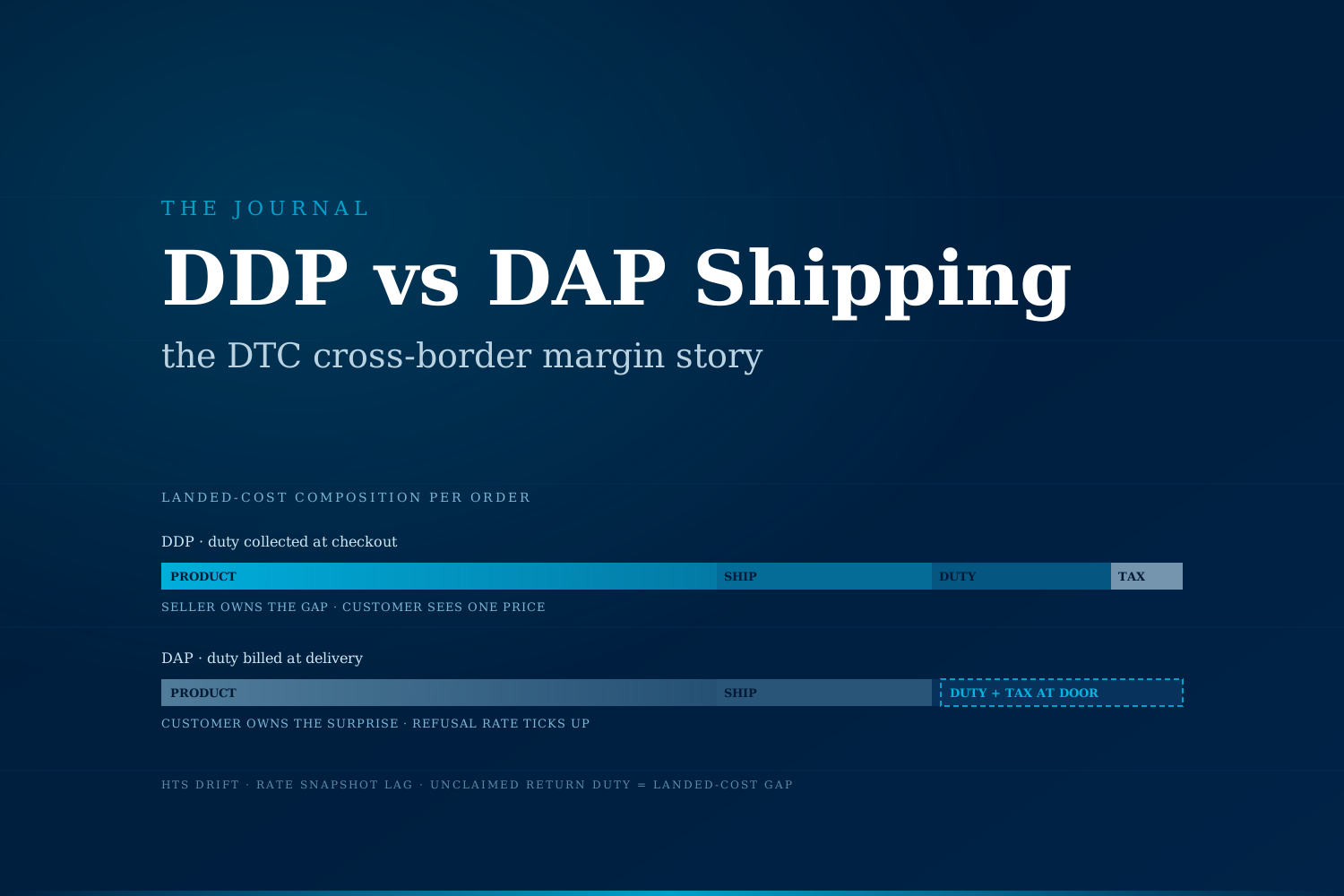
Cross-border DTC brands shipping DDP absorb duty and taxes into the sale price, while DAP passes those costs to the customer at delivery. On $2M+ order volumes, manual HTS classification and reconciliation leaves margin on the table both ways: understated duties get billed back, overstated duties overprice the SKU, and delivery experience swings on which model the brand chose. AI-assisted duty prediction closes the gap before the order ships.
What is DDP shipping, and what is DAP?
DDP (Delivered Duty Paid) and DAP (Delivered at Place) are Incoterms that decide who pays customs duties and import taxes on a cross-border order. Under DDP, the seller collects estimated duties at checkout and clears customs on the buyer's behalf. Under DAP, the seller ships internationally and the buyer is billed for duties by the carrier or customs broker at delivery.
For a DTC brand, the choice shows up in three places: the checkout page, the P&L, and the CX inbox. According to a joint FedEx and Forrester study on cross-border commerce, unexpected fees at delivery are one of the top reasons for cross-border refusals and returns. DDP removes the surprise. DAP keeps sticker prices lower but hands the surprise to the shopper.
Why does manual duty determination break at DTC volume?
Once a brand crosses a few hundred international orders per month across more than two destination countries, the manual classification workflow starts leaking margin in ways that are difficult to attribute. Every SKU needs an HTS or HS commodity code. Every destination has its own duty and tax schedule. De minimis thresholds change (the US $800 threshold, the EU EUR 150 IOSS ceiling, and the UK GBP 135 line have all seen revision or scrutiny in recent trade cycles). Trade preference eligibility (like USMCA on Mexico or Canada shipments) is often left on the table because ops teams do not have time to check.
The result is a persistent gap between the duty the brand estimated, the duty the destination country actually assessed, and the duty the customer either saw at checkout or was billed later. On DDP orders, that gap gets absorbed into landed cost. On DAP orders, that gap becomes a CX ticket and a refusal.
What breaks, specifically?
Common failure modes on a manually operated cross-border DTC desk:
- HS/HTS code drift. SKUs get coded once at launch, then reused. When the product spec changes (fiber blend, plating, dosage), the code often does not. Misclassification carries reassessment risk on both sides of the border.
- De minimis threshold blindness. A shipment structured just above a threshold pays duty the brand could have avoided; a shipment structured just under can pass duty-free. Manual desks rarely see the threshold clearly at pack time.
- Duty pre-collect drift. DDP checkouts quote duty using a snapshot rate table. When the underlying rate changes, the checkout still quotes the old number. The brand eats the difference.
- Return duty recovery gets skipped. Cross-border returns generate a duty refund claim from customs. The claim window is short and paperwork-heavy, and most DTC brands never file. That duty stays with the destination government.
- Preference program leakage. USMCA, GSP, and other preference eligibility requires a certificate of origin or supplier declaration on file. When the ops team is buried, the certificate does not get generated and the shipment pays full duty.
Before: what the manual cross-border desk looks like
A typical mid-size DTC brand doing $10M to $30M in revenue with 15% international volume runs the desk something like this:
- An ops associate maintains a spreadsheet of HS codes indexed by SKU, updated ad hoc.
- Duty and tax rates are pulled from a rate table refreshed quarterly.
- The Shopify or WooCommerce checkout uses a third-party duty pre-collector configured against that snapshot.
- International orders that fail duty pre-collect fall to a manual queue. An associate emails the customer to confirm the destination address and duty responsibility.
- Refused packages come back with restocking, return shipping, and unrecovered duty already counted against margin.
- Cross-border chargeback disputes involving "duties not disclosed" go to a CS lead who resolves them with goodwill refunds.
Nothing in that flow is unreasonable at 200 international orders per year. At 2,000, the compounding cost is not the labor. It is the invisible gap between what was collected, what was owed, and what was refundable.
After: what changes when duty determination is AI-assisted
An AI-augmented cross-border desk shifts the leverage upstream. Instead of maintaining an HS code spreadsheet, the brand runs a product-description-to-code classifier over the catalog on a schedule and on every SKU change. Instead of quoting duty from a snapshot, the checkout queries a live rate service that also flags de minimis threshold hits. Instead of skipping return duty recovery, the desk generates the claim automatically when a return arrives back at the origin warehouse.
The visible outcome for the operator: fewer refused packages, cleaner disputes, and a landed-cost number in the P&L that matches reality. The invisible outcome is the one that matters. Duty gaps stop being an unowned line item and start being a tracked KPI.
Manual vs AI-augmented cross-border ops
| Dimension | Manual desk | AI-augmented desk |
|---|---|---|
| SKU classification | Spreadsheet, launch-time, drifts | Continuous, description-driven, re-checked on change |
| Rate table | Quarterly snapshot | Live, per-destination |
| De minimis thresholds | Rarely visible at pack | Flagged in the order routing decision |
| Return duty recovery | Skipped | Auto-claimed within window |
| Preference programs | Left on table | Certificate assembled when eligible |
| DDP quote accuracy | Drifts with rate changes | Stays live |
| Refused package rate | 3 to 7% typical | Trends toward 1 to 2% |
| CS "duties not disclosed" tickets | Recurring | Rare exception |
Refused-package benchmarks vary by category, but industry surveys of cross-border retail (Global-e, Zonos, and DHL trend reports) consistently report that visible, accurate duty presentation at checkout is the single largest lever on refusal rate.
Where does the AI actually earn its keep?
Three areas do most of the work. Product-to-code classification handles the volume that no human wants to touch weekly. Live rate lookup handles the drift that manual desks cannot see. Return duty recovery handles the money that manual desks leave with foreign governments. The rest is orchestration: making sure the classifier's output flows into the checkout, that the checkout's quote flows into the label, and that the label's duty flows into the accounting entry cleanly enough to reconcile.
None of that requires the brand to become a customs expert. It requires the workflow to stop treating cross-border as an exception and start treating it as a first-class fulfillment path.
Signs the manual desk is costing more than it looks
If any of the following are true on your cross-border operation, the gap is likely wider than the P&L shows:
- Landed-cost variance greater than 5% between quoted and assessed duty on DDP orders.
- Refused-package rate above 3% on DAP orders to the EU or UK.
- No return duty claim filed in the last twelve months.
- HS codes for the top 50 international SKUs last reviewed more than a year ago.
- CS receiving more than a handful of "duties not disclosed" tickets per month.
Each of those is a symptom of the same underlying problem. The desk is running manually against a workflow that stopped fitting the volume.
What this article deliberately does not cover
There is a temptation to publish the classifier prompt, the rate service integration recipe, the exact return-duty claim workflow. That is not what a mid-size DTC brand needs from an article. Those are configuration details that shift with carrier, geography, and tax regime. What the brand needs is a clear picture of where the money is going, and a partner who has already assembled the components. The delta between reading about it and running it is the entire point of hiring for it.
Ready to see the gap on your own desk?
If your international volume has grown past the point where the spreadsheet still fits, we run a completely free automation audit for DTC ops teams that want a second opinion before committing to anything. No slide deck, no pressure. → Book the audit
Sami Raza
Software Developer & Technical Author
Sami Raza builds AI automation for logistics, DTC, and construction operations teams at ApexifyLabs, and writes about the operational failures that automation is actually worth pointing at.