Empty Miles Are a Brokerage Problem, Not a Carrier One
The reload that would have filled a truck's empty leg is usually lost on the broker side, in the two hours after delivery when the driver is still deciding.
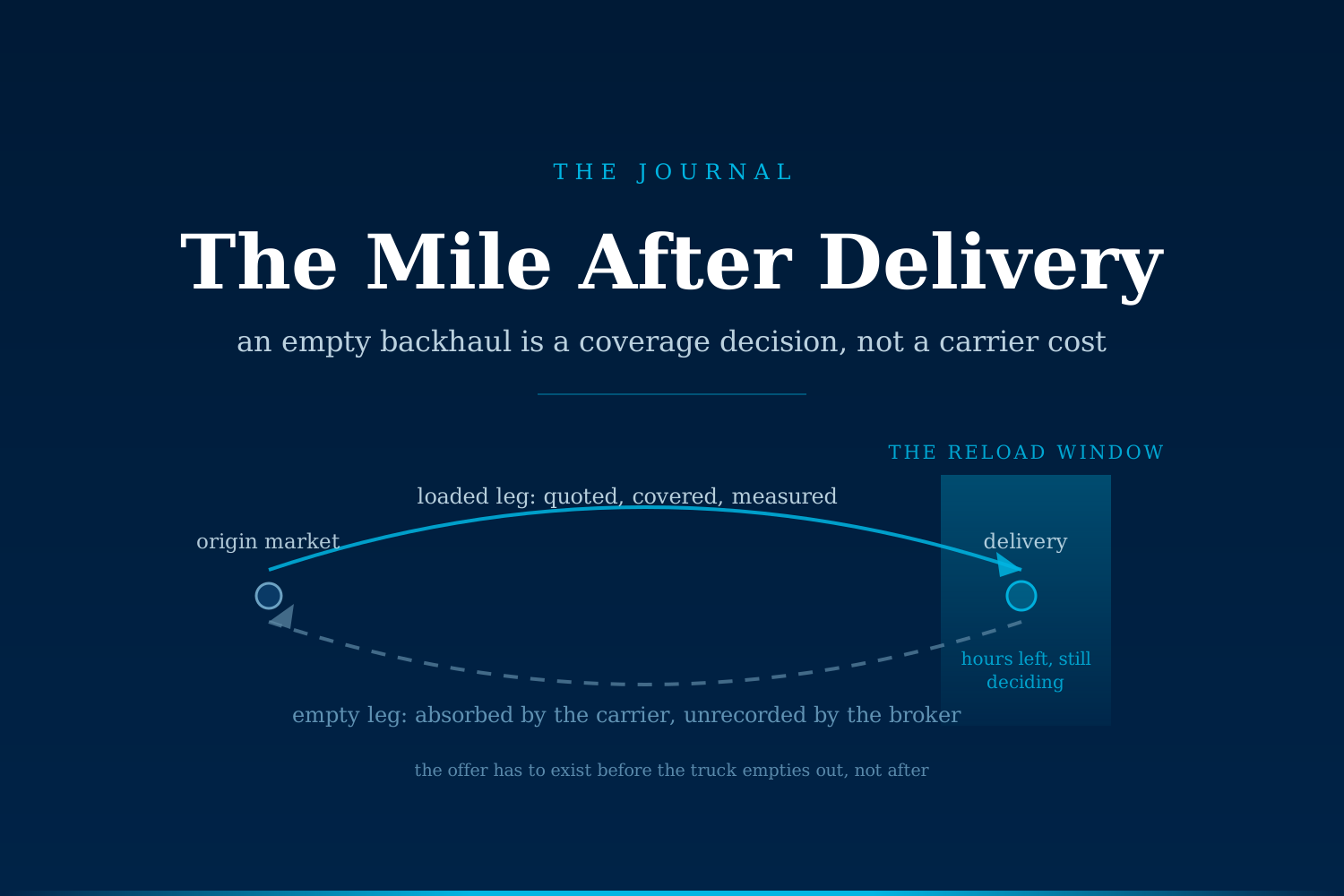
Empty miles get filed as a carrier cost, so brokerages rarely price them. But the reload that would have filled them is usually lost on the broker side, in the short window between a driver's delivery appointment and the moment they commit to someone else's freight. That window is a coverage problem, not a trucking one.
What counts as an empty mile on a brokered load?
Any mile a truck runs under dispatch with nothing revenue-generating on the trailer. The obvious one is the deadhead into a pickup, which usually gets negotiated because it is visible before the load is booked. The expensive one is the mile after delivery, when the driver still has hours available, sits in a market the brokerage covers regularly, and rolls out toward home or a load board with nothing arranged.
Freight network research and carrier cost studies have consistently put empty running somewhere in the mid-teens to around twenty percent of total truck miles. The precise figure moves with the market and with who is counting. The direction does not: a meaningful share of the miles a truck runs earn nothing, and the cost of running them does not fall just because the trailer is light.
That cost is knowable rather than theoretical. ATRI's Analysis of the Operational Costs of Trucking put the average marginal cost of operating a truck at $2.27 per mile in 2023, covering fuel, driver wages, maintenance, insurance and equipment. On that basis a 250 mile repositioning leg is roughly $570 of genuine spend against zero revenue, and a carrier who runs it twice a week prices that expectation into the next rate they quote you.
Brokerages read all of this as a line on someone else's P&L. It is, on the day. It arrives on the brokerage's own numbers later and in a different currency: as rate, as reluctance, as capacity that answers a different phone next quarter.
Why does the reload window close so quickly?
Because the decision belongs to a driver working against a clock, not to a broker working through a queue.
Under FMCSA hours of service rules, a property-carrying driver has 11 hours of driving inside a 14 hour on-duty window, with a weekly ceiling on top. A driver who finishes unloading at 11am is not deciding what to haul next week. They are deciding what to do with the hours they have left today, from wherever the receiver happens to be, and they are deciding it in a window measured in tens of minutes.
On most brokerage desks, nobody is holding that window. The rep who booked the outbound is measured on the outbound. Once the load delivers, it closes, the POD gets chased, and attention moves to tomorrow's coverage. The truck that just emptied out in one of your best origin markets becomes, administratively, someone else's truck. The reload is nobody's assignment, so it happens when a rep happens to remember the equipment, which is to say it happens sometimes.
This is a genuinely hard problem to hold in a human head. Knowing which trucks are delivering in the next four hours, where, with how many hours left, against which open freight, is a live picture that changes every few minutes across a whole board. Reps are not failing at it. They are being asked to keep a moving inventory in memory while doing three other jobs.
What does one unfilled backhaul actually cost?
More than the empty leg, and in places the brokerage does not have a field for.
| Cost | Who absorbs it first | When the brokerage feels it |
|---|---|---|
| Empty miles after delivery | Carrier | In the next quoted rate on that lane |
| Driver hours burned repositioning | Carrier | As reluctance on the outbound you actually need covered |
| Margin on a reload never booked | Brokerage | Never, because it was never a record |
| Rep time re-sourcing capacity later | Brokerage | As coverage cost on an unrelated load next week |
| Lane depth with that carrier | Both | When the lane tightens and the call does not get returned |
The third row is the one that never gets measured. A load that was never quoted leaves no trace in any system. There is no lost-opportunity report, no exception, no angry email. It is the cleanest kind of cost there is: entirely invisible, entirely recurring.
The arithmetic is worth running on your own numbers rather than ours. Public brokerage segment reporting has generally shown truckload gross margins in the low-to-mid teens, so a $2,200 reload at 14 percent holds roughly $308 of gross profit. A desk that misses five plausible reloads a week is passing on something in the neighborhood of $1,500 of weekly gross profit on freight it was already positioned to move. Annualized, that is a hire.
And that is only the direct half. The half that compounds is the rate you pay next time, on the lane where you needed that carrier most.
Manual reload coverage vs an AI-assisted desk
The distinction is not intelligence. It is which facts are in front of a rep at the moment the driver is still deciding.
| Moment | Typical manual desk | AI-assisted desk |
|---|---|---|
| Truck approaching delivery | Rep is working tomorrow's outbound; the load is functionally closed | Delivering equipment is surfaced with market, timing and remaining hours |
| Reload discovery | Depends on whether someone remembers the truck | A standing view of delivering trucks against open freight |
| What gets offered | Whatever is on a board at that minute | The brokerage's own open loads and shipper commitments first |
| Carrier contact | Made if a rep has a gap | Made inside the window while the driver is still choosing |
| If nothing matches | Carrier finds freight elsewhere and the brokerage never knows | The gap is visible as a lane pattern, not a one-off miss |
| Measurement | Reloads happen by accident and are never counted | Reload rate by lane is a number the desk can actually see |
Notice what is not in the right-hand column. Nothing here replaces a rep's judgment on which carrier to trust, what a lane is worth, or when to walk away from a rate. The change is upstream of judgment: it is about the truck being on the screen at all, at the hour when offering it something is still possible.
Why does this look like a carrier problem from the broker's side?
Because every visible symptom sits on the carrier's side of the invoice.
The carrier is the one who ran empty. The carrier is the one who raised their rate on your lane. The carrier is the one who stopped answering during produce season. From the brokerage's chair, that reads as market conditions, or as a carrier getting greedy, or as capacity tightening. It rarely reads as a series of reload offers that a desk was never in position to make.
Carriers experience the same relationship in reverse, and they are explicit about it. Brokers who reload them reliably are worth taking a slightly lower outbound rate from, because the round trip is what pays. Brokers who do not are one-way freight, priced accordingly. Most mid-size brokerages are being sorted into one of those two categories continuously, without ever seeing the sorting happen.
Three checks worth running on last quarter's loads
You can size this without starting a project.
- Reload rate. For the last ninety days, count deliveries where the same carrier took another load from you within 24 hours, in any lane. Most desks guess high before they count. The gap between the guess and the count is the size of the opportunity.
- Market overlap. Put your top ten delivery markets beside your top ten origin markets. Where they overlap, freight you already control was sitting near equipment you already had. That overlap is not a hypothesis about the market; it is your own board.
- Rate spread by relationship. Compare what you pay carriers who haul for you repeatedly against what you pay one-and-done carriers on comparable lanes. The spread is the price of being one-way freight.
Individually these are diagnostics. Together they usually point at the same two-hour window nobody owns.
What changes when the reload conversation starts before delivery?
The visible change is that trucks stop disappearing at the receiver's gate. Equipment that is about to empty out in a market you cover is something the desk knows about while it can still act, and the reload offer goes out during the window instead of after it.
The quieter changes matter more across a year. Reps stop re-sourcing capacity from a cold start on lanes where they already had a truck. Head-haul rates soften with carriers who have started counting on the round trip, which is worth more on constrained lanes than a rate negotiation ever is. Reload rate becomes a number an ops manager can look at by lane, so the question shifts from whether reloads are happening to why they are not happening in one particular market. And the carriers who like working with you tell other carriers, which is the only capacity strategy that gets cheaper over time.
None of that requires new freight. It requires knowing about a truck two hours earlier than the desk currently does.
The pitch
If your reload rate is a number nobody has counted, or if reps are finding out about empty equipment from a carrier calling to ask what you have, the money is almost always sitting in the window before delivery rather than in the rate negotiation after it. We map where that window is actually being lost on a specific desk, how much of the work is pure information movement, and which parts should stop depending on someone remembering a truck.
If that sounds like your board, we run a completely free automation audit for freight brokerages. No commitment, no slide deck, just an honest read on where the reloads are going. → Book the audit
Sami Raza
Software Developer & Technical Author
Sami Raza builds AI automation for logistics, DTC, and construction operations teams at ApexifyLabs, and writes about the operational failures that automation is actually worth pointing at.