Missed Factoring Notices Put Brokers on the Hook Twice
Carriers change factoring companies constantly. When the assignment notice never reaches the payee record, a brokerage can be asked to pay the same load a second time.
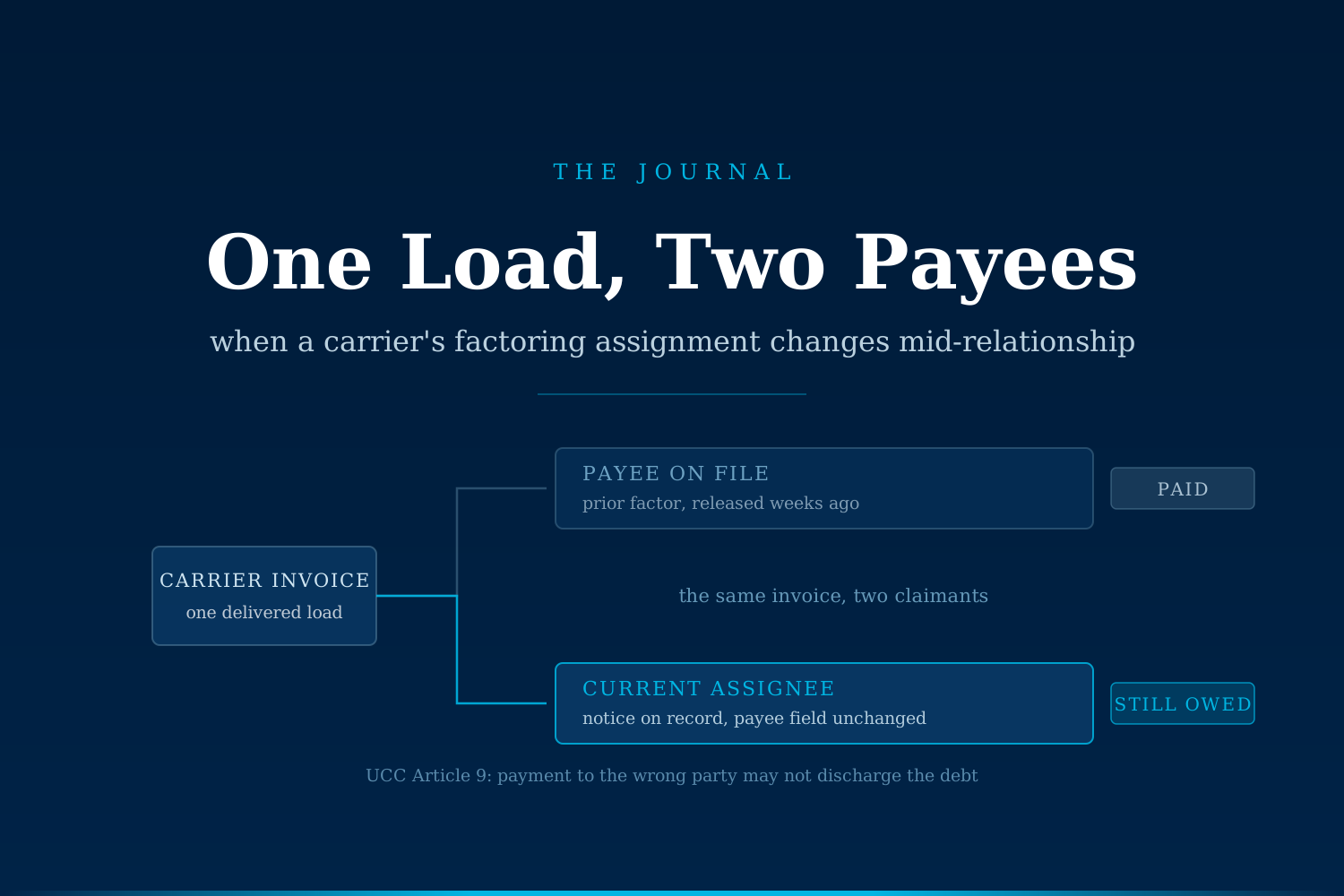
When a carrier switches factoring companies mid-relationship, the broker's payment obligation follows the new assignment, not the old remittance record. Under UCC Article 9, paying the wrong party after a valid notice does not discharge the debt, so the brokerage can be asked to pay the same load a second time.
What is a notice of assignment in freight factoring?
A notice of assignment (NOA) is the document a factoring company sends a broker to say that a carrier has assigned its receivables to the factor, and that payment for that carrier's loads must now be remitted to the factor rather than to the carrier.
The legal weight behind it comes from UCC Article 9, section 9-406, which governs discharge of an account debtor. Legal commentary on the section is consistent on the practical rule: once a payer receives an authenticated notification of assignment, paying anyone other than the assignee may not discharge the obligation, and the assignee can come back for the money. Law firm guidance on handling these notices is titled, more or less literally, do not pay that invoice twice.
The mirror image matters just as much. When a carrier leaves a factor, the outgoing factor issues a release letter, and the incoming factor issues a fresh NOA. A brokerage's payee record has to reflect both documents, in the right order, effective from the right date. Two pieces of paper from two companies that have no relationship with each other, arriving days apart, describing the same carrier.
Why does this show up so often on mid-size brokerage desks?
Because of who the carriers are. FreightWaves reporting on FMCSA registration data notes that roughly nine in ten US motor carriers operate ten trucks or fewer, and factoring is the standard cash bridge for that segment. Carriers in that population move between factors for advance rates, fee structures, or service, and they do it without telling the broker directly, because the factor handles the notice.
A brokerage running a few hundred active carriers will therefore see assignment traffic more or less continuously. The documents arrive as PDF attachments from a company the brokerage has never done business with, into whatever inbox the factor happened to have on file: a general AP address, a carrier rep, a compliance queue, occasionally a fax line nobody has checked since the last audit.
None of that is anyone's fault. It is simply an inbound document stream that arrives on someone else's schedule and has to change a field in a system of record before the next settlement run.
Where does the assignment notice actually get lost?
On most desks, the failure is not a decision. It is a handoff. Six points account for the majority of misdirected payments:
- Wrong destination. The notice lands with a carrier rep or in a shared inbox rather than in the queue that owns the payee record, and it is read as information rather than as an instruction to change something.
- In-flight loads. The notice arrives while loads are already tendered, delivered, or invoiced. Whether those loads pay to the old or new party depends on the effective date, which requires someone to actually read it.
- Out-of-order documents. The release letter from the outgoing factor and the NOA from the incoming factor arrive days apart, sometimes in reverse order. The carrier's payee status between those two dates is genuinely ambiguous until someone reconciles them.
- The carrier's own paperwork disagrees. Carriers frequently keep sending invoices with their direct remit-to details printed at the bottom, which is exactly the instruction UCC 9-406 says the broker cannot follow once a notice is on record.
- The change lives in a document, not in the record. The PDF is filed correctly in the carrier folder and the pay-to field is never touched. The file is right and the payment is still wrong.
- Entity mismatch. The notice names a legal entity, the carrier record carries a DBA, and the MC number appears in one of the two. Name-based matching quietly misses.
Manual payee management vs an AI-assisted settlement desk
The goal here is not to remove anyone's judgment from carrier payments. It is to stop asking a human to be the durable link between an inbound PDF and a field in the pay system.
| Step | Typical manual desk | AI-assisted desk |
|---|---|---|
| Notice arrives | Lands in a shared inbox, read by whoever is on AP that day | Inbound document classified on receipt and attached to a carrier record |
| Identity matching | Matched by company name; DBA and entity mismatches slip through | Matched on MC and DOT identifiers, name mismatches raised as exceptions |
| Release vs new NOA | Two letters filed separately, effective dates read by eye | Effective dating tracked, conflicting instructions surfaced before payment |
| Payee of record | Remit-to updated in the pay system when someone remembers | Payee state derived from the current assignment record, not from memory |
| In-flight loads | Already-invoiced loads keep the old remit-to by default | Loads tendered before the change flagged for a deliberate decision |
| Pre-payment check | Large payments spot-checked, routine ones assumed correct | Every settlement run checked against current assignment status |
| Error discovered | When the factor calls, often 30 to 90 days later | At the point of payment, before funds leave |
The difference is not accuracy in the abstract. It is when the error becomes visible: before the money moves, or after a factor's collections team opens a file.
What does one misdirected payment actually cost?
More than the duplicate. A brokerage that pays the released factor and is then held to the current assignment carries several costs at once.
The duplicated payment itself is the headline, and it is rarely small. The arithmetic is unforgiving: on a $2,000 linehaul at a 15% gross margin, a single duplicated payment consumes the gross margin on roughly seven comparable loads. Recovery from the carrier is possible but uncertain, and it is least likely in exactly the situations where these errors cluster, which is carriers in financial transition. Then there is the internal time, which lands on a settlement team that did not create the problem, and the relationship cost with a factor whose approval decisions influence whether that brokerage stays easy to haul for.
Industry legal commentary is blunt that the account debtor bears this risk, which is the part that surprises operators most. The broker did not choose the factor, was not party to the assignment, and is still the one who pays twice.
Three checks worth running this quarter
A brokerage owner or controller can size this exposure without a project.
- Latency between notice and record. Pull every carrier whose payee changed in the last twelve months. Compare the effective date on the assignment document to the date of the first payment actually sent to the new party. The spread is the exposure window, repeated across the carrier base.
- Documents received versus records changed. Count inbound assignment and release documents against carrier payee updates over the same period. If notices meaningfully exceed record changes, some are sitting unapplied right now.
- Recovery history. Look at misdirected or duplicated carrier payments over 24 months: how many, total dollars, how much was actually recovered, and how long recovery took. The unrecovered share is the real annual cost line, and it is usually the first time anyone has totalled it.
Each check has innocent explanations on its own. Together they tend to point at the same handoff.
What changes when payee status is always current?
The visible change is that settlement stops being an act of trust. The pay run reflects the current assignment for every carrier on it, and the exceptions that need a human are the genuinely ambiguous ones: an entity mismatch, a release without a successor notice, a load delivered inside the changeover window.
The quieter changes matter more over a year. AP staff spend their time on judgment rather than on reading third-party letters and retyping remit-to details. Carrier reps stop being an accidental part of the finance control path. Factors experience the brokerage as a reliable payer, which affects how readily they approve invoices against that broker's credit, which in turn affects how willing small carriers are to take its freight. And the controller stops discovering payment errors through someone else's collections call.
This is a document-control problem before it is a finance problem. It behaves like a compliance issue, it gets funded like an annoyance, and it settles like a loss.
The pitch
If a brokerage is absorbing occasional duplicate carrier payments as a cost of doing business, or the settlement team is manually verifying remit-to details before every pay run, the inbound document path is usually where the time and the exposure both sit. We map where assignment notices actually land, how long they take to reach the payee record, and which of those steps are pure document movement, without changing a single control the finance side depends on.
If any of this looks like your settlement desk, we run a completely free automation audit for freight brokerages. No commitment, no slide deck, just a clear read on where the exposure is. → Book the audit
Sami Raza
Software Developer & Technical Author
Sami Raza builds AI automation for logistics, DTC, and construction operations teams at ApexifyLabs, and writes about the operational failures that automation is actually worth pointing at.