Why Off-Hours Loads Slip Through Mid-Size Freight Brokerages
Most mid-size brokerages staff Monday to Friday, seven to six. Carriers, shippers, and problems do not. Here is where off-hours coverage actually costs.
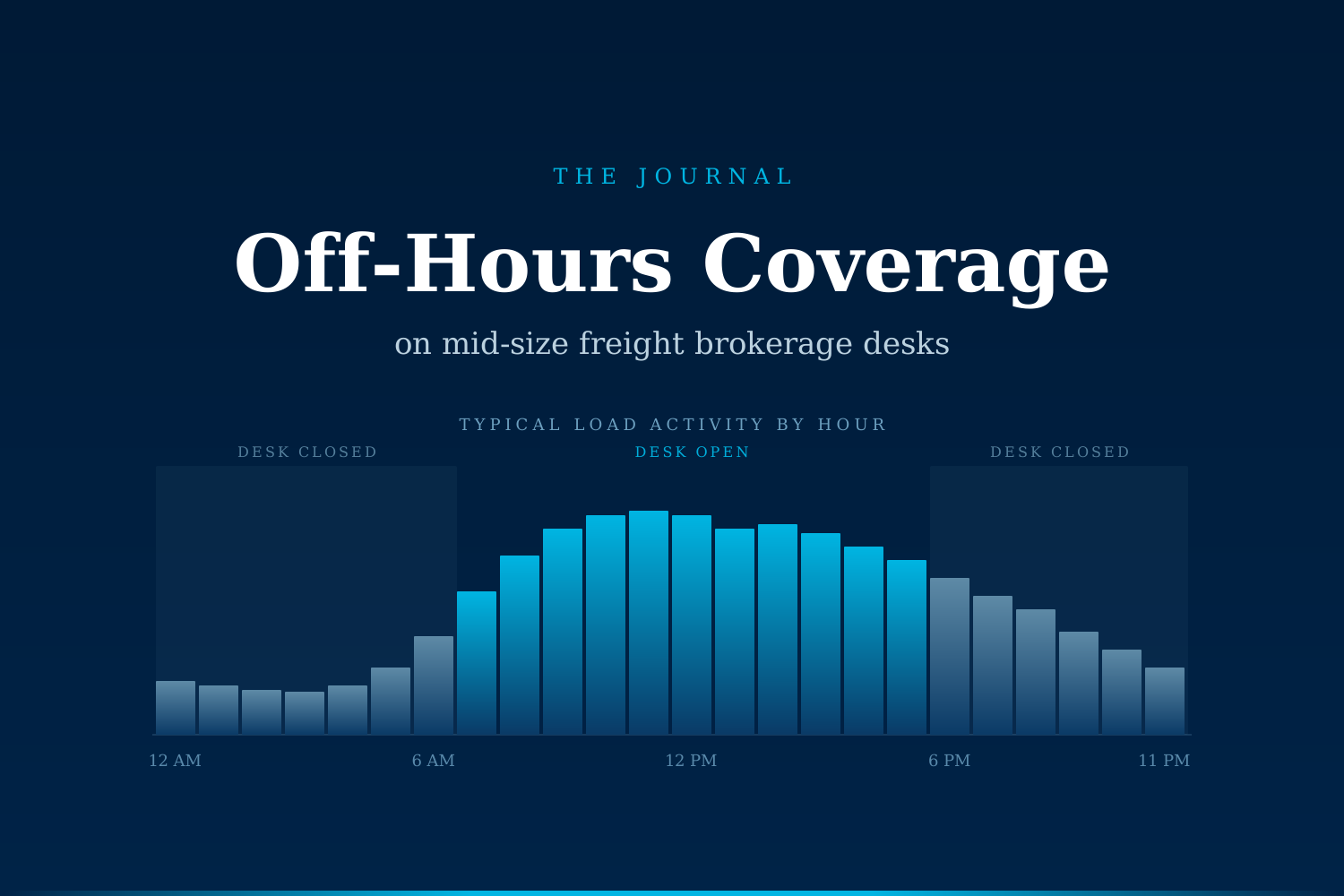
Most mid-size freight brokerages staff a Monday to Friday, seven to six desk. Carriers, shippers, and load boards run around the clock. The result: loads posted at 8 PM sit unclaimed, quote requests from West Coast shippers go stale by morning, and problem-solve calls hit voicemail. That window is measurable, and closing it changes the numbers on the desk.
What counts as off-hours on a freight brokerage desk?
For a typical mid-size US brokerage running on Central or Eastern time, "off-hours" covers three distinct windows:
- Evenings (6 PM to 10 PM local). West Coast shippers are still active. Carriers post trucks after settling for the day. Load boards see heavy churn.
- Overnight (10 PM to 6 AM). Team drivers move loads; problems on active shipments (breakdowns, HOS violations, late dispatches) surface here.
- Weekends and holidays. Reefer freight keeps moving, e-commerce peak volumes stack up, and retail delivery windows squeeze.
Add all three together and roughly two-thirds of the calendar sits outside standard staffing. The American Trucking Associations reports that trucks moved 72.7% of US freight tonnage in 2022, and a meaningful share of that tonnage does not respect business hours.
Why do so many loads slip after 6 PM?
The pattern repeats on desk after desk. It rarely comes down to one broken thing, it is a compounding cascade of small delays that only compound after the desk closes.
A shipper drops an RFQ at 7:12 PM asking for a Wednesday morning pickup. By the time the desk sees it at 7:00 AM the next day, two competing brokerages have already quoted. The shipper has awarded. That lane, for that quarter, is gone. Multiply that by the number of shippers who send late RFQs (in a brokerage's book of 60 to 200 accounts, this is not rare) and the pattern becomes real revenue.
The same dynamic plays out on the carrier side. A driver's dispatcher posts a truck available Tuesday morning ex-Dallas at 9 PM Monday. By Tuesday at 7 AM, that truck has been booked, or the driver has committed to a run through another broker. A brokerage that could have covered its own load with that carrier now pays a spot-market premium to find a replacement.
Freight moves in windows, and windows close. DAT and industry tracking consistently show that spot rates and capacity availability shift meaningfully inside 12-hour cycles, especially in tight lanes and around weather events.
What does an off-hours coverage window actually cost?
The cost is spread across five line items. None of them show up neatly on a P&L labeled "off-hours." Together, they explain why two brokerages of similar size can post very different net-per-load numbers.
| Cost category | What it looks like on the desk | Where it hits the P&L |
|---|---|---|
| Lost RFQs | Late-evening quote requests seen next morning, already awarded | Revenue |
| Late tender acceptance | Auto-tenders from routing guides expire before the desk sees them | Revenue and shipper scorecard |
| Missed capacity | Trucks posted evening or weekend, gone by Monday | Cost per load (higher spot buy) |
| Detention accrual | Driver at receiver Sunday afternoon, no one to negotiate live | Uncollected accessorial revenue |
| Service failures | Overnight breakdowns, HOS issues, wrong-address problems left until morning | OTIF penalties and shipper churn |
Industry post-mortems on lost accounts routinely surface "we could not reach you" and "your quote came late" as top reasons a shipper stops sending freight. Neither one is a pricing problem. Both are coverage problems.
Why is a night dispatcher not the answer on its own?
Every brokerage of size has considered it. Some have tried it. A few make it work. Most quietly wind it back after two or three quarters. The math is harder than it looks:
- One night dispatcher covers one desk, not five. A four-person daytime desk becomes a one-person overnight desk, and the coverage per lane drops proportionally.
- Talent is scarce and expensive. Experienced brokerage staff who will work nights command a premium, and turnover in the seat is high.
- The workload is spiky, not steady. An overnight seat can be idle for 90 minutes, then flooded for 20. Human attention does not scale to that curve.
- Training compounds. A night dispatcher who is not deeply steeped in your customer accounts will make judgment calls a senior day broker would not.
The result: a night dispatcher solves the "phone rings and no one picks up" problem, but rarely solves the "we missed the RFQ" or "we missed the truck posting" problem. Those require scanning, watching, and near-instant response, which is where the math starts to bend.
What changes when AI covers the desk after hours?
The interesting shift is not that AI replaces the night broker, it is that the shape of the coverage changes. The desk moves from "someone in the seat during business hours" to "the desk watches itself continuously and escalates to a human only when a decision needs to be made."
In practical terms:
- Every RFQ from a known shipper gets an acknowledgement inside minutes, with a preliminary rate range based on lane, mode, and current market posture. A human confirms and books in the morning; the shipper is not sitting in silence overnight.
- Every posted truck on watched carriers gets flagged against open loads in the brokerage's book. If there is a fit, the desk is holding a booking conversation while the truck is still available.
- Every active shipment is monitored for exceptions (late, off-route, at-receiver-with-no-appointment, dwell time crossing detention threshold), and the right person is paged only when action is genuinely needed.
- Every problem-solve call routes through an assistant that can gather context, log the issue, and either resolve it (rebooking, appointment reschedule, ETA update to the shipper) or hold the line while paging on-call.
None of that removes the need for skilled human brokers. It removes the need for skilled human brokers to be watching an empty screen at 2 AM. The judgment work stays with people; the scanning and acknowledgement work does not.
Three signs your off-hours coverage is measurably costing margin
If any of the following show up on your desk, the coverage window is probably worth quantifying:
- Your quote win rate is materially higher on RFQs received before 3 PM than on RFQs received after 5 PM. If it is not, you are either the only brokerage the shipper contacts (rare), or your late-day quotes are only competitive when you are lucky.
- Your cost per load on Monday morning pickups is measurably higher than on Wednesday or Thursday pickups from the same lane. That premium is the sound of your Monday desk buying capacity that had been available all weekend.
- Your shipper scorecards flag "response time" or "communication" issues, even when your on-time delivery is strong. Service metrics that look good on paper can mask a communication gap that quietly erodes the account.
A brokerage that runs these three cuts on its own data usually finds a number worth acting on. Sometimes it is a few percentage points of margin per load; sometimes it is a full account or two per quarter that stopped sending freight for reasons the desk can now name.
The bottom line
Off-hours coverage is not primarily a staffing question. It is a coverage-model question. The brokerages that quietly outperform in tight markets are not the ones with the most brokers on the desk; they are the ones who have figured out how to keep the desk watching, acknowledging, and escalating around the clock without doubling payroll.
For most mid-size operations, that shift is a one-quarter project with a payback measured in months, not years.
The completely free automation audit
If any of the patterns above look familiar, ApexifyLabs runs a completely free automation audit for freight brokerages that want an outside read on where their coverage model is actually leaking. No slide deck, no obligation. We look at where the day (and the night) is going, and share what we see.
Sami Raza
Software Developer & Technical Author
Sami Raza builds AI automation for logistics, DTC, and construction operations teams at ApexifyLabs, and writes about the operational failures that automation is actually worth pointing at.