Where Third-Party Inspections Stall GC Project Turnover
City inspectors, TAB agents, and commissioning consultants do not sit inside a GC's schedule. Here is where their calendars actually move the finish line.
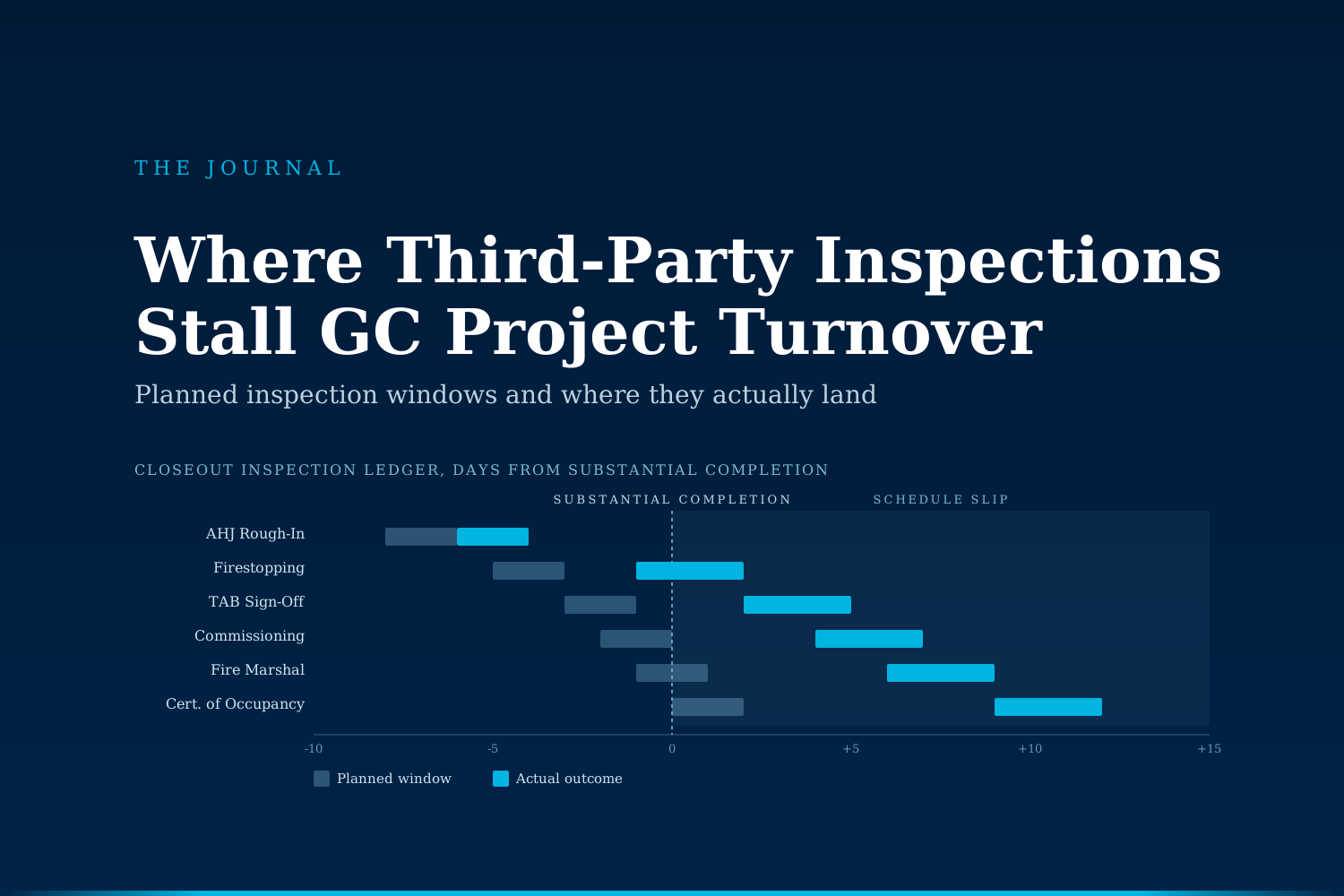
Third-party inspectors do not staff the general contractor's schedule. City building officials, TAB agents, commissioning consultants, and code enforcement officers all run their own calendars. On a mid-size job, that mismatch can push turnover past substantial completion by ten business days or more. The pattern is measurable, and closing it changes how tight the schedule feels.
What counts as a third-party inspection on a mid-size GC job?
"Third-party" here means any inspection or certification the general contractor cannot perform in-house or through a direct subcontractor. On a typical mid-size commercial or multifamily job (five to fifty million dollars in construction value), the list usually includes:
- Authority Having Jurisdiction (AHJ) inspections. City or county building officials, fire marshal, health department, plumbing, mechanical, and electrical inspectors. Each has its own scheduling portal and its own service level.
- Testing and Balancing (TAB) agents. Independent HVAC balancers who certify the mechanical system before commissioning can sign off.
- Commissioning (Cx) consultants. Third-party engineers who verify that mechanical, electrical, and plumbing systems perform to specification.
- Special inspections. Structural steel, concrete, welds, fireproofing, and firestopping, usually performed by the owner's independent testing lab.
- Utility company sign-offs. Power, gas, water, and telecom cutovers where the utility has to be on site.
- Life safety and elevator inspections. State or municipal inspectors that gate certificate of occupancy.
None of these calendars are inside the GC's control. Each one is a booking on someone else's ledger, subject to their backlog.
Why do these inspections keep sliding right?
Three dynamics repeat on job after job.
First, the backlog is real and rarely stable. Municipal building departments across the US have run persistently understaffed since 2020, and multiple industry surveys (including reporting from the International Code Council on jurisdictional staffing) describe hiring gaps and elongated inspection windows in growth markets. What looks like a two-day scheduling promise in a plan schedule can become a seven-day queue by the time the GC calls to book.
Second, the request has to be right the first time. Most AHJs require the specific permit number, the scope of the inspection, the responsible subcontractor, and the prerequisite inspections closed out. If any of those fields are wrong, the inspection is rescheduled, not corrected on the fly. Two or three back-to-back rescheduling loops can eat a week, and the field superintendent usually finds out on the morning of the missed slot.
Third, the readiness call is often optimistic. Subcontractors have their own incentive to declare "ready for inspection" so the invoice can be released for that milestone. An inspector who arrives to a scope that is not ready either fails it (a re-inspection fee and a delay) or refuses to inspect (a fresh request in the queue). Either way, the schedule slips and the failure often goes into the daily report as "AHJ delay," when the root cause was upstream.
What does an inspection scheduling slip actually cost?
The cost is not a single dollar figure, it is a compounding set of line items that show up in different parts of the pro forma. Two mid-size GC jobs of similar size and scope can post very different turnover margins depending on how their inspection windows are managed.
| Cost category | What it looks like on the job | Where it hits the P&L |
|---|---|---|
| General conditions extension | Site trailer, superintendent, dumpsters, sanitation past substantial completion | GC self-perform cost |
| Owner-side liquidated damages | Contract clause triggers on days late past guaranteed date | GC contingency |
| Subcontractor idle time | Trades waiting on a preceding inspection to close their scope | Backcharge fights, morale, retention |
| Re-inspection fees | AHJ or third-party fee per failed attempt | Job cost |
| Warranty start slippage | Manufacturer warranties tied to substantial completion date | Post-turnover risk to owner and GC |
| Owner move-in cost | Furniture, IT, tenant fit-out crews standing by | Owner claim exposure |
Independent research on construction schedule performance (McKinsey and Company's ongoing capital-projects work, along with regular reporting from the Construction Industry Institute) consistently finds that a meaningful percentage of large projects finish materially late, with schedule slippage measured in double digits of percent against baseline. Inspection scheduling is not the whole story, but on the closeout tail of a job, it is often the last domino to fall.
Why does the AHJ portal not solve this on its own?
Every jurisdiction of size now runs some form of online scheduling. The tools have improved. The pattern still shows up.
- The portal is booking-only, not tracking. A submitted request confirms a slot; it does not tell the GC when the inspector's route was changed, when a prerequisite inspection failed elsewhere in the building, or when the assigned inspector called in sick.
- The prerequisites live outside the portal. Firestopping cannot be inspected until the mechanical rough-in is signed. If the mechanical rough-in slipped three days, the firestopping booking still sits on the calendar, still counts as scheduled, and still fails when the inspector arrives.
- The confirmation loop is manual. Superintendents call, text, and email the sub who owns the scope the afternoon before, asking if it will really be ready. That call is a judgment call, and it happens hundreds of times over a job.
- The paper trail is fragmented. Reports, punch items from the inspector, and clearance certificates land in three different inboxes and rarely land in the project management system without a human handoff.
A GC with a strong closeout team can manage all of this. The point is that the management cost is high, it shows up as senior superintendent hours, and it does not scale linearly when the closeout portfolio grows.
What changes when AI monitors the inspection ledger?
The interesting shift is not that AI books the inspection. The AHJ portals still book. The shift is that the inspection ledger becomes a watched, live artifact, and the readiness call becomes a check, not a guess.
In practical terms:
- Every scheduled inspection is cross-checked against its prerequisite inspections. If a prerequisite has slipped, the downstream request is flagged for reschedule before the inspector shows up.
- Every readiness declaration from a subcontractor is checked against the submittal log, the RFI log, the punch list, and the daily reports for signals of "not actually ready." Anything ambiguous escalates to the responsible superintendent with the specific reason.
- Every inspection outcome (pass, partial pass with corrections, fail) is captured, tagged to the responsible sub, and rolled up into the closeout dashboard on the morning after. The re-inspection request is drafted before the daily huddle.
- Every AHJ portal change (rescheduling, inspector reassignment, cancellation) is monitored and surfaced to the project manager the moment it lands, not the afternoon after it happens.
None of this replaces the field superintendent's judgment. It removes the surprise from the calendar and moves the conversation from "what happened this morning?" to "here are the three inspections at risk this week, sorted by cost of slip."
Three signs your inspection scheduling is measurably costing turnover margin
If any of the following show up on your last few closeouts, the inspection window is worth quantifying:
- Your daily reports flag "AHJ delay" more than once a week in the last thirty days of a job. That is a proxy for readiness misses, not for inspector backlog. The inspector is usually a symptom, not the cause.
- Your general conditions run past substantial completion by more than three business days on the average job. Extended GC is one of the least visible margin leaks in the industry, and inspection tails are one of its most common causes.
- Your certificate of occupancy is issued after the owner's contractual move-in date on more than one job per quarter. Liquidated damages clauses vary by contract, but the pattern itself is a signal that the tail of the schedule is being managed reactively.
A GC that runs these three cuts on the last four closeouts usually finds a number worth acting on. Sometimes it is a few days of general conditions per job; sometimes it is an owner claim that could have been avoided by catching a readiness miss a week earlier.
The bottom line
Third-party inspections are not primarily a scheduling problem, they are a readiness and monitoring problem. The GCs that finish jobs on time in tight markets are not the ones with the most cooperative AHJs, they are the ones who have built a habit of checking readiness before the inspector is booked and watching the ledger continuously once it is.
For most mid-size operations, that shift is a one-quarter effort with a payback measured in weeks of general conditions saved per closeout.
The completely free automation audit
If any of the patterns above look familiar, ApexifyLabs runs a completely free automation audit for general contractors that want an outside read on where their closeout tail is actually leaking. No slide deck, no obligation. We look at the last two closeouts and share what we see.
Sami Raza
Software Developer & Technical Author
Sami Raza builds AI automation for logistics, DTC, and construction operations teams at ApexifyLabs, and writes about the operational failures that automation is actually worth pointing at.