Carrier Onboarding Backlogs Cap Broker Spot Coverage
A brokerage can vet a carrier fast and still lose the load. The gap between approval and full setup is where spot coverage quietly stalls. Here is what that backlog costs.
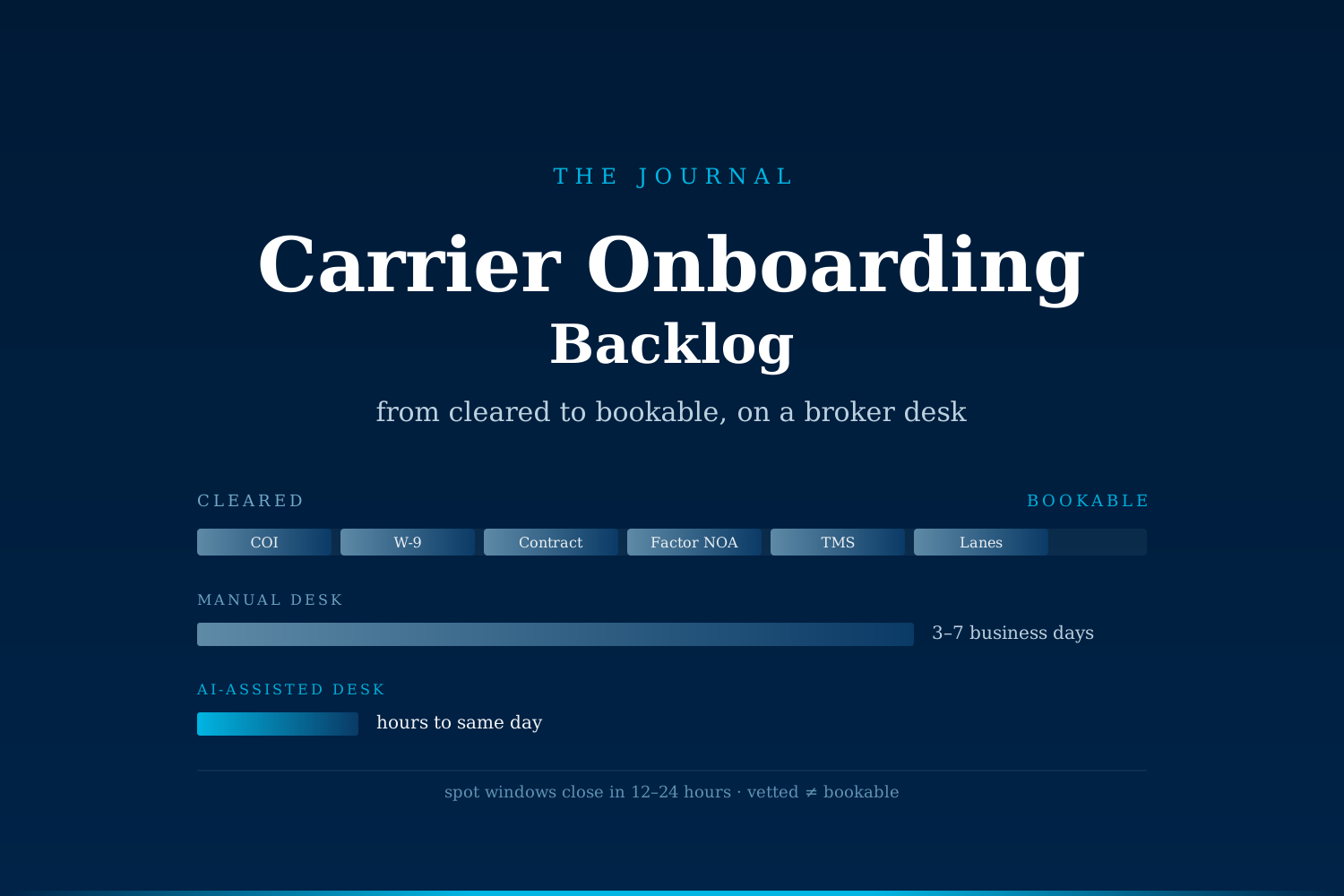
Approving a new carrier and booking a new carrier are two different milestones. In between sits an onboarding queue: contract signature, W-9, certificate of insurance verification, factor notice, TMS setup, EDI credentials, load-preference capture. For most mid-size brokerages, that queue is where a real share of spot coverage quietly stalls out.
What is a carrier onboarding backlog?
The backlog is the set of carriers a brokerage has already vetted and cleared to haul, but has not yet finished setting up to actually book. A vetted carrier is a decision. An onboarded carrier is a workflow.
The workflow typically includes eight to twelve steps: signed broker-carrier agreement, current W-9, verified certificate of insurance (auto liability, cargo, general liability, workers' comp), FMCSA authority and safety rating pull, MC and DOT number cross-check, factoring company notice of assignment, banking or remit-to details, TMS profile creation, lane preferences and equipment mix, contact routing, and (for repeat shippers) EDI or portal credentials.
Any one step waiting on the carrier or the compliance desk holds the whole file. The carrier stays on a "cleared, not yet active" list. When a spot load lands on their lane, the desk cannot book them without a rushed manual push, and often books someone else instead.
Why does this queue form on so many brokerage desks?
Three structural reasons repeat across desks of similar size.
First, the work is document-heavy and back-and-forth. FMCSA data shows more than 700,000 active for-hire motor carriers in the US as of 2024, with roughly 95 percent operating 10 or fewer trucks according to ATA and FMCSA breakdowns. Small carriers rarely have a compliance clerk. Documents arrive by email, in PDFs of varying quality, sometimes as phone photos, sometimes without the requested endorsements. Each round trip adds a day.
Second, insurance certificates are the single biggest choke point. A brokerage needs to confirm the COI names the correct certificate holder, meets minimum limits (industry-standard $1M auto liability and $100K cargo, higher for reefer or hazmat), and covers the equipment class the carrier will actually run. If any of that is off, the certificate has to be reissued through the carrier's agent, and that is not a same-day event during a busy quarter.
Third, the compliance desk is usually the same team handling doc re-verification for the existing carrier network. Industry surveys and brokerage operating reports consistently note that carrier compliance is under-resourced relative to sales, especially at brokerages doing $20M to $75M in annual revenue. When re-verifications spike (renewals cluster in Q1 and Q3 for many auto policies), new-carrier onboarding drops to second priority. The queue lengthens.
How does the backlog cap spot coverage?
Spot coverage is a time-sensitive market. DAT and Freightwaves reporting consistently shows that spot capacity in tight lanes turns over inside 12 to 24 hours. A load posted at 9 AM often has a booked carrier by early afternoon. A vetted but not-yet-onboarded carrier is invisible to that window.
The pattern looks like this on a typical desk. A rep pulls up matched capacity for a Dallas-to-Atlanta reefer at 10:30 AM. Three carriers match on lane, equipment, and rating. One is active in the TMS. Two are in the onboarding queue: cleared last Tuesday, still waiting on a signed contract or a corrected COI. The rep books the active carrier at whatever rate they'll take. The two queued carriers, who might have covered at a better rate, never enter the conversation.
Multiply that by the number of spot loads a desk quotes in a week, and the invisible backlog becomes a visible margin gap. When a brokerage says "we're carrier-constrained on that lane," what is often true is that their active carrier list on that lane is thinner than it needs to be, because the onboarding queue is holding back the truck count.
Manual onboarding versus AI-assisted onboarding
The comparison is not about eliminating the compliance desk. It is about compressing the cycle time between "cleared" and "bookable" from days to hours, so more of the vetted list is actually usable in a spot window.
| Step | Typical manual desk | AI-assisted desk |
|---|---|---|
| COI intake | Email attachment, manual field entry | Auto-parsed, cross-checked against holder name, limits, endorsements |
| Insurance limit verification | Analyst reads certificate | System validates against contract minimums, flags gaps for the agent |
| W-9 collection | Emailed request, followed up manually | Portal request with automated reminders and OCR intake |
| MC / DOT / safety pull | Analyst visits SAFER, copies fields | API call, populated in the carrier profile |
| Broker-carrier agreement | Countersign, scan, file | e-signature envelope, auto-filed in the carrier record |
| Factor NOA processing | Manual verification with the factoring company | Automated NOA capture, remit-to updated in TMS |
| TMS profile creation | Analyst types every field | Auto-populated from vetted intake data |
| Typical time from cleared to bookable | 3 to 7 business days | Hours to same day, depending on how fast the carrier returns docs |
The AI layer does not replace the compliance judgment call. It replaces the typing, the tab switching, and the "did they ever send that COI" follow-up loops. The compliance analyst reviews exceptions, approves borderline cases, and stops chasing routine paperwork.
Three signals your onboarding backlog is capping coverage
If a brokerage owner or head of ops wants to check quickly whether this is happening, three signals are usually enough.
- The gap between "cleared" and "first load." Pull a sample of carriers cleared in the last 90 days. Count how many have hauled a load. If a meaningful share (industry conversations suggest 30 percent or more is common on manual desks) has cleared but never booked, the queue is capping capacity, not carrier quality.
- The COI re-request rate. How often does the compliance desk send a second or third certificate request per new carrier? A high re-request rate points to a manual intake process that misses field-level validation on the first pass.
- Same-lane rate variance in the spot book. If two similar loads on the same lane, booked within the same week, show a 10 to 15 percent rate spread, part of the story is carrier availability. A deeper active list on that lane compresses that spread.
None of these signals prove the backlog is the cause on its own, but together they usually point to it.
What changes when the backlog clears?
The most obvious change is that the active carrier list catches up to the vetted list. A brokerage that used to describe itself as "well-vetted, 900 carriers on file" becomes a brokerage where 900 carriers are actually bookable this week, not next month.
Downstream, three things move. Spot coverage rates tighten in the lanes where the newly active carriers concentrate, because the desk has real optionality inside the 12-hour spot window. First-load-per-carrier time drops, which matters for the return-on-effort of the compliance work. And the sales team stops losing lanes to competitors who happened to have the truck already onboarded when the load came in.
None of this shows up as a headline savings number. It shows up as a slightly better fill rate, a slightly better buy rate, and a slightly less painful Monday morning.
The pitch
If a mid-size brokerage is quoting more loads than it books, or watching spot loads move to competing brokers on lanes where the vetted list should be deep, the onboarding queue is worth a look. We map the cycle from "cleared" to "bookable" and identify where the time actually goes, without asking the compliance desk to rebuild their process from scratch.
If this pattern sounds familiar on your desk, we offer a completely free automation audit for freight brokerages. No slide deck, no commitment. → Book the audit
Sami Raza
Software Developer & Technical Author
Sami Raza builds AI automation for logistics, DTC, and construction operations teams at ApexifyLabs, and writes about the operational failures that automation is actually worth pointing at.