Expired Carrier Docs Cost Broker Capacity Nobody Tracks
Freight brokerages think they hold 500 vetted carriers. A rolling share have expired insurance, revoked FMCSA authority, or stale W9s. Capacity silently shrinks.
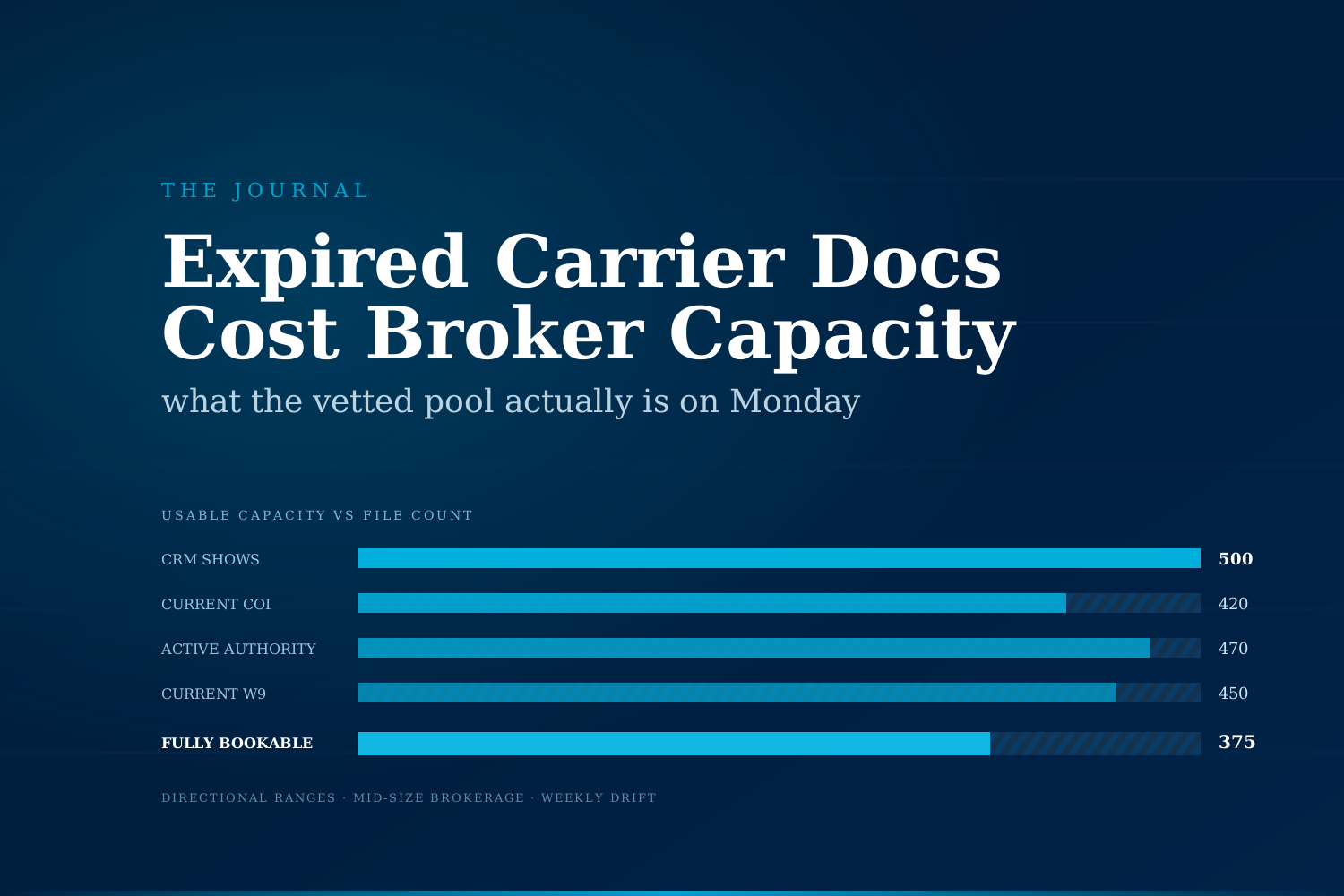
Freight brokerages routinely believe they hold 400 to 600 vetted carriers in their capacity pool. In practice, a rolling share of those carriers carry expired insurance certificates, revoked FMCSA operating authority, or stale W9s on any given week. When ops tries to tender a load, effective capacity is smaller than the CRM shows, and coverage cost rises.
The problem is not vetting. Most brokerages have a workable onboarding process. The problem is what happens between onboarding and re-onboarding, when a previously vetted carrier goes out of compliance without notice and nobody at the desk updates the record.
What is a stale carrier packet on a broker desk?
A carrier packet is the file a brokerage keeps for every trucking company it works with. Depending on the desk, it typically includes:
- A valid Certificate of Insurance (COI) for auto liability, cargo, and general liability coverage
- A current W9 tax form for 1099 processing
- A signed carrier-broker agreement, often the TIA standard version
- Proof of active FMCSA operating authority (an MC or MX number in authorized status)
- A current safety rating pulled from the SAFER database
- Add-ons where applicable: drug and alcohol clearinghouse consent, hazmat endorsements, refrigeration equipment inspections, C-TPAT documentation for cross-border loads
Any one of these elements going stale means the carrier cannot legally or safely be booked without an update, even if the broker desk has loaded with them 20 times before.
Why do carrier packets go stale so quickly?
The renewal cadences are set by different regulators and different renewal clocks, and they do not line up with each other:
- COIs typically renew annually. Some carriers forward updated certs proactively; many do not. The certificate that names the broker as certificate holder is what has to arrive, and email volume alone means a percentage of renewals never reach the ops inbox in a form ops can act on.
- W9s go stale on entity or ownership changes. A carrier that flips from LLC to S-corp, or that reissues under a new EIN, needs a new W9 before the next 1099 cycle.
- FMCSA operating authority is revoked when the required insurance filing lapses. Per FMCSA policy, if the underlying BMC-91 (cargo) or BMC-91X (liability) filing lapses more than 30 days, the authority is moved to revoked status. Reinstatement requires refiling and a fee.
- Safety ratings can shift after a compliance review or an out-of-service crash. A downgrade may not revoke authority, but it often removes the carrier from shipper-side approved lists.
- Clearinghouse queries expire annually per FMCSA rule. Consent that was current at onboarding is no longer current a year later.
A brokerage with 500 carriers on file has 500 independent renewal clocks. Nobody at the ops desk is tracking each clock individually.
How much of a "vetted" carrier pool is actually usable this week?
Industry churn data helps set expectations. FMCSA's public statistics show tens of thousands of new operating authorities issued each year and roughly comparable numbers being revoked, primarily for lapsed insurance filings, per reporting from FreightWaves and Overdrive Magazine. Carrier411, DAT, RMIS, and My Carrier Portal all exist commercially because monitoring authority and insurance is a non-trivial ongoing task, not a one-time onboarding check.
The rough shape of a mid-size broker's usable pool at any given moment:
| Metric | What the CRM shows | What is actually bookable this week |
|---|---|---|
| Total carriers on file | 500 | 500 |
| Carriers with current COI on record | 500 (assumed) | 400 to 440 |
| Carriers with active FMCSA authority | 500 (assumed) | 460 to 480 |
| Carriers with current W9 on file | 500 (assumed) | 430 to 470 |
| Carriers loaded within the last 90 days | 500 (assumed) | 220 to 280 |
| Fully usable, zero packet friction | 500 (assumed) | 350 to 400 |
These ranges are directional and vary by desk, region, and how aggressive the ops team is on renewal follow-up. The point is that the "500 vetted carriers" number in the CRM is not the number ops can tender to today, and the two figures drift further apart the longer a monitoring gap goes unaddressed.
What does the cost look like when a packet gap slips through?
Three cost buckets, in order of visibility:
- Delayed coverage on time-sensitive loads. When ops discovers the packet gap at tender time, they either wait for the carrier to refile documents, delaying booking by hours, or move down the pool to a more expensive backup. On a same-day load, hours matter.
- Higher spot rate paid. A backup carrier for a same-day load typically costs more per mile than the first-choice carrier. Load board data referenced regularly by DAT and FreightWaves shows that re-cover pricing runs several percent above the original tendered rate, and the gap widens in tight capacity markets.
- Compliance exposure. Loading a truck whose insurance has lapsed exposes the broker to liability if a claim occurs. Even when the broker's ultimate legal liability is limited by contract, defense costs on cargo or auto claims run into six figures per incident, according to TIA member surveys and claims-desk commentary in industry publications.
There is a fourth, softer cost: sales rep confidence. When ops repeatedly promises coverage and then walks it back because a carrier's insurance lapsed, account managers stop trusting the carrier list and start working from their own side lists. Rate discipline erodes over time.
Why does this get missed on an otherwise healthy ops desk?
Because it is nobody's job. The onboarding coordinator moves on to the next new carrier. The dispatcher assumes documents on file are current. The controller only asks about W9s at year-end. There is no forcing function that says "these 40 packets expire this month, chase them now." The friction only becomes visible at tender time, at which point it is already a same-day problem.
The other reason: renewal chasing feels like a low-status task. It is emails, PDFs, and phone calls to carrier office managers. On a busy ops desk with real revenue loads to cover, it consistently loses.
What changes when carrier packet health is monitored continuously?
Before: ops learns a packet is stale at the moment they try to tender. The clock is against them because the load is already booked with the shipper.
After: packet health becomes a background monitor. Insurance expiration dates are tracked against a live watchlist. FMCSA authority checks refresh nightly. When a certificate is close to expiry or an authority moves to revoked, the carrier drops out of the ready pool automatically and the ops desk sees an accurate view of who is bookable right now. The renewal request goes to the carrier before ops needs them, not while ops is trying to book them.
Effective capacity does not go up. It just stops silently shrinking. That, plus the reduction in mid-tender re-covers, is what shows up in the P&L: fewer premium buys, fewer compliance close calls, and less time spent negotiating from a weak position at 3pm when a load is still uncovered.
When should ops refresh a carrier packet?
Rough guidance from compliance industry training and TIA best-practice notes:
- 60 days before COI expiry. Enough runway to chase the renewal without pressure.
- On any FMCSA authority status change. Revocations happen fast; ops should not learn about it from a claim.
- After a safety rating downgrade. Even without an authority change, a downgrade may affect shipper-side approved-carrier lists.
- On any change of ownership, DBA, or EIN. Regenerates the W9, and sometimes a new carrier agreement.
- After a 90-day dormant period. Carriers a broker has not loaded in three months are the most likely to have gone offline in the interim.
Whether that guidance is enforced by a person or by a monitor is the design decision. Doing neither is what the current baseline typically looks like.
The completely free automation audit
If the carrier pool on your desk feels larger on paper than it does in practice, there is a good chance a share of those carriers have already lapsed on something. We run a completely free automation audit for freight brokerages that want a second opinion before committing to anything. No slide deck, no obligation. We look at where paperwork friction is steadily costing you capacity and rate, and we share what we see.
Sami Raza
Software Developer & Technical Author
Sami Raza builds AI automation for logistics, DTC, and construction operations teams at ApexifyLabs, and writes about the operational failures that automation is actually worth pointing at.