Why Double-Brokering Fraud Slips Past Mid-Size Brokerages
Double-brokering fraud is now the industry's top freight fraud category. Here is where mid-size brokerages get exposed and what shifts with continuous verification.
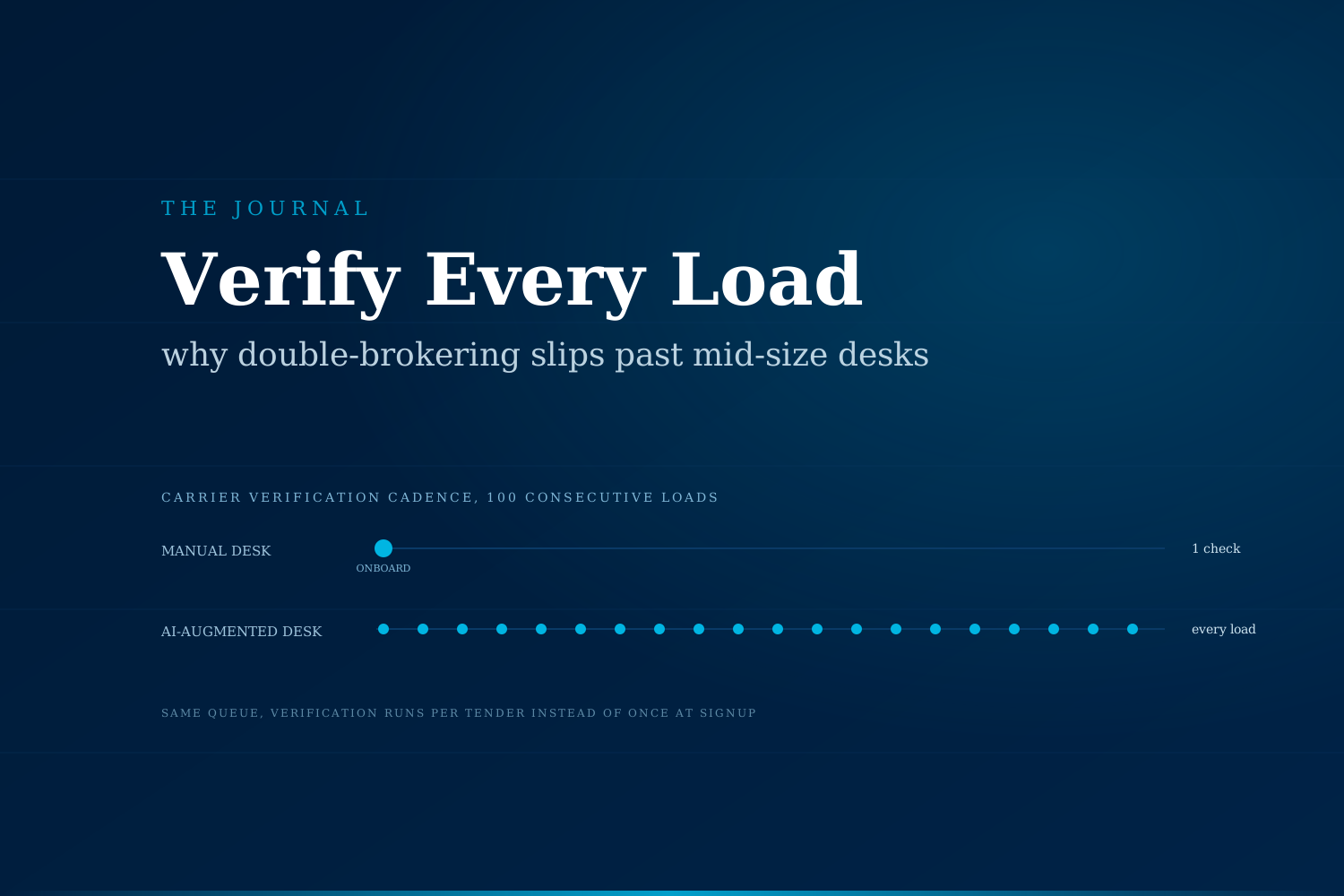
Double-brokering fraud is now the industry's most costly freight-broker exposure, and mid-size desks absorb an outsized share of the loss. The tactic is simple: a fraudulent actor takes a load tender, then re-brokers it to a real carrier while pocketing the shipper's payment. The verification blind spot sits in the middle of a busy dispatch queue.
What is double-brokering fraud, and how is it different from co-brokering?
Co-brokering is a documented and disclosed practice. One licensed broker hands a load to another licensed broker with the shipper's consent, and every party in the chain is contractually visible. Double-brokering fraud is the opposite. A bad actor accepts a load as a "carrier," then quietly re-brokers it to a real trucking company without authorization or disclosure, often using a stolen or impersonated identity. The real carrier hauls the freight. The bad actor collects the shipper's payment and disappears. The real carrier is left chasing money from a company that never actually engaged them.
The pattern comes in several recognizable shapes:
- Identity impersonation. A bad actor uses a legitimate motor carrier's MC number, phone, and a lookalike email variant to bid on loads. The real carrier has no idea it is even being represented.
- Legit-then-fraudulent drift. A carrier onboards cleanly, hauls a few loads, then begins double-brokering once trust is established.
- Spoofed dispatch service. A single dispatch operation represents multiple "carriers" that share a bank account and vanish once payment lands.
The Transportation Intermediaries Association (TIA) has publicly identified double-brokering as the industry's top fraud concern, and its Fraud Task Force has documented a sharp rise in reported incidents since 2022.
Why does double-brokering slip past mid-size brokerages?
Because most mid-size desks were built for a market where carrier fraud was rare. Onboarding checks a carrier's MC authority, insurance, and safety score. That check happens once, at signup, and the file then sits in the TMS. If someone impersonates that carrier three months later using a lookalike email domain, nothing in the day-to-day workflow catches it.
Trade coverage in FreightWaves and Transport Topics has repeatedly attributed the surge to three factors:
- A soft market pushes carriers to bid on more loads at more places. Volume drowns out anomalies.
- Communication has moved to email and load boards. Voice checks, once a natural fraud filter, are far less common.
- The average dispatch queue is fuller than it was five years ago. Time-per-load has compressed, and verification is the first casualty.
CargoNet, which tracks cargo theft and fraud across North America, has reported year-over-year increases in strategic cargo theft (of which double-brokering is a major share) in each of the last several years, with total industry losses now measured in the hundreds of millions annually.
None of this reflects poorly on the brokerages absorbing the losses. It reflects a threat model that has evolved faster than most workflows.
Where do the detection blind spots sit on a manual desk?
Three places, consistently:
- The stretch between onboarding and dispatch. A carrier is vetted once, then trusted for every future load. A stolen MC number is not caught until the invoice arrives, and sometimes not even then.
- The email inbox. Bid responses arrive from lookalike domains, close-copy branding, and matching phone numbers. On a busy queue, a dispatcher skims for rate and equipment. Domain provenance is not scanned.
- The post-dispatch silence. A double-brokered load can move perfectly. The bad actor sub-contracts a real carrier who picks up, delivers, and files POD. Everything looks normal until the real carrier's invoice lands.
The consequences land at settlement. The brokerage has already paid the "carrier" it thought it hired. Now a second, legitimate carrier is asking to be paid for the same load. Under the FMCSA's chain-of-responsibility framework, the shipper and the broker can both carry exposure to the real carrier regardless of who was paid first.
How much does one double-brokered load actually cost?
The per-load cost is not just the linehaul. It compounds across several categories.
| Cost category | Typical hit per incident | Where it lands |
|---|---|---|
| Duplicate payment | Full linehaul, $1,500 to $6,000 | Broker's cash |
| Legal and collections | $500 to $3,000 | Broker or shipper |
| Insurance claim work | 10 to 30 hours of ops time | Ops team |
| Shipper relationship damage | 1 lost quarter of freight, sometimes more | Sales pipeline |
| Carrier network trust | Fewer preferred carriers accepting tenders | Capacity strategy |
Industry practitioners have publicly cited average per-incident losses in the $10,000 to $25,000 range once ancillary costs are included, and larger orchestrated schemes have hit individual brokerages for six-figure sums in a single quarter. TIA members have testified before Congress in support of tighter carrier registration rules for exactly this reason.
What changes when carrier verification runs on every load, not just at onboarding?
An AI-augmented desk stops treating onboarding as the last verification event. Instead, every tender response is checked against the carrier's canonical record in real time. Domain, phone, banking, and dispatch identity are compared to the file the brokerage already keeps. Any drift surfaces before dispatch.
The dispatcher's screen still looks like a dispatch queue. The difference is a quiet confidence signal on every tender, and any anomaly is surfaced before dispatch, not after settlement.
| Verification step | Manual desk | AI-augmented desk |
|---|---|---|
| Carrier identity check | Once, at onboarding | Every load, before tender confirmation |
| Domain and email provenance | Not checked | Cross-referenced to onboarded contacts |
| Bank routing consistency | Checked at first payment | Re-verified per payment cycle |
| Dispatch service overlap | Manual, only if flagged | Auto-flagged when multiple MCs share a dispatcher |
| Post-dispatch anomaly | Discovered at second invoice | Flagged the moment tracking diverges |
The dispatcher's day feels the same. Settlement's day feels dramatically calmer. Duplicate-payment incidents drop toward zero. The carrier network stabilizes because preferred carriers see the brokerage catching fraud earlier than peers.
What do operators keep missing in the recovery cycle?
Even when fraud is detected, most desks under-recover. Three patterns show up.
- The insurance claim is filed on cargo policy when the policy that actually covers duplicate payment is broker E&O. The claim gets denied.
- The shipper is not notified in the same 24-hour window that the freight moved. The relationship absorbs the blame instead of the bad actor.
- The canonical carrier record is not updated after the incident, so the same lookalike domain gets a bid response one lane over the following month.
None of these are policy failures. They are workflow gaps. The recovery cycle for double-brokering is not standardized on most mid-size desks, and muscle memory takes months to build when the events are rare and painful.
Signs your desk is more exposed than it looks
A short list from typical desk visits:
- Sales, dispatch, and settlement do not share a single canonical carrier record. Two of the three keep their own list.
- Carriers get onboarded from load-board profiles without a second-channel voice or video verification.
- Payment instructions get updated from an email request without a callback to a known number.
- Settlement discovers duplicate invoices more than once per quarter.
None of these are catastrophic in isolation. Together, they describe a desk that has grown faster than its fraud controls.
Where the pattern is heading
The FMCSA's 2024 registration reforms have raised the bar for new entrants, and industry associations have pushed for stricter broker-carrier authority separation. Both changes will reduce, but not eliminate, the surface area for double-brokering. What tends to close the remaining exposure, on mid-size brokerages specifically, is a continuous verification layer that treats every tender response as a fresh identity check without adding friction to the dispatcher's day.
Brokerages that adopt continuous verification early tend to preserve their capacity relationships, because their preferred carriers stop losing loads to impersonators. Brokerages that wait tend to spend a growing share of settlement cycles on recovery and legal work that the industry increasingly considers preventable.
The interesting shift is not the technology. It is the moment a sales conversation with a new shipper starts with "we verify every carrier on every load," and the shipper visibly relaxes.
Closing
If your desk has felt the sharp end of a suspicious tender or a duplicate carrier invoice in the last two quarters, we run a completely free automation audit for freight brokerages. No commitment, no slide deck. We spend an hour walking your last ninety days of carrier tenders with you and show you where a continuous verification layer would have caught the impersonation before dispatch. → Book yours
Sami Raza
Software Developer & Technical Author
Sami Raza builds AI automation for logistics, DTC, and construction operations teams at ApexifyLabs, and writes about the operational failures that automation is actually worth pointing at.