How OTIF Penalties Erode Broker Margin on Retail Freight
Retail OTIF fines land on freight broker invoices long after delivery. Here is where the exposure sits and what shifts when AI monitors it live across the book.
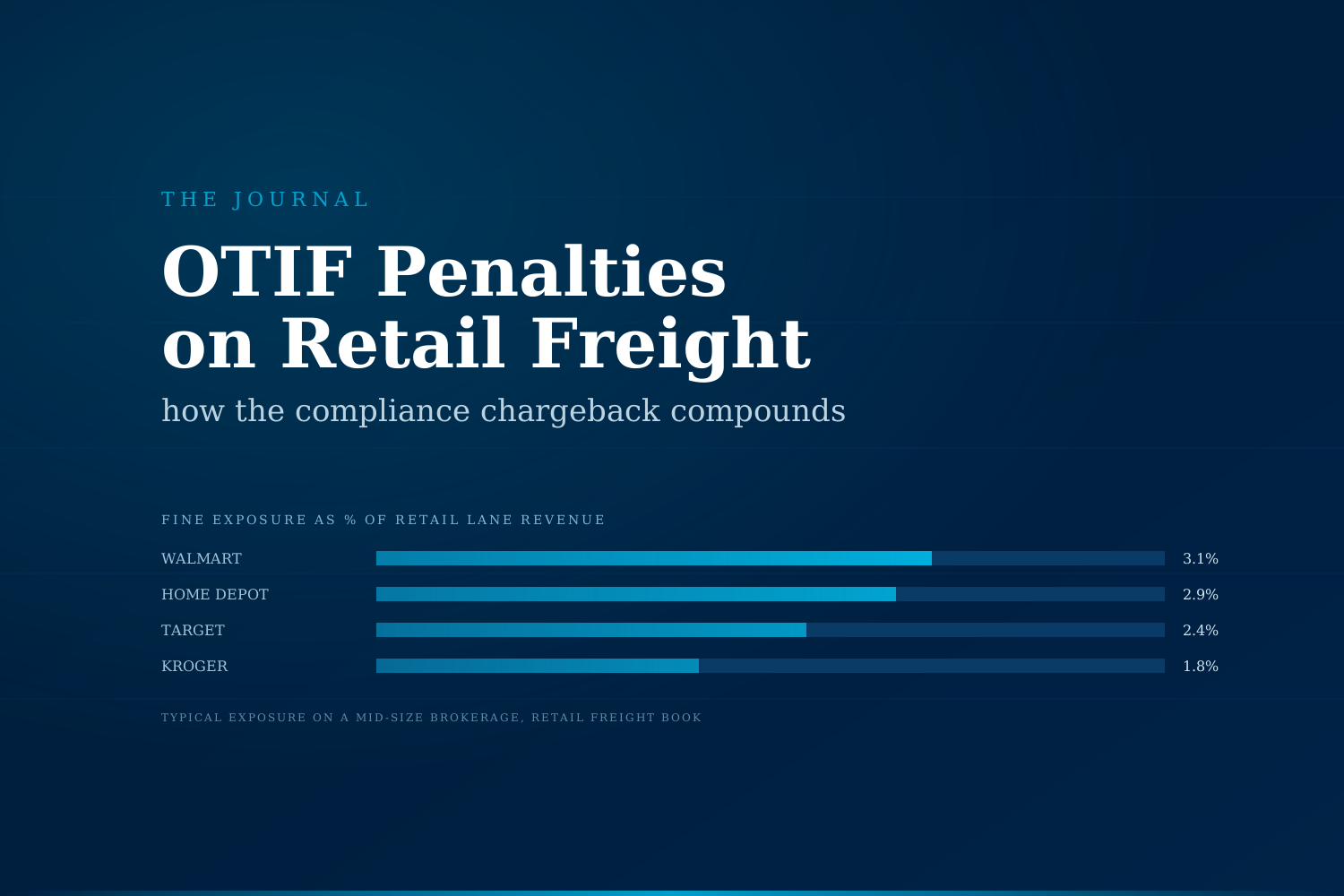
OTIF penalties from big-box retailers show up on freight broker invoices long after the load has delivered. What began as a shipper compliance program at Walmart in 2017 now sits inside almost every retail-facing brokerage's freight margin, reducing the profit on lanes the desk has already committed to running on time. The invoice looks clean at settlement. The chargeback shows up a month later.
What are OTIF penalties, and why do brokers absorb them?
OTIF stands for On-Time, In-Full. It is a compliance program that big retailers use to enforce delivery performance from their vendors and, by extension, from the freight brokerages moving those vendors' loads. When a shipment misses the arrival window or the case count is short, the retailer deducts a penalty from the vendor's invoice. The vendor then decides whether to absorb the penalty, chase it upstream to the carrier, or write the exposure into the freight rate the brokerage is quoting on the next RFP.
Retail-facing brokerages sit inside every stage of that decision. On CIF or delivered tenders where the broker is contracted to hit the appointment window, the OTIF fine is billable back to the brokerage on almost every mid-market retail RFP written in the last five years. Even on FOB Origin tenders where the fine technically stays with the vendor, the vendor almost always renegotiates the following year's contract based on OTIF performance. A broker who cannot post consistent OTIF numbers loses the lane.
Which retailers run OTIF-style programs today?
Walmart made OTIF a category in 2017 when it launched a 3 percent charge on the invoice cost of any unit that missed the compliance window. The program has been revised several times since, most notably in 2020 when Walmart consolidated the fine structure and tightened the on-time and in-full thresholds toward 98 percent. FreightWaves and Modern Retail have documented each revision publicly.
Target runs a Traffic Vendor Requirements program that assesses chargebacks for missed appointments and mis-labeled shipments. Kroger enforces its own set of vendor compliance charges through its supplier portal. Home Depot, Costco, Lowe's, and CVS all publish vendor compliance manuals that carry OTIF-style penalty structures, though the exact percentages and windows vary by category. SPS Commerce's annual retail vendor performance survey has consistently reported vendor chargeback rates between 1 and 3 percent of gross invoice value across the retail supply chain.
None of this is new. What has changed is the number of mid-market brokerages routing freight for shippers who now sit inside three or four of these retailer programs at once.
Where does the broker exposure actually sit?
Not on the loads that deliver on time. The exposure concentrates inside three narrower categories of retail freight:
- Loads with tight MABD windows. Retailer must-arrive-by-date rules typically allow a two-day early window and a zero-day late window. Miss the late edge, and the fine attaches to the entire receipt.
- Loads to DCs with hard appointment slots. A missed dock appointment often forces the load to be reworked to the next available slot, which can be 24 to 72 hours out.
- Loads with case-count or unit-count reconciliation. Any short-shipment against the ASN triggers the in-full portion of the OTIF fine, even if the carrier hit the appointment on time.
On a mid-size brokerage running 200 to 400 retail loads a month, industry commentary places OTIF exposure somewhere between 4 and 9 percent of retail lane revenue when the desk has no dedicated compliance workflow. That is not a small line item on a business quoting at 8 to 12 percent gross margin.
What does one missed OTIF window actually cost?
The direct fine is only part of the picture. The compounding cost is where the margin actually leaves the lane.
| Miss type | Direct fine | Compounding cost |
|---|---|---|
| Late arrival at DC | Roughly 3% of unit cost on the late line | Reappointment fee, driver detention, dock rework |
| Short case count | Same percentage on the missing units | Vendor rescheduling of the balance shipment |
| Missed appointment (no-show) | Full penalty plus dock closure fee | Load rerouted to next slot, 24 to 72 hours out |
| Wrong pallet build | Compliance chargeback on the pallet | Manual re-palletization at the retailer's cross-dock |
| Missing or wrong ASN | Fixed fee per non-compliant ASN | Vendor's next PO can be flagged as high-risk |
For a shipper doing $50 million a year in Walmart volume through a brokerage, a 4 percent OTIF exposure translates to $2 million in fines annually before the brokerage even quotes the freight. The shipper wants that number closer to 1 percent, and the RFP language now reflects it.
Why do manual freight desks miss OTIF windows?
Because OTIF compliance is not one workflow. It is at least four workflows that only converge at settlement:
- Appointment scheduling. Retailer receiver portals (Retail Link, Target Vendor Portal, Kroger Vendor Hub) each have their own appointment rules, cancellation windows, and reappointment SLAs.
- Carrier check-in visibility. The carrier is often a third party the broker booked, and the driver's arrival status arrives via check calls or ELD ping rather than through the retailer's system.
- In-transit exception detection. Weather, breakdowns, and border delays surface late on manual desks because the exception owner is the dispatcher, not the compliance team.
- Post-delivery reconciliation. The retailer's compliance chargeback lands 30 to 60 days after the load, usually as a line item on a monthly deduction report that accounting has to parse.
By the time the OTIF fine shows up on a Walmart or Target settlement report, the desk that booked the load has moved on. The reconciliation work falls to accounting, and the appeal window (which is real, and which is enforceable, but which is also short) has often already closed.
What changes when AI monitors OTIF exposure across the book?
The desk's day does not change. Dispatchers still cover loads. Sales still quotes lanes. What changes is that the OTIF risk on every retail load becomes visible before the load is at risk, and the appeals workflow becomes something the brokerage actually runs rather than something it always meant to build.
| Workflow layer | Manual desk | AI-augmented desk |
|---|---|---|
| Appointment risk | Reviewed on the day of pickup | Monitored against MABD from load acceptance |
| Exception detection | Depends on driver check calls | Combines ELD, weather, and receiver portal signals |
| Compliance alerts | Reactive, at chargeback receipt | Proactive, before the delivery window closes |
| ASN accuracy | Verified at settlement | Cross-checked against the tender payload |
| Appeal filing | Ad hoc, often skipped | Drafted automatically from OS&D and check-call records |
| Monthly chargeback reconciliation | Manual line-by-line review | Aggregated and reason-coded on receipt |
The brokerage that runs this layer is not doing anything the shipper is not already asking for. It is doing what the shipper's compliance team wishes their carrier could do. That difference is what wins the RFP the following year.
How OTIF loss compounds into broker margin
OTIF exposure is a leading indicator of lane retention. Shippers with sophisticated compliance teams (which now includes almost every retail-facing shipper doing more than $30 million in retail sell-through) score their carriers on rolling 90-day OTIF averages. A brokerage that stays above the retailer's threshold typically renews at its quoted rate. A brokerage that drops below the threshold sees a repeating pattern:
- Lane renewal at a rate 3 to 6 percent below the previous cycle.
- Reduced load volume during the peak season.
- Loss of the shipper's premium lanes to a competing brokerage that can post better compliance numbers.
- Additional overhead on the next RFP response, since the compliance section becomes more detailed each year.
None of this shows up on a weekly P&L. It shows up on a lane-level margin report a quarter or two later, by which point the desk has already lost the pricing conversation.
Three signs your retail freight book is bleeding OTIF without you seeing it
Three quick observations from a desk visit:
- Your accounting team keeps a shared spreadsheet of Walmart or Target chargebacks that never got appealed because nobody had time.
- Dispatchers ask for the MABD after the load has already been covered, not before the load was quoted.
- Your top three retail shippers all raised the OTIF threshold in their last two RFPs, and your desk did not change how it handles their loads.
If any of these are true, the workflow is not broken. It is doing what a growing retail freight book does when compliance is treated as an accounting problem instead of a live signal on the desk.
Where the pattern is heading
Retail OTIF thresholds keep moving up, not down. Walmart's OTIF target has held near 98 percent since 2020. Target's chargeback structure now includes tighter appointment windows on high-velocity SKUs. Kroger's compliance program adds new penalty categories almost every quarter. The brokerages that will still be routing retail freight in 2028 are the ones that decided in the last 18 months to treat OTIF compliance as a live workflow rather than a settlement report.
The interesting shift is not the technology. It is the moment the compliance number on the shipper's quarterly business review stops being a surprise and starts being something the brokerage forecasts alongside the rate.
Closing
If any of the patterns above sound familiar, we run a completely free automation audit for freight brokerages. No commitment, no slide deck. We spend an hour with your team, walk your last 60 days of retail chargebacks, and show you where an AI layer would have caught the OTIF exposure before the window closed. → Book yours
Sami Raza
Software Developer & Technical Author
Sami Raza builds AI automation for logistics, DTC, and construction operations teams at ApexifyLabs, and writes about the operational failures that automation is actually worth pointing at.