How Load Board Tab Churn Slows Freight Broker Coverage
Coverage reps hop across four to six load boards on every search. The friction between windows is where cover times and rate discipline erode.
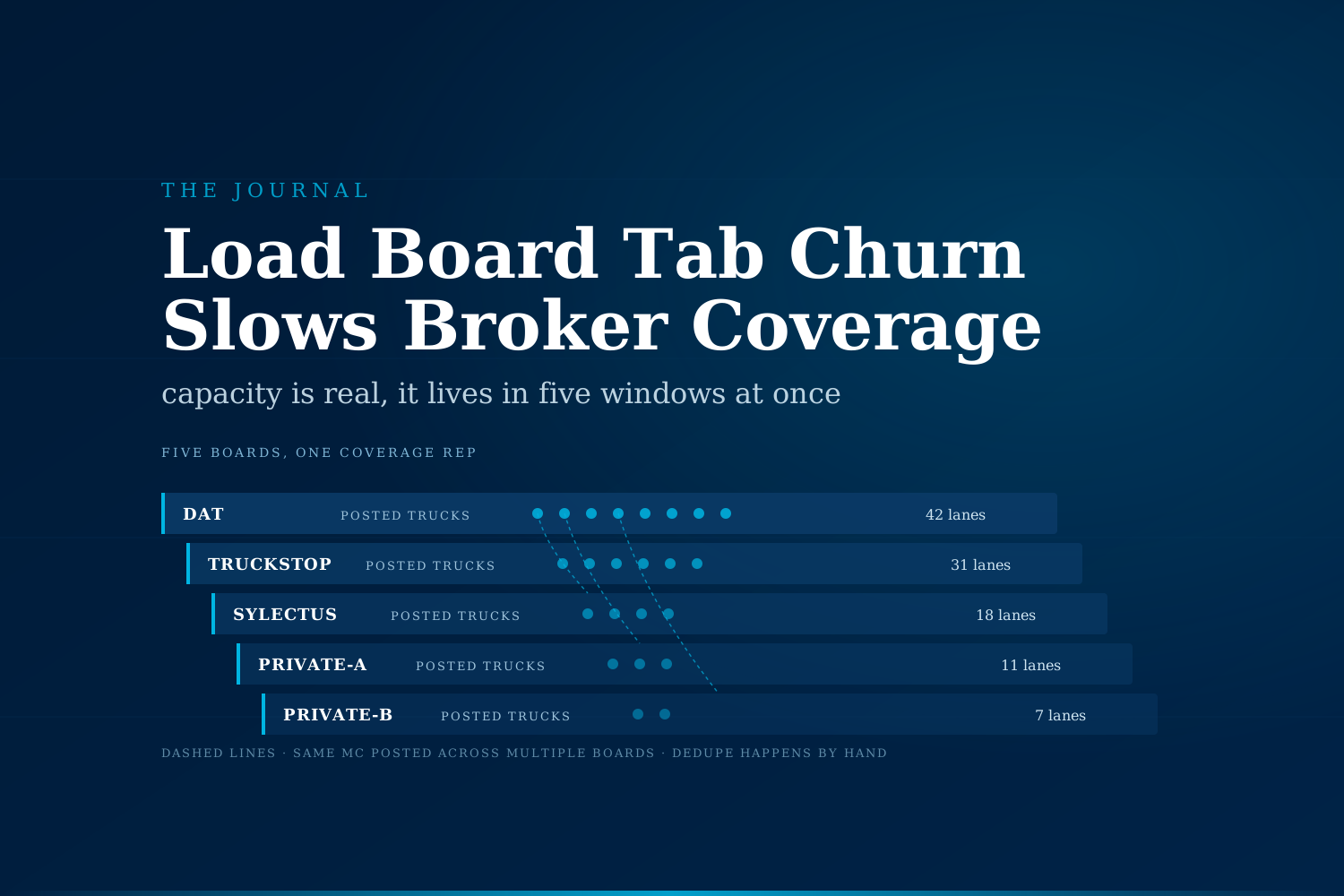
Freight brokerage coverage desks routinely keep four to six load board tabs open at once. DAT, Truckstop, Sylectus, and a handful of private boards, each refreshed in turn while a load sits uncovered. The productivity cost of that tab hopping is real. Cover times slip, first-choice trucks slip past, and margin slips with them.
Adding reps and adding subscriptions have both hit a ceiling. The friction is not on any single board. It sits between the boards, in the manual work of stitching a fragmented capacity picture back together every 15 minutes.
How much time does load board tab churn cost a coverage desk?
A coverage rep at a mid-size brokerage often works 20 to 40 loads a day. For each load, the process looks roughly like this: post the load or read the incoming tender, open two or three load boards, search by lane and equipment, evaluate the trucks that come back, cross-reference against the internal carrier list, and either call or offer through the board's messaging system. If nobody responds, cycle through the same boards 15 minutes later. If a truck matches on two boards, decide which posting to answer.
Industry surveys and DAT operator research have long noted that brokers spend a large share of their day on repetitive lookup tasks. The exact breakdown varies by desk, but a conservative estimate: 30 to 45 percent of a coverage rep's day is spent in board search, cross-reference, and refresh loops. On an eight-hour shift, that is two to three hours of tab hopping per rep, per day.
The cost is not just labor. When it takes 15 to 30 extra minutes to confirm a match because the same truck is posted on multiple boards with slightly different rates and different contact numbers, the shipper's target booking window shrinks. For time-sensitive loads, that alone bumps the desk down to a second-choice carrier at a higher rate.
What is load board tab churn, exactly?
Load board tab churn is the coverage desk pattern of manually multiplexing across public and private load boards to find matching capacity. It shows up in a few recognizable forms:
- Redundant posting. The same outbound load is posted to two or three boards to widen exposure. When a truck responds, the coverage rep has to remember to take the posting down on the other boards. Often they do not, and other trucks continue calling on a load that is already covered.
- Duplicate truck evaluation. A single truck posts itself on DAT, Truckstop, and Sylectus. The coverage rep sees three "different" trucks in the search results, sometimes at slightly different prices, and burns time figuring out that all three are the same MC number.
- Refresh loops. Because posted trucks and posted loads on public boards are re-sorted by time and by paid promotion, reps refresh the same searches every 10 to 15 minutes to keep the freshest matches at the top.
- Cross-reference to internal carrier list. A carrier the desk already has a rate agreement with is worth calling directly, but the desk has to notice that the truck on the board is the same MC in the internal CRM. That noticing does not always happen.
- Manual rate benchmarking. DAT RateView, Truckstop rate insight, and internal historical data live in different windows. Reps compare them tab by tab to decide what to offer.
None of these steps is exotic. Each is a small unit of manual coordination. They add up.
Why do brokerages end up on so many load boards at once?
Because no single board covers the whole market. DAT dominates dry van and reefer volume, but Truckstop has different pockets of carrier participation. Sylectus carries a heavy expedite and team-driver mix. Private boards run by 3PLs, shipper co-ops, and regional groups each carry loads and trucks that never post publicly.
For a brokerage trying to source capacity across regions, equipment types, and shipper preferences, being on one board means missing capacity that only lives on the others. Being on all of them means paying for redundant subscriptions, and juggling more tabs than any human coverage rep can meaningfully track in real time.
Industry commentary from FreightWaves and Overdrive Magazine has repeatedly framed this as a board fragmentation problem. Capacity is real, it just is not visible from any single vantage point. The workaround has been to add reps and add subscriptions, both of which have a ceiling.
What does the coverage cost look like when a truck posts to three boards at once?
Consider a mid-size brokerage covering 200 spot loads a day across three coverage reps. Each rep works roughly 65 to 70 loads per shift. For every load, tab churn adds friction in three ways: time to first outbound tender, likelihood of missing the first-choice truck, and likelihood of accidentally over-committing.
Rough shape of the day, side by side:
| Coverage step | Manual multi-board desk | Consolidated capacity view |
|---|---|---|
| Boards checked per load search | 3 to 5 tabs, sequential | 1 unified query, all sources |
| Time to first outbound offer | 8 to 15 minutes per load | 2 to 4 minutes per load |
| Duplicate truck detection | Manual, often missed | Deduplicated by MC on ingest |
| First-choice carrier hit rate | Depends on rep memory | Cross-checked against contract history |
| Repost cleanup on cover | Manual, sometimes forgotten | Auto-removed on covered status |
| Rate benchmark reference | 2 to 3 windows, side by side | Displayed inline with each match |
These figures are directional and vary by desk maturity, board mix, and lane density. The pattern holds regardless of exact numbers. Consolidation compresses time to cover and improves the odds that the truck a broker books is actually the best match available, not just the fastest to answer.
What changes when the boards are consolidated into one view?
Two things stop happening. First, the same truck stops being counted three times. Second, the coverage rep stops burning cognitive load on the mechanical part of the job (which board is showing what, which posting to answer, which listing to pull down) and gets to spend more of the shift on the parts that actually require judgment: carrier fit, rate negotiation, shipper relationship.
What the desk sees instead is a single deduplicated capacity view. It ingests trucks and rates from every board the brokerage subscribes to, cross-checks each MC against the internal carrier database for contract history and prior loads, and surfaces first-choice matches on top. Coverage reps still make the calls. They just stop losing minutes per load to tab management.
There is a second-order effect worth naming. When board data is consolidated, the desk starts to see patterns across boards that were invisible when each was in its own tab. Which lanes have carrier surplus this morning. Which shippers are getting posted-and-forgotten by other brokers. Which trucks post everywhere versus which trucks only respond privately. That layer of visibility is where the real coverage advantage lives, not in any single load.
When is it time to stop juggling tabs?
Rough guidance based on operator patterns:
- When coverage reps are working more than 40 loads per shift each. The math on tab churn breaks at scale. Time per load compresses to the point where no human can meaningfully evaluate three boards' worth of trucks on each one.
- When the desk carries five or more board subscriptions. At that point the number of open windows exceeds working memory, and the value of any individual subscription is diluted by the friction of cross-referencing.
- When re-cover rates on same-day loads climb above 8 to 10 percent. A rising re-cover rate is often the visible symptom of missed first-choice matches, not carrier flake.
- When new coverage reps take more than 60 days to hit full productivity. Long ramp times often reflect the tacit knowledge required to work multiple boards in parallel. Consolidation shortens that ramp.
Whether the fix is a person managing the boards centrally or a system doing it is a design decision. Doing neither is what the current baseline typically looks like, and the cost shows up in cover times and rate discipline, not in a line item on the P&L.
The completely free automation audit
If coverage on your desk has been trending slower even though the team has not shrunk, load board tab churn is a common culprit worth ruling out. We run a completely free automation audit for freight brokerages that want a second opinion before committing to anything. No slide deck, no obligation. We look at where the coverage day is going, where the boards are steadily costing time and rate, and we share what we see.
Sami Raza
Software Developer & Technical Author
Sami Raza builds AI automation for logistics, DTC, and construction operations teams at ApexifyLabs, and writes about the operational failures that automation is actually worth pointing at.