Bill of Lading Errors and the Freight Broker Cash Trap
Bill of lading errors stall freight broker invoicing long after the load delivers. Here is where they come from and what shifts when AI checks them at origin.
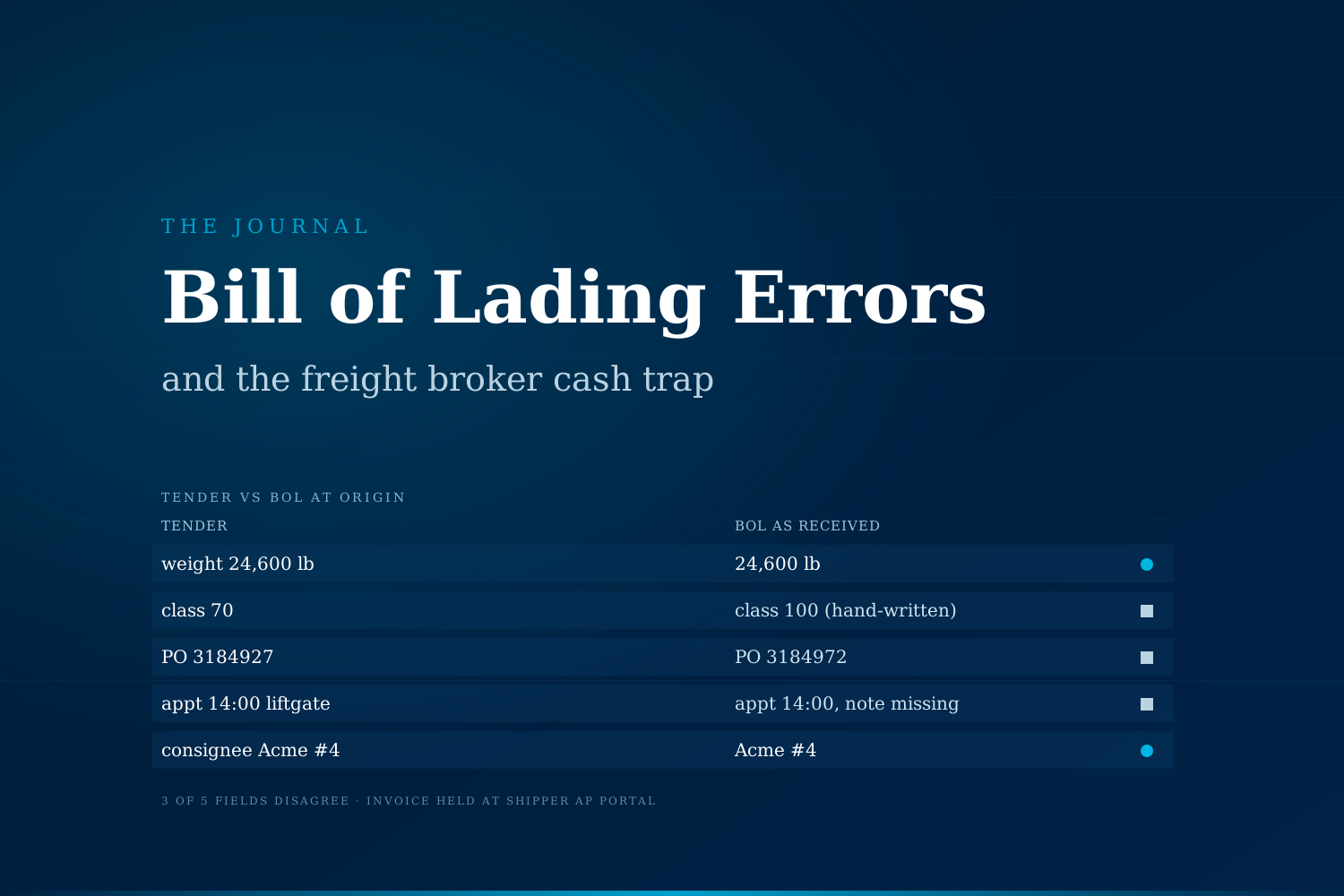
Bill of lading errors stall freight broker invoicing days after the load delivers. Wrong weight, incorrect freight class, missing accessorial notes, transposed reference numbers: what looks like a paperwork nuisance at origin becomes a cash trap at settlement. Invoices sit unbillable, POD matches fail on the first pass, and the receivable ages while accounting plays discovery on documents that should have been correct the moment the driver pulled out.
What counts as a bill of lading error?
A bill of lading (BOL) is the origin document a driver signs when a load is picked up. It confirms what was tendered, who owns the freight in transit, and what the carrier is contracted to move. On the settlement side, the BOL is one of two documents that unlock invoicing (the other is the POD). If it disagrees with the rate confirmation, the tender, or the shipper's system of record, the invoice cannot go out cleanly.
The common shapes of BOL errors on a brokerage desk:
- Weight on the BOL differs from the weight on the tender, sometimes by hundreds of pounds.
- Freight class is written by hand at the dock and disagrees with the NMFC code on the quote.
- Consignee name or address is a legacy record that the shipper's system no longer uses.
- Accessorial notes (inside delivery, liftgate, notify, appointment) are missing or hand-added by the driver after the fact.
- Reference numbers (PO, SO, BOL number, delivery order) are transposed by one digit.
- Shipper signature is missing or on a stamped line that the receiver disputes at delivery.
Each one looks small at pickup. Each one, on its own, is enough to stop an invoice from posting.
Why do BOL errors slip through on manual freight desks?
Because the BOL is produced at the origin dock, often on paper, and travels through three sets of hands before it reaches the brokerage back office. The shipper prints it. The driver signs it. The receiver countersigns it. By the time the imaged copy reaches the brokerage, hours or days have passed, and the desk that booked the load has already moved to the next tender.
Trade coverage in FreightWaves and TIA-member surveys has consistently identified document reconciliation as one of the largest hidden costs in brokerage back offices. The issue is not the BOL template itself. The issue is that manual desks do not have a workflow that compares the imaged BOL to the rate confirmation, the tender, and the shipper's system of record before the invoice is queued.
Instead, the sequence usually looks like this:
- Load delivers.
- Driver emails or texts a photo of the BOL to dispatch.
- Accounting queues the load for invoicing.
- The invoice bounces at the shipper's AP portal because a reference is off or a weight does not match.
- Someone at the brokerage now spends 20 to 40 minutes finding the discrepancy, calling the shipper or the driver, and getting a corrected BOL.
The load has already delivered. The receivable is already aging. The margin on that lane is now competing with the labor cost of the fix.
What does one BOL error actually cost a brokerage?
The direct cost varies. The indirect cost is more consistent:
| Error type | Direct impact | Where it lands |
|---|---|---|
| Weight mismatch (BOL vs tender) | Reweigh charge or shipper short pay | Carrier bill goes up, invoice held |
| Freight class discrepancy | Reclass fee, class 70 to 100 jump | Direct margin loss on LTL loads |
| Wrong consignee address | Redelivery or reconsignment fee | $150 to $600 accessorial exposure |
| Missing accessorial note | Carrier accessorial not billable to shipper | Accessorial revenue lost outright |
| Transposed reference number | POD match fails at shipper AP portal | Invoice ages 10 to 30 extra days |
| Missing signature line | Load flagged as undelivered on paper | Cash on that load stalls entirely |
On a mid-size brokerage running 300 to 500 loads a month, industry commentary suggests BOL discrepancies affect somewhere between 4 and 8 percent of invoiced loads, with about half surfacing at settlement rather than at pickup. That translates to 12 to 40 invoices per month that need active discovery work before the shipper will pay. The Transportation Intermediaries Association has long noted that back-office labor per load is one of the harder brokerage cost lines to compress, and BOL reconciliation is a material share of that labor.
Which desks show the highest BOL error rate?
Three patterns recur:
- High mix of new shippers. Onboarding brings unfamiliar BOL templates, reference conventions, and stamp requirements. Errors follow the learning curve.
- Paper-first origin points. Shippers who still hand out printed BOLs at the dock produce more discrepancies than shippers whose TMS or WMS auto-prints from the tender payload.
- Split responsibility between sales, dispatch, and accounting. The desk that quoted the load is not the desk that catches the invoice bounce, so the feedback loop is slow.
None of these describe a badly run brokerage. They describe a growing one where document reconciliation is the last workflow to catch up with volume.
What changes when AI reviews the BOL against the tender?
An AI-augmented brokerage desk treats the BOL like a reconciliation event, not a filing task. The moment a BOL image arrives (email, driver text, EDI 210, TMS upload), an AI layer reads it, compares the extracted fields against the rate confirmation and the shipper's tender, and flags every discrepancy before the load is queued for invoicing. Nothing about the dispatcher's day changes. Everything about the accounting team's day changes.
| Workflow step | Manual desk | AI-augmented desk |
|---|---|---|
| BOL intake | Image sits in a shared inbox | Fields extracted on receipt |
| Weight check | Retyped or eyeballed | Compared against tender automatically |
| Class check | Not checked until a reclass bill lands | Cross-checked against NMFC on the quote |
| Reference numbers | Rekeyed at invoicing time | Copied from the tender payload |
| Accessorial detection | Depends on driver notes | Detected from BOL text and route data |
| Discrepancy surfacing | At the shipper AP bounce | At origin, before invoicing |
| Corrected BOL request | Reactive, days later | Proactive, within hours |
The invoice that goes out is the invoice that clears. POD matches happen on the first attempt. The shipper's AP portal stops sending bounce codes that the accounting team then has to reverse-engineer.
How does BOL accuracy compound into DSO?
BOL accuracy is a leading indicator of first-pass invoice acceptance, and first-pass acceptance is the direct input into brokerage DSO. Consultant coverage and TIA member observation have documented DSO ranges of 35 to 55 days for mid-size freight brokerages, and BOL discrepancies sit inside that number even when nobody attributes them there.
A brokerage that reduces its BOL discrepancy rate from 6 percent to under 2 percent typically sees:
- 4 to 7 days off DSO within a quarter.
- 25 to 45 percent fewer manual settlement adjustments.
- A measurable drop in reclass and reweigh charges the brokerage was absorbing quietly.
- A less friction-heavy relationship with the accounting teams at the top 20 shippers.
None of that requires a new lane, a new sales hire, or a bigger back office. It is cash that was already earned, sitting inside document friction the desk had not priced.
Three signs your BOL workflow is due for a review
Three quick observations from a desk visit:
- Accounting keeps a private list of shippers whose BOLs "always" need clarification.
- Dispatchers rekey reference numbers into the TMS after the load delivers.
- More than one out of every twenty invoices bounces the first time it hits a shipper AP portal.
If any of these are true, the workflow is not broken. It is doing exactly what a growing brokerage's workflow does. It is also the highest-leverage place to insert an AI layer, because the fix compounds directly into cash conversion rather than into anything the sales team has to hunt for.
Where the pattern is heading
BOL reconciliation is one of those workflows that never shows up on a strategic planning slide, because nobody wants to spend the quarterly review talking about paperwork. That is exactly why it stays broken longer than it should. Brokerages that automate BOL review early tend to keep the DSO gains permanently, because the labor that used to reconcile documents redeploys onto lanes or into shipper conversations. Brokerages that wait continue to hire the next accounting clerk to keep up.
The interesting shift is not the technology. It is the moment the accounting team stops treating BOLs as a mystery to solve and starts treating them as a queue that clears on its own by lunch.
Closing
If any of the patterns above sound familiar, we run a completely free automation audit for freight brokerages. No commitment, no slide deck. We spend an hour with your team, walk your last thirty days of invoice bounces, and show you where an AI layer would have caught the BOL discrepancies before they left the origin dock. → Book yours
Sami Raza
Software Developer & Technical Author
Sami Raza builds AI automation for logistics, DTC, and construction operations teams at ApexifyLabs, and writes about the operational failures that automation is actually worth pointing at.