Cancellation Reason Capture and the DTC Winback Blind Spot
Most DTC subscription cancellation flows fail to capture why a subscriber left, and the brand loses winback revenue the reason data would unlock.
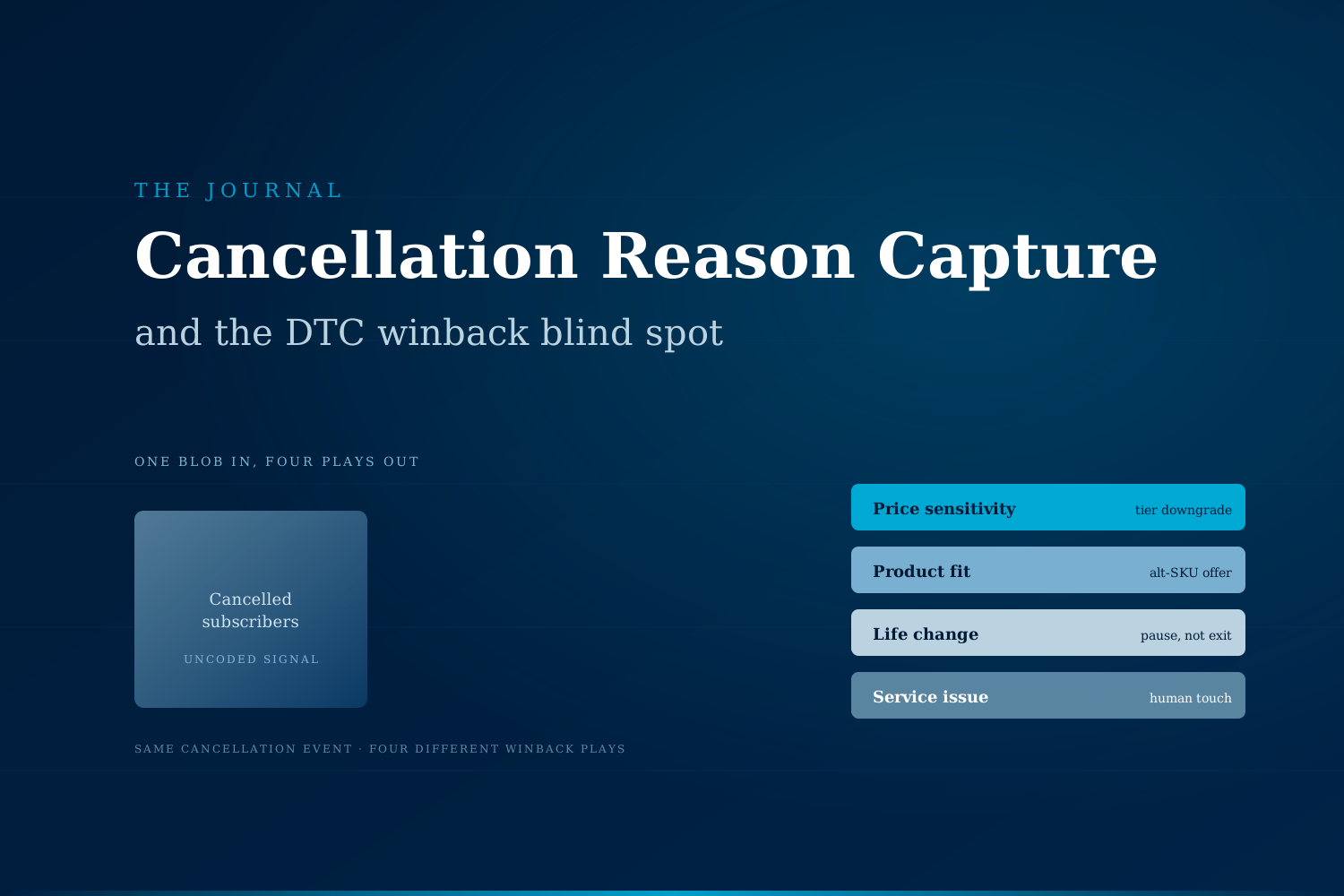
DTC brands lose winback revenue not because subscribers cancel, but because the cancellation flow rarely captures why they left in a form the retention team can act on. Reason dropdowns summarize nothing, free-text answers go unread, and the brand ends up sending the same generic "come back" offer to every ex-subscriber.
What is the cancellation reason capture gap?
The gap is the distance between why a subscriber actually left and what your retention system knows about it. On most DTC subscription flows, three things happen in the last 90 seconds of the customer relationship: a click on "Cancel subscription," a canned dropdown, a confirmation screen. The dropdown ships six or seven options, most of them abstract ("Too expensive," "Not using enough," "Other"), and the free-text field, if it exists, feeds a support queue nobody reads at scale.
The reason data that survives that flow is almost always low-signal. It groups a subscriber who churned because a competing brand launched a better formula in with one who moved apartments and lost the delivery address, and one who is going through a career change and cannot afford a $60 monthly box. Three different problems, three different winback plays, one blob labelled "Not using enough."
Why does the reason field usually fail?
Three failure modes stack on top of each other in most DTC cancellation flows.
The dropdown that summarizes nothing. Reason menus are typically written once, by whoever built the cancellation page, and never revised. "Too expensive" is not actionable because it lumps price sensitivity in with perceived value. "Product didn't work for me" is not actionable because it flags a defect, a fit issue, or a misuse pattern equally.
The free-text field nobody reads. When brands add "Anything else you'd like us to know?" they capture real signal, sometimes the most valuable qualitative data the brand has. That data lands in a support ticket queue or a spreadsheet export, and unless someone codes it manually every week, it sits.
The exit page that isn't instrumented. Some brands run a "final offer" page (a discount, pause, skip, or downgrade choice). Whether the customer accepts, declines, or bounces off entirely is often not tracked as a distinct event, so the brand cannot tell which subscribers were saveable and at what cost.
Which subscription categories feel this hardest?
Any brand where subscriber lifetime value drives the P&L feels this, but three categories carry the sharpest exposure.
- Consumables (beauty, supplements, coffee, pet food). The winback window is short, roughly one purchase cycle. If the brand cannot re-engage the customer inside that window, the customer buys elsewhere and the routine sets.
- Curated boxes (apparel, food, hobby kits). Reason capture matters because "the last box wasn't a fit" is often a curation problem, not a cancellation reason, and can be fixed with a preference update rather than a discount.
- Digital-plus-physical hybrids (fitness, wellness, learning). Cancellations often reflect a lapse in the digital habit, not a rejection of the product. Different intervention entirely.
How much winback revenue is actually on the table?
Subscription-industry research consistently reports that meaningful winback recovery is possible when brands act on the right signal at the right time. Zuora's 2024 Subscription Economy Index puts subscription churn recovery among the highest-leverage retention levers when reason data drives the offer. Recharge's 2024 State of Subscription Commerce report notes that brands running segmented winback flows outperform brands sending blanket "we miss you" campaigns on both re-activation rate and post-winback LTV.
The exact recovery rate varies by category and offer, but the pattern in the data is consistent. The brands that recover the most revenue from cancelled subscribers are the ones that know why the subscriber left. The brands that recover the least are the ones that treat every cancellation as identical.
What changes when the reason is captured, coded, and routed?
Three things shift.
Winback offers stop being blanket. A brand that knows a subscriber left because of a price ceiling can send a lower-tier product recommendation instead of a discount that trains the customer to expect a discount every time. A brand that knows a subscriber left because a specific SKU underperformed can lead the winback with a different SKU. A brand that knows a subscriber moved and lost the delivery address can send a simple "update your address" nudge, not a re-onboarding sequence.
Product feedback loops close faster. Reason data, when it is coded consistently, tells product and merchandising teams which SKUs, formulations, or price tiers are shedding subscribers. That signal usually exists in support tickets and support notes today, but it never gets to the merchant on a weekly cadence because nobody has the hours to summarize it.
Retention team routing gets smarter. A subscriber who cancels citing a service issue (missing delivery, damaged box, incorrect ship date) is a different retention conversation than a subscriber who is downsizing their budget. Right now, both usually get the same automated email. When reasons are captured and coded, those two subscribers get routed to two different playbooks, and the higher-intent ones get a human touch instead of a template.
Manual reason coding vs AI-assisted reason coding
The traditional way to close this gap is to hire a retention analyst who reads free-text cancellation responses, codes them into categories, and updates the retention team's dashboards on a cadence. That works, but the cadence is usually monthly at best, the coding drifts across analysts, and free-text volume tends to outpace what one person can sustainably read.
The AI-assisted alternative reclassifies free-text answers, exit-page selections, and support-note context into a consistent taxonomy in near real time, then routes each cancellation event to the correct winback flow based on that classification.
| Dimension | Manual reason coding | AI-assisted reason coding |
|---|---|---|
| Coding cadence | Weekly to monthly | Near real time |
| Free-text volume tolerated | Limited by analyst hours | Not the bottleneck |
| Category consistency | Drifts across coders | Consistent by design |
| Winback flow routing | Static, one offer | Dynamic, matched to reason |
| Product signal to merchants | Monthly summary at best | Weekly, with SKU-level tags |
| Handles multi-language answers | Rarely | Yes, by design |
| Cost profile | 1 FTE analyst | Setup, then low variable cost |
The point of the table is not that AI replaces the analyst. It is that the analyst stops doing coding and starts doing what the coding was meant to enable: offer design, product feedback, strategy.
Three questions to run against your own cancellation flow
None of these require a tool change. They test whether the flow captures usable signal today.
- If you pulled last month's cancellations, could you separate the "product fit" cancellations from the "budget" cancellations from the "life change" cancellations? If not, the dropdown is coarser than the decisions the retention team wants to make.
- What percentage of your free-text cancellation responses were read by a human in the same week they were submitted? If the honest answer is under a quarter, the free-text field is theatre.
- Do subscribers who cite different reasons actually receive different winback offers? If everyone lands in the same "come back and save 20%" flow, the reason capture is not driving the outcome it was meant to drive.
Any brand that answers "no, no, no" to these three is probably running a large winback blind spot, and the fix is upstream of the winback offer itself.
Capturing the reason inside the cancellation conversation, rather than in a dropdown after the fact, is one of the more useful things a purpose-built AI chatbot does: it can ask a single follow-up question and code the answer in the same motion. The adjacent leaks worth reading are card-on-file declines, the store-credit versus cash-refund split, and return-to-exchange conversion.
Where does this sit on the retention roadmap?
Reason capture is not a replacement for a good retention program. Save flows, pause options, downgrades, and product improvements all still matter. What reason capture does is make every other retention lever sharper. A pause option is more valuable when you know which subscribers to offer it to. A downgrade is more valuable when you know which price tier the ex-subscriber was signalling toward. A product roadmap is more valuable when the merchandising team sees this month's cancellation reasons segmented by SKU, not aggregated into one "product feedback" bucket.
The compounding effect is what makes this quiet leak matter. Every cancellation with an uncoded reason is a decision the retention team could have made better, and the cost is not just the missed reactivation, it is the missed input into every future retention decision as well.
If any of this feels familiar, we run a completely free automation audit for DTC brands that suspect they are leaving winback revenue on the table. No slide deck, no obligation, just a working diagnosis of where your cancellation and reason-capture flow is losing signal. → Book yours
Sami Raza
Software Developer & Technical Author
Sami Raza builds AI automation for logistics, DTC, and construction operations teams at ApexifyLabs, and writes about the operational failures that automation is actually worth pointing at.