Store Credit vs Cash Refund: The DTC Repeat-Purchase Split
When a DTC refund defaults to cash instead of store credit, the retention math shifts on every returns cohort. See where the RMA step decides the split.
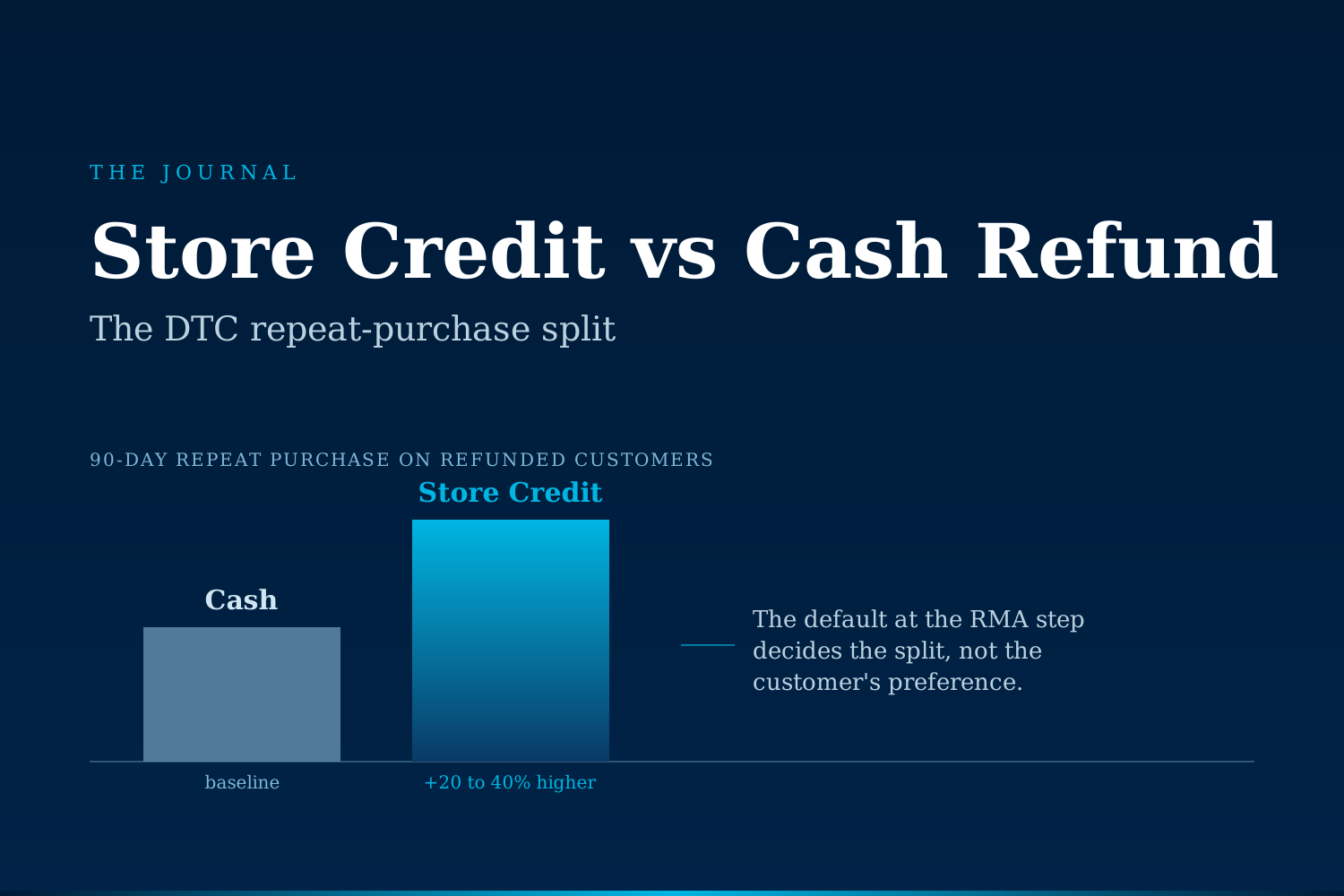
When a DTC customer requests a refund, the choice between store credit and cash decides more than the return outcome. Store credit keeps the customer inside the brand's revenue loop and lifts repeat purchase rates by a measurable margin. Cash sends them elsewhere. The operational question is how the RMA step is designed.
What is the actual difference between store credit and a cash refund?
A cash refund puts money back on the customer's card and closes the loop with the brand for that order. A store-credit refund books a credit balance in the customer account, redeemable on future purchases. The dollar value is often equal, but the retention behavior is not.
Loop Returns' industry benchmarks, based on retention data across mid-market DTC brands, have repeatedly shown that customers who accept store credit come back and spend at meaningfully higher rates than customers who take a cash refund. Their return-analytics reports frame this as a "retained revenue" metric, and the direction of the finding matches what returns platforms like Narvar and Yotpo have published in adjacent research.
The reason is behavioral. A cash refund is a completed exit. A store-credit balance is an open pattern of attention, a receipt with a dollar value the customer can spend against, sitting in their inbox and account dashboard until it is used.
Why does the default refund method matter so much?
Most brands treat the refund method as a customer preference, an operational afterthought handled at the RMA step. But defaults set behavior. When cash is presented first, cash gets picked. When store credit is presented first with a small incentive attached, store credit gets picked more often than most operators expect.
This is a familiar default-effect pattern. Choice-architecture research has been consistent across categories: framing store credit as the primary refund path, and cash as a secondary option, reshapes the mix without any change in customer sentiment when the incentive is fair.
At the P&L level, the impact runs three ways at once:
- Retained revenue. The refunded dollars stay inside the brand's account balance instead of returning to the card issuer.
- Attach on the next order. Customers redeeming store credit almost always spend past the credit balance. The average uplift on the redemption order is where brands recover full-price margin.
- Reduced processing cost. Every card refund carries interchange and gateway fees. Store credit does not. On high-volume returns, this alone is a low single-digit percent of processed volume.
How do most DTC brands currently handle refund method?
The typical mid-size DTC ops setup runs one of three patterns.
- Default to cash, silent option for store credit. The RMA portal shows cash as the primary path. Store credit is available if the customer asks, or is buried under a secondary menu. This is what most Shopify-native brands default to, and it maximizes cash refunds.
- Cash unless the CS agent intervenes. CS reps manually offer store credit during ticket resolution, but only when a customer pushes back on the reason for the return. The offer is inconsistent, and depends on which rep handled the ticket.
- Store credit default with a fair incentive. The RMA portal presents store credit first, often with a modest boost (a small percentage on top of the refund value). Cash refund is one click away, still available, but the frame has shifted. This is the pattern high-retention DTC brands settle into, and it is the one that shows up in the retention data.
The first two patterns are common. The third is not, and the P&L difference between them is not small.
Store credit vs cash refund: the operational comparison
The table below is what a mid-market DTC brand can expect on a hundred-order returns cohort, based on retention benchmarks published by returns platforms and adjacent industry surveys. Numbers are directional, not universal, and vary by category, price point, and brand affinity.
| Metric | Cash-default RMA | Store-credit-default RMA |
|---|---|---|
| Share of returns settled in store credit | Under 15% | 40 to 60% |
| Repeat purchase rate within 90 days | Baseline | 20 to 40% higher on refunded customers |
| Average redemption order value vs credit balance | Not applicable | 130 to 170% of credit value |
| Refund processing cost per return | Card and gateway fees | Zero |
| Customer sentiment on the refund flow | Baseline | Roughly comparable when the incentive is fair |
| CS ticket volume for refund-method changes | Baseline | Slightly lower (fewer follow-up asks) |
The retention lift in the second column is what makes this a P&L conversation, not a customer-service one. On an apparel brand running fifteen percent monthly returns, shifting a meaningful share of those returns into store credit is often worth more than a paid-media optimization pass.
Where does the RMA workflow decide the outcome?
The refund method choice does not get made when the customer emails support. It gets made at the moment the RMA request is confirmed, on the returns portal, before the shipping label is printed. Three points inside that flow set the outcome.
- Order of presentation. Cash-first or credit-first. Whichever comes first wins the majority of picks.
- Framing of the credit option. A neutral label ("store credit") lands differently than a value label ("get a small credit boost, redeemable now"). The framing does not have to be aggressive to work.
- Reason-code branching. A "damaged item" reason should not force store credit; a "changed my mind" reason can safely default to it. Reason-aware defaults protect customer trust while capturing retention on the right cohort.
Brands that handle refund method well are not being clever. They are treating the RMA step as a marketing surface, not a support flow.
What changes when the refund workflow is agentic?
The RMA portal is one surface, but the refund workflow spans several. An AI-augmented workflow closes a few specific gaps without replacing the CS team's judgment.
- Reason-code parsing. Customer-written return reasons in the free-text field get parsed into the underlying reason category. The refund default aligns with the reason automatically, so damaged and defective returns route to cash while preference returns route to credit.
- Fairness checks on the incentive. The credit boost size gets tuned by cohort. A first-time buyer might see a different offer than a customer with three prior returns. The workflow enforces the rule so CS reps do not have to remember it.
- Retention-aware routing. High-LTV customers who explicitly ask for cash get it, without friction. Categories where cash refunds hurt the brand get a stronger credit default. Segment-level rules run in the background, not on the CS rep's shoulders.
- Ledger cleanup. Store-credit balances that expire, get partially redeemed, or convert to cash get reconciled without a separate spreadsheet. Finance sees the accrued liability as a live number, not a quarterly reconstruction.
- Post-refund nudge. When a store-credit balance lands, the customer gets a well-timed reminder before redemption drops off. This is where store credit's retention math actually converts.
None of this requires the ops team to build new tools. It requires the ops team to decide what the default should be, and to let a workflow enforce it consistently.
Three signs your refund workflow may be leaking retention
- The refund-method mix skews above ninety percent cash. If almost every return settles in cash, the RMA step is defaulting for you, and the retention math is not landing.
- CS reps are the ones offering store credit on a case-by-case basis. Consistency is the whole point of a default, and case-by-case offers are the opposite of that.
- Store credit balances live in a spreadsheet, not on the customer record. If finance and CS have different totals, the workflow is not really running.
When is a cash refund the right answer?
Store credit is not the right default in every case. Damaged product, defective units, wrong item shipped, and clearly negative customer moments should settle in cash without a nudge. Store credit as a default belongs on preference returns (fit, color, taste, changed mind), not on brand failures. Brands that miss this line burn trust, and the retention math does not survive lost trust.
Reason-aware defaults are the single most important guardrail. Every refund method comparison that ignores the reason code will eventually push credit onto the wrong return and pay for it in reviews.
Book a free automation audit
If store credit is defaulting to under fifteen percent of your returns and CS reps are the ones catching the exceptions, the retention math is available on the P&L. We run a completely free automation audit for DTC operators who want a second opinion on where their RMA workflow could move without breaking the customer experience. No slide deck, no commitment. → Book the audit
Sami Raza
Software Developer & Technical Author
Sami Raza builds AI automation for logistics, DTC, and construction operations teams at ApexifyLabs, and writes about the operational failures that automation is actually worth pointing at.