Card-on-File Declines and DTC Subscription Churn
Failed renewal payments drive 20 to 40 percent of DTC subscription churn at most brands. Most desks still treat dunning as a billing problem, not a customer one.
When a card on file fails on a DTC subscription renewal, the customer rarely sees the email, the retry sequence is static, and the relationship often ends without either side noticing. Brands that treat dunning as a billing problem lose customers worth thousands. Brands that treat it as a customer-experience problem recover most of them.
What happens when a subscription card declines on renewal day?
The renewal job fires on schedule. The card processor returns a decline code, which can mean anything from "insufficient funds today" to "issuer reissued the card last month and we never got the update." The billing platform queues a retry, sends a templated email, and marks the subscription past_due. From the brand's dashboard, this is a routine billing exception.
From the customer's side, almost nothing visible happens. The product they expected does not ship. An email may have arrived in a promo tab they do not check. They assume the brand will sort it out. A week later they have moved on to a competitor's product, and the brand has marked the subscription as cancelled for non-payment.
Recurly's subscription benchmarks consistently show involuntary churn accounting for 20 to 40 percent of total churn at consumer subscription brands. ProfitWell's recurring revenue research lines up: for most DTC subscription brands, failed payments are not the largest single cause of cancellation, but they are the largest cause of cancellation that the brand could plausibly recover.
Why is involuntary churn worse than voluntary churn?
A voluntary cancellation is information. The customer is telling you something is wrong (price, fit, frequency, value), which gives the brand a chance to fix the underlying objection. An involuntary cancellation tells you nothing useful. There is no exit reason, no NPS clue, no win-back trigger. The lifetime value just stops.
The math compounds because involuntary churn is concentrated in the customers brands most want to keep. Long-tenured subscribers are more likely to have a card on file long enough to expire or be reissued. The 18-month customer with a $1,400 projected LTV is statistically more likely to churn for a card reason than the 30-day customer, and statistically less likely to be recovered if no one notices for two weeks.
What does a typical manual dunning sequence look like?
Most DTC brands inherit the default dunning flow from whatever subscription billing tool they use. The defaults are reasonable on paper and surprisingly fragile in practice.
A fixed retry cadence
Default retries happen on calendar days (often days 1, 3, 7, 14) regardless of why the card failed. A card declined for "do not honor" on a Wednesday morning has different odds of clearing on Wednesday night than on the following Monday. Static retries ignore this. They burn opportunities, and they also burn issuer trust, which can cause subsequent attempts to look like card-testing patterns to fraud systems.
A templated email cadence
The default email is a polite "we couldn't process your payment" line with a billing-portal link. It is identical for the customer whose card was reissued, the customer whose bank flagged the charge for fraud review, and the customer who is genuinely short of funds for the week. The open rate is usually low, the click-through to the update-card page is lower, and the brand never learns which segment the customer fell into.
A blind spot on bank decline reasons
Issuer decline codes are coarse and inconsistent across networks. "Insufficient funds" sometimes means insufficient funds and sometimes means the issuer is rate-limiting recurring transactions on that card type. "Do not honor" is the catch-all that hides at least a dozen real causes. A manual ops team cannot decode these at scale, so the retry strategy ends up treating every decline as the same kind of problem.
How does an AI-assisted dunning flow differ?
The shift is not about sending more emails. It is about treating each failed renewal as its own small problem with its own probabilities.
| Dimension | Manual / default dunning | AI-assisted dunning |
|---|---|---|
| Retry timing | Fixed calendar days | Adapted to decline code, issuer pattern, prior cardholder behavior |
| Customer message | One templated email per attempt | Message segmented by likely cause (expired, reissued, soft decline, hard decline) |
| Update-card path | Generic billing portal link | One-tap update flow, sent through the channel the customer last responded to |
| Recovery visibility | A past_due count in the dashboard | Per-cohort recovery rate, expected revenue at risk, decline-reason mix |
| Escalation | None until cancellation | A human-touch attempt on high-LTV cohorts before the final retry |
| Time to detect a structural issue | Weeks | Same-day, because pattern shifts are surfaced instead of buried in a totals row |
Stripe has published data on its adaptive retry product (Smart Retries) showing it recovers a meaningful additional share of payments compared with static schedules. Public case studies from other payment platforms report recovery uplifts in the 10 to 30 percent range over default flows. The exact number any specific brand can expect depends on cohort mix, average order value, and how well the customer messaging is segmented. The direction, across sources, is consistent.
What is the realistic recovery uplift for a $2M to $30M DTC brand?
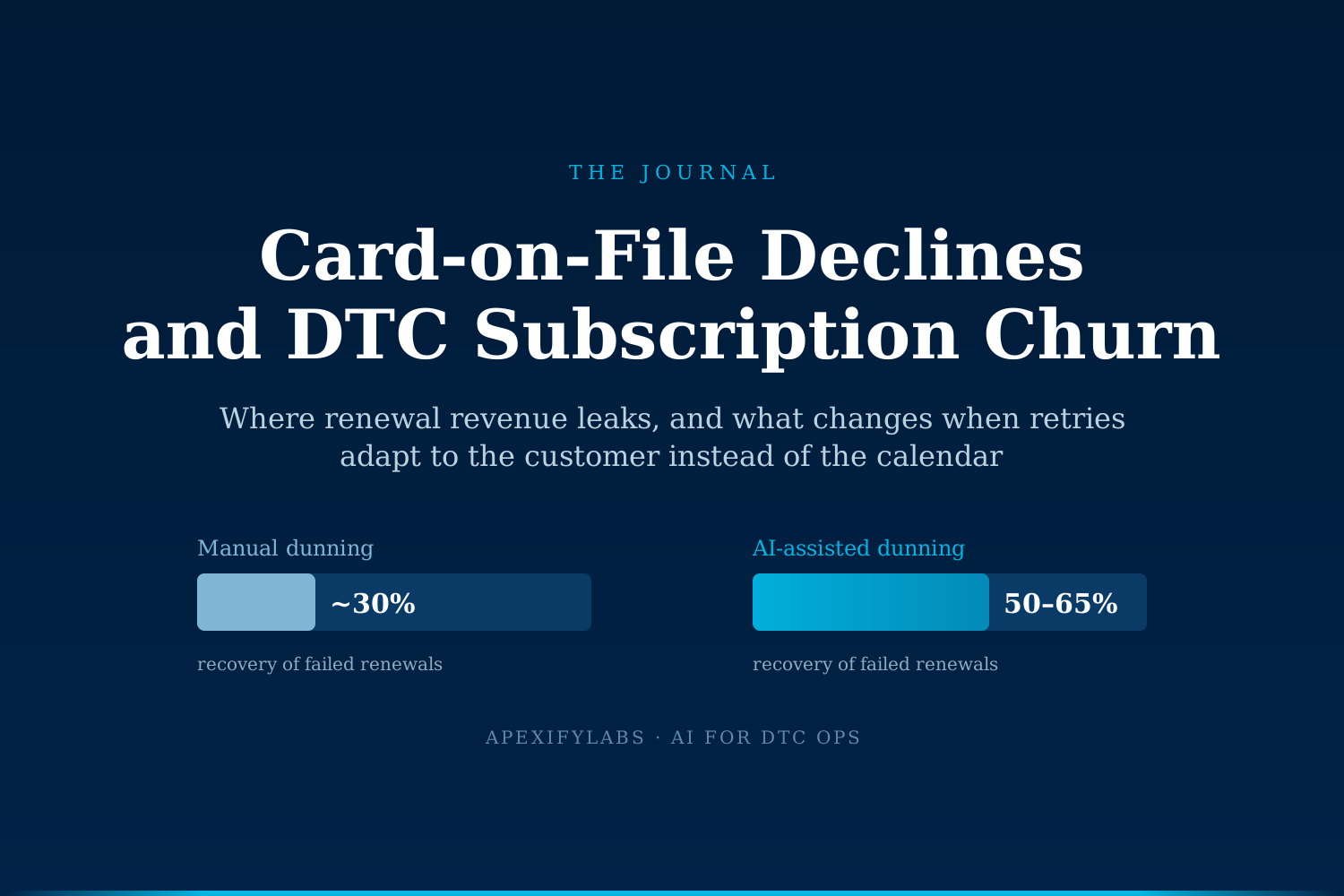
The honest answer is a range, and it depends on where the brand starts. A brand whose current dunning recovers roughly 30 percent of failed payments (a typical industry default) and whose involuntary churn accounts for around a quarter of total churn can usually move recovery into the 50 to 65 percent range with adaptive retries and segmented messaging. That math turns into real numbers fast at $2M plus in annual subscription revenue.
The second-order effect matters more than the first. Recovered customers do not just preserve the next renewal. They keep their LTV trajectory intact. A brand that loses a $1,200-LTV customer at month 14 because the card-reissue email went to a promo tab is not losing $80 of MRR. It is losing the remaining $600 of expected revenue, plus the referral and review tail.
Three signs your DTC subscription brand is leaving renewal revenue behind
- Your past_due bucket gets reviewed weekly, not daily. By the time a Friday review meeting happens, the Monday card failures have already cooled. The customer has moved on. The recoverable window for most decline codes is the first 48 to 72 hours.
- Your dunning email reads the same to every cohort. If a long-tenured customer with a reissued card gets the same templated message as a new subscriber with a true insufficient-funds decline, the message is doing none of the work it could be doing.
- You cannot tell, this morning, which decline reason is driving your past_due growth. When the answer to "why is involuntary churn up this week" requires pulling a CSV and pivoting it, the brand is operating with a two-week lag on a problem that resolves itself in 72 hours.
If any of these match, the recovery story for the next renewal cycle is already partly written. Brands that close the loop here usually do it not by adding people to billing ops, but by giving the existing team a system that decides per-card, per-customer, instead of per-calendar-day.
What we are not covering here
This piece is not a build guide. We are not publishing the issuer-code decision tree, the retry-timing model, the segmentation logic, or the messaging templates that make a closed-loop dunning flow actually recover the additional share. Those are the engineering, and they differ meaningfully by billing platform, processor, and customer mix. What this article is for: clarifying what the operational shift looks like, what the recoverable dollars typically are, and whether the underlying problem is worth solving on your desk.
If you run a DTC subscription brand and want a second opinion on what your current dunning flow is leaving on the table, we offer a completely free automation audit. No commitment, no slide deck, just a clear read on the recovery math and the next move. → Book the audit
Sami Raza
Software Developer & Technical Author
Sami Raza builds AI automation for logistics, DTC, and construction operations teams at ApexifyLabs, and writes about the operational failures that automation is actually worth pointing at.