AI Automation vs Manual 3PL Billing: Where Revenue Leaks
Kitting, relabeling, rush receipts, storage snapshots. The work gets done on the floor every day, but a surprising share of it never reaches the client invoice.
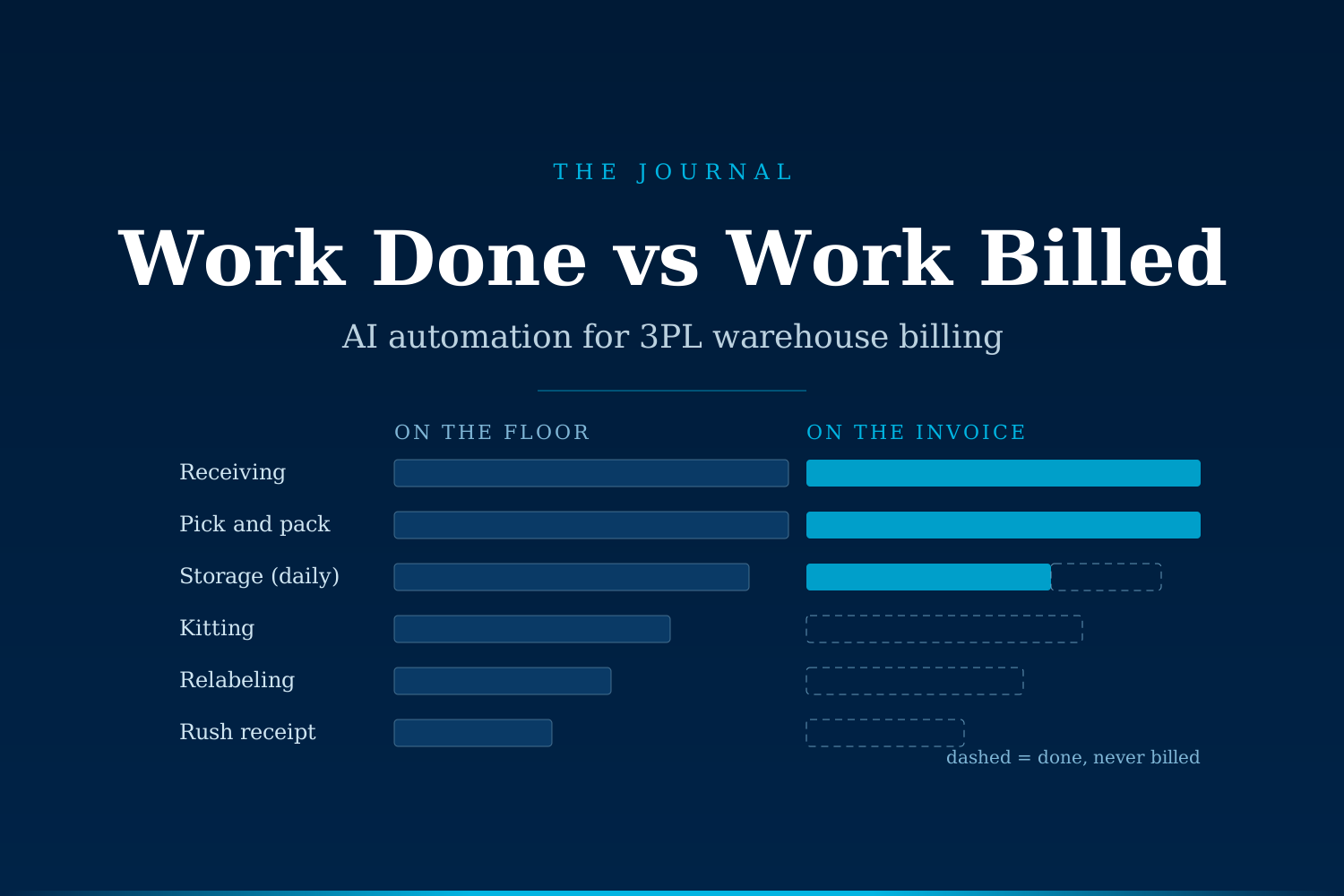
AI automation for 3PL billing captures every billable warehouse event as it happens (receipts, picks, value-added services, storage, special requests), matches it to each client's rate card, and flags anything unpriced before the invoice goes out. Manual billing rebuilds the month from memory and spreadsheets, which is where billable work slips away.
Why does 3PL billing leak revenue in the first place?
A 3PL does not sell one product at one price. It sells dozens of small services to each client, and every client has a slightly different rate card. Receiving by the pallet or by the carton. Storage by the pallet position, the bin or the cubic foot. Pick fees per order and per line. Then the long tail: kitting, relabeling, rework, photo requests, cycle counts the client asked for, a rush receipt on a Friday afternoon.
The core activity usually bills fine because the warehouse management system records it. The leak sits in the tail. Value-added work is often agreed by email, done by a lead on the floor, and written on a sheet or in a chat message. By the time billing closes the month, the person preparing invoices has to find that work, confirm it was approved, look up the rate, and work out quantities. Anything that was not written down clearly enough does not get billed.
Software vendors in the space put numbers on this. Camelot 3PL Software estimates that 3PLs lose between 5% and 15% of annual revenue to billable activities that are never captured or invoiced. SC Codeworks, which runs event-by-event billing audits for mid-market warehouses, reports typically finding 6% to 9% of billable revenue unbilled. These are vendor estimates rather than independent research, so treat them as a range to test, not a guarantee. Even the low end, on a $20M operation, is real money.
What usually goes unbilled at a 3PL warehouse?
When warehouse operators walk through a month of activity against the invoices that went out, the misses tend to cluster in the same places:
- Value-added services agreed outside the system. Kitting, bundling, relabeling and inspection requests that arrive by email and never become a work order.
- Storage calculated from a single snapshot. Billing storage on the month-end count rather than actual daily occupancy undercharges any client whose inventory peaks mid-month, which is most of them ahead of a promotion.
- Exceptions on inbound. Floor-loaded containers, mixed-SKU pallets, missing or wrong ASNs and labeling fixes all take extra labor. Contracts often allow a charge for them; few invoices show it.
- Ad hoc client requests. Pulling a sample, photographing damage, counting a SKU on demand, holding an order. Each is small. Across a client base, they add up every week.
- Rate changes that never reached the billing sheet. Annual escalators or renegotiated rates that were signed but not updated in the template used to invoice.
None of these are failures of the warehouse team. They are failures of capture. The work was done. The record of it just lived somewhere billing could not see.
How does AI automation change 3PL billing?
The shift is from reconstructing the month to recording it as it happens. An AI automation layer sits between the places where billable work shows up (the WMS, client emails, floor notes, scanner events, the ticketing system) and the billing process.
When a client emails "can you relabel the 400 units of SKU 2210 before Thursday's ship," the automation reads the request, recognizes it as a billable service under that client's agreement, and opens a pending charge linked to the email. When the floor marks the job complete, the charge is confirmed with the actual quantity. If the client's rate card has no price for that service, the item goes to a person to price before the month closes, not after the client has paid.
Storage works the same way. Instead of a month-end snapshot, the system computes occupancy daily against each client's terms and shows the difference between what the contract supports and what the old method would have billed.
At month end, the billing team is no longer hunting for activity. They are reviewing a draft invoice where every line traces back to a source event, plus a short list of exceptions that need a human call.
Manual 3PL billing vs AI-automated billing: how do they compare?
Here is how the same month looks under each approach.
| Billing step | Manual month-end process | With AI automation |
|---|---|---|
| Capturing value-added work | Found in emails, floor sheets and memory at month end | Logged from the request and confirmed when the job closes |
| Storage charges | Usually one month-end snapshot | Calculated daily against each client's contract terms |
| Rate lookup | Person checks each client's rate card by hand | Rates applied automatically; unpriced items flagged |
| Rate changes and escalators | Depend on someone updating the template | Applied from the contract effective date |
| Disputes from clients | Hard to answer without digging through records | Each line links to its source event and approval |
| Time to close billing | Days of work for the billing team each month | Review and approve, then handle exceptions |
| Visibility during the month | None until invoices are built | Running unbilled total by client, every day |
The common thread is evidence. Under the manual process, a charge exists only if someone remembers it and can prove it. With automation, the proof is captured at the moment of work, so billing becomes a review step instead of an investigation.
Is this the job of the WMS billing module?
Partly, and it is worth being clear about the boundary. Most modern warehouse management systems include billing features, and they handle the events the WMS itself records: receipts, picks, shipments, storage. If those events are configured correctly, they bill reliably.
What a WMS rarely sees is everything around it. The relabeling request in an account manager's inbox. The rework the floor did because the inbound arrived wrong. The verbal yes from a client's ops lead on a rush. AI automation earns its place in that space, reading the unstructured channels where billable work actually originates and turning it into structured charges the billing module can use. It complements the WMS; it does not replace it.
This mirrors what we see on the client communication side. In our piece on AI agents and the 3PL client email backlog, the same inbox that holds status questions also holds most of the service requests that later go unbilled.
What does unbilled work do to 3PL margin?
Warehouse margins are thin, and the work that leaks is often the most labor-intensive work in the building. A pallet sitting in storage costs little to handle. A kitting job ties up a team for a shift. When that job goes unbilled, the 3PL has paid for the labor and collected nothing.
There is a second-order cost too. Clients get used to free services. A relabeling job that was never billed in March becomes an expectation in April, and raising it later turns into an awkward commercial conversation. Accurate capture from the start protects pricing as much as revenue.
It also matters at renewal. The 31st annual Third-Party Logistics Study found that 74% of shippers are consolidating the number of logistics providers they use. When fewer 3PLs keep each account, clean, explainable invoices become part of how a provider earns its place. Shippers notice when every line can be traced, just as brands notice when a 3PL invoice does not add up, a problem we covered from the brand's side in the DTC 3PL invoice audit most brands never run.
Freight brokerages face a close cousin of this problem with detention, layover and other extras, which we wrote about in the accessorial revenue most brokerages forget to bill. The pattern is the same: the work happens, the evidence is scattered, and billing arrives too late to collect it.
How can a 3PL tell how much it is missing?
A useful first check does not require new software. Take one client and one recent month. Pull every email, ticket and floor note that mentions a special request, then compare that list against the invoice. Most operators who try this find lines they expected to see and did not.
A second check is storage. Compare what the client was billed on the month-end snapshot with what daily occupancy would have produced under the same contract. For seasonal clients, the difference is often visible within minutes.
A third is the rate card itself. Look at when each client's rates last changed in the billing template, and compare that with the dates in their signed agreements.
What these checks will not tell you is how to fix it permanently across every client, every channel and every month. That depends on how your WMS, your inboxes and your floor processes fit together, and it is where most homegrown fixes stall.
What a billing automation build looks like for a 3PL
Every warehouse runs billing a little differently, so we start with how yours works today: which WMS you use, where client requests arrive, how floor teams record extra work, and how your rate cards are structured. From there, we build automation that captures billable events from those sources, prices them against each client's terms, and gives your billing team a reviewable draft with exceptions flagged. Your team keeps every pricing decision. You can see how we approach warehouse and freight operations on our logistics industry page.
If you suspect your invoices are lighter than the work your floor is doing, we offer a completely free automation audit. We will review one client's month with you and show where billable activity is being lost and what capturing it would be worth. → Book the free audit
Sami Raza
Software Developer & Technical Author
Sami Raza builds AI automation for logistics, DTC, and construction operations teams at ApexifyLabs, and writes about the operational failures that automation is actually worth pointing at.