AI Chatbot or Inbox? Rethinking Freight Claims Intake
Damage photos in one thread, the delivery receipt in another, the invoice still missing. Most freight claims slow down before anyone has even filed them.
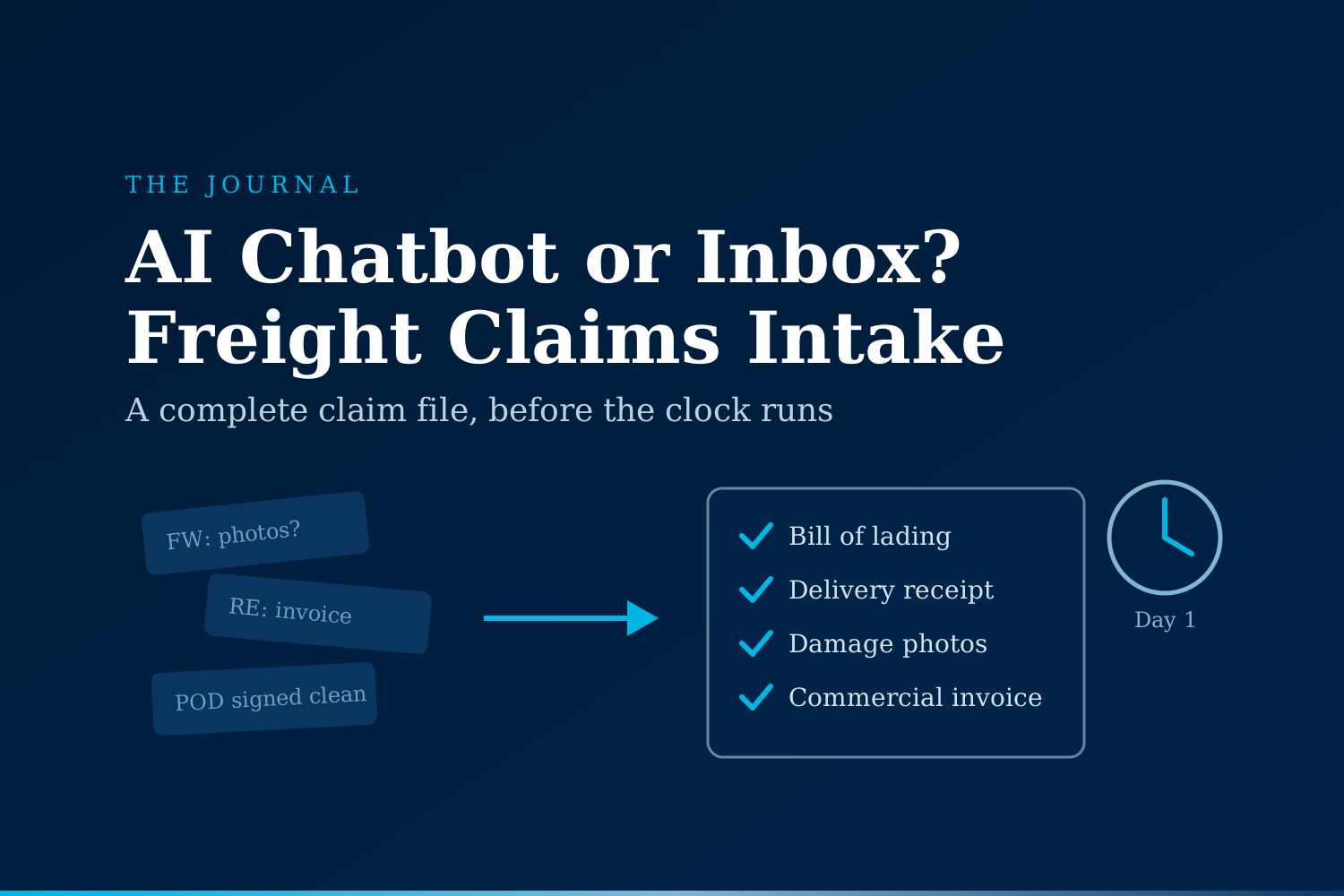
An AI chatbot for freight claims takes the first report of damage, shortage or loss from a shipper, consignee or driver, asks for the exact documents and photos the claim will need, checks them against the shipment record, and starts the deadline clock. Brokers and 3PLs get a complete claim file in hours instead of a thread that drags on for weeks.
Why do freight claims stall before they are even filed?
Ask a claims coordinator at a freight brokerage or 3PL where their week goes, and the answer is rarely "arguing with carriers." It is chasing the claimant. A consignee reports crushed pallets on a phone call. The shipper's customer service rep forwards two blurry photos. Someone asks for the commercial invoice, and it arrives nine days later. The delivery receipt turns out to be signed clean, so now the conversation is about concealed damage and whether anyone noted it in time.
None of this is unusual. In a 2024 shipper survey commissioned by Flock Freight, respondents reported an average LTL damage rate of 1.94% in 2023, roughly one damage or loss claim for every 51 shipments, at an average cost of about $3,777 per claim. The same study found 37.8% of businesses have at least one employee dedicated to damage claims, disputes and accessorial fees.
For a brokerage moving a few thousand LTL shipments a month, that is dozens of new claims every month, each one starting as an unstructured conversation. The money is real, but the drag usually comes from the intake step: incomplete files, missing documents and nobody sure which deadline applies.
What does an AI chatbot for freight claims actually handle?
Think of it as the claims front desk. It sits on the channels claimants already use (email, SMS, a web form on your customer portal, sometimes a driver app) and runs the conversation that turns "the freight showed up damaged" into a claim a carrier can process.
- First notice. It records who is reporting, the PRO or load number, and what happened, then matches the report to the shipment in your TMS so nobody retypes it.
- Document collection. It asks for the specific items the claim will need: bill of lading, signed delivery receipt with exceptions, photos of the freight and packaging, the commercial invoice or proof of value, and a repair or salvage estimate where relevant.
- Quality checks. It flags a delivery receipt signed clean, photos that do not show packaging, or an invoice value that does not match the declared value, and asks for what is missing while the claimant is still engaged.
- Deadline tracking. It stamps the delivery date and the date of first notice, then tracks the windows that apply to that shipment and lane.
- Status questions. "Did the carrier acknowledge our claim?" "When will we hear back?" The bot answers from your claims record, so your team stops fielding the same follow-up email every week.
This is the same pattern that works for dock appointment requests and the 3PL client email backlog: a high volume of repetitive conversations, each needing structured data at the end.
How does inbox claims intake compare with an AI chatbot?
Here is the same damaged LTL shipment, handled two ways.
| Step | Inbox and phone intake | AI chatbot claims intake |
|---|---|---|
| First report | Phone call or email to whoever answered; details on a sticky note or in a forwarded thread | Logged in minutes on any channel and matched to the load automatically |
| Photos and documents | Requested one at a time, often days apart | Requested together, with a checklist the claimant can see |
| Missing items | Discovered when the carrier rejects or stalls the claim | Flagged at intake while the claimant is still responsive |
| Deadlines | Tracked in someone's head or a spreadsheet | Computed from delivery date and lane, with alerts before they expire |
| Status follow-ups | Repeated emails to the claims coordinator | Answered instantly from the claims record |
| Coordinator's time | Mostly chasing paperwork | Mostly reviewing complete files and negotiating |
The coordinator does not disappear from this picture. What changes is where their time goes: away from collecting documents and toward the judgment calls that recover money.
Which freight claim deadlines does the chatbot keep in view?
Claims are deadline-heavy, and the rules change with the market and the mode. A few that matter for US, UK and Canadian lanes:
- US interstate motor freight (Carmack Amendment). Under 49 U.S.C. 14706, a carrier cannot set a claim filing period shorter than nine months, or a lawsuit window shorter than two years, as J.J. Keller summarizes. Carriers often set exactly those minimums in their tariffs.
- Carrier response windows. Under 49 CFR 370.5, a carrier must acknowledge a claim in writing within 30 days of receipt, and the follow-on rule gives it 120 days to pay, decline or make a settlement offer. A chatbot that tracks those dates tells your team when to escalate instead of waiting.
- UK and cross-border road freight under CMR. For damage that was not apparent at delivery, the CMR Convention as scheduled to the Carriage of Goods by Road Act 1965 expects written reservations within seven days of delivery, Sundays and public holidays excepted. UK hauliers and forwarders working continental lanes live with that short window.
- Canadian and carrier-specific terms. Bills of lading and carrier tariffs often add their own notice requirements on top of the statute, so the bot should read the governing terms for each carrier rather than assume one rule.
Missing these dates is rarely a knowledge problem. Most claims teams know the rules. The problem is that the clock starts on the delivery date, and the first report often reaches the right desk days later. A chatbot that logs first notice the moment it happens keeps that time from slipping away.
Why does faster claims intake matter to shippers?
Slow claims payment is one of the more visible frustrations in the shipper relationship. In the UPS Capital survey reported by SDCExec, 70% of shippers said they waited more than a month for claim payments, and 55% said resolving freight issues cost them time and resources.
A broker or 3PL cannot control how quickly a carrier pays. It can control how quickly a complete, well-documented claim reaches that carrier, and how well the shipper is kept informed in between. Shippers judge a logistics partner on exactly those moments. A clean, fast claims experience after a bad delivery often does more for retention than the on-time percentage in the quarterly review.
There is a billing angle too. Teams that already feel stretched on 3PL billing and accessorial capture are usually the same people handling claims. Taking intake off their plate frees them for the work that recovers revenue.
Where should people stay in the freight claims process?
An AI chatbot for customer service in logistics should handle the conversation, not the liability decision. The parts that stay with your team:
- Deciding whether to file at all. Small claims against a strategic carrier sometimes get absorbed for good reason.
- Valuation and negotiation. Released rates, limitation of liability and settlement offers need a human who understands the account.
- Root cause. Repeated damage on one lane, one dock or one packaging type is a conversation with the shipper and the carrier, not a ticket.
- Anything unusual. Hazmat, high-value freight, suspected theft or a claimant who is clearly upset gets routed to a person immediately.
The best setups make that handoff obvious. The bot assembles the file, summarizes the case in two or three lines, and puts it in front of the coordinator with the deadlines already marked. The coordinator's first look at a claim is a complete file, not an inbox search.
Mapping claims intake on your own desk
Every claims desk is shaped by its TMS, its carrier mix, its shipper contracts and how claims currently arrive. A brokerage running mostly truckload has different intake needs from a 3PL handling parcel and LTL for e-commerce brands. That is why we build these chatbots around the real workflow and systems rather than a template; our AI chatbot development work starts with how claims reach you today, and our logistics practice covers the systems that surround it.
If claims intake feels like the part of the week nobody owns, we offer a completely free automation audit. We will look at how claims, OS&D reports and status questions reach your team and show you which parts a chatbot could take over. No commitment, no pitch deck. → Book your free audit
Sami Raza
Software Developer & Technical Author
Sami Raza builds AI automation for logistics, DTC, and construction operations teams at ApexifyLabs, and writes about the operational failures that automation is actually worth pointing at.