The DTC 3PL Invoice Audit Most Brands Never Run
Every DTC 3PL invoice carries accessorial line items nobody maps to the rate card. Where the exposure hides and what an instrumented audit catches.
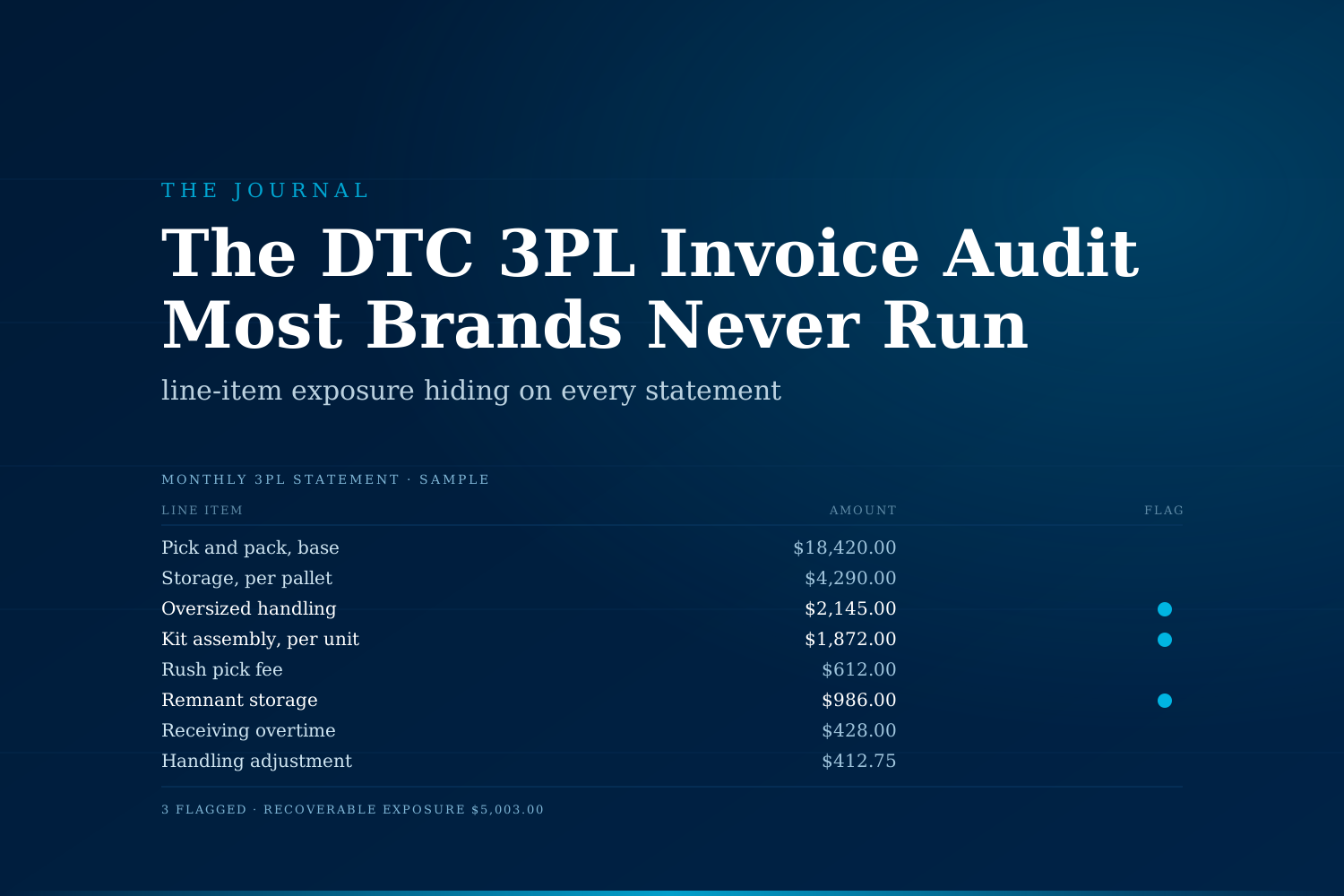
A 3PL accessorial invoice audit is the line by line review of every non-base fee a warehouse partner charges a DTC brand, from oversized handling to remnant storage to receiving overtime. Most mid-size DTC brands sign off on these invoices without a real audit, and the brands that do audit find recoverable errors on nearly every statement.
This article looks at where that money sits, why even sharp finance teams miss it, and what changes when the audit runs on every line item instead of a monthly sample.
What sits on a 3PL accessorial invoice?
Every 3PL invoice has two layers. The base rate covers pick, pack, ship, and per-unit or per-pallet storage. That is what the brand originally quoted against. The accessorial charges cover everything the warehouse handles outside the base scope, and they can push total 3PL cost per unit up 15 to 35 percent over the base card on kit-heavy or apparel operations.
On a mid-size DTC brand shipping 30,000 units a month, a single statement can carry thirty to sixty distinct accessorial line items. Typical categories:
- Receiving and putaway (per pallet, per SKU, per hour)
- Rush pick fees on batches that missed the cutoff
- Oversized or awkward SKU handling
- Kit and bundle assembly, per unit and per setup
- Remnant or dead storage on slow SKUs
- Receiving overtime for trucks arriving after hours
- Reship handling on carrier returns to sender
- SKU relocation and cycle count adjustments
- Custom insert, sticker, and gift-message handling
- Container or trailer unload variance
- Volumetric adjustment fees
- Damaged goods disposal
Each item is small on its own, often 0.20 dollars to 3.50 dollars apiece. Stacked across a monthly volume of 900,000 to 1.2 million units a year, the aggregate becomes a real P&L line, one worth reading carefully before it gets signed off.
Why does the invoice slip past finance?
Three structural reasons show up on almost every brand that has not built a real audit process.
First, the pricing sheet is not the invoice. The 3PL agreement usually specifies base rates and reasonable-use accessorial pricing, but the invoice format changes each month depending on which categories fired. Finance rarely has a stable mapping from every PDF line item back to the executed rate card, and reading a 300-line accessorial statement without that mapping is unreadable work.
Second, accessorial reason codes are opaque by design. A line item labeled "Handling adjustment, 412.75 dollars" gives finance nothing to challenge. Without an event log tied to the specific SKU, receipt, or order, the reasonable move is to sign off and move on.
Third, ownership is split. The person who could actually challenge a mislabeled accessorial is the ops director who knows what happened in the warehouse that week. That person is almost never the one seeing the monthly finance statement. By the time the two sides compare notes, the invoice has been paid and the contractual dispute window is closing.
What does a real invoice audit surface?
Categories of recoverable exposure that show up when a brand actually reads each line:
- Miscategorized SKUs. A standard SKU coded as oversized because its dimensional weight file was never updated after a repack.
- Duplicate receipts. The 3PL logged one receiving twice because the ASN arrived split across two windows.
- Rate-card violations. Bundle assembly billed at 1.20 dollars per unit when the contract locked 0.80 dollars.
- Free-day violations. Storage charges landing on inventory still inside the contractually free storage window.
- Unauthorized overtime. After-hours receiving that was a warehouse scheduling choice, not a brand-requested rush.
- Reship charges the carrier owes. RTS handling that the brand's carrier agreement puts on the carrier, not on the brand.
Third-party 3PL invoice auditors consistently report recoverable variance in the 3 to 7 percent range of total invoiced amount, with outliers higher on brands running kit-heavy or apparel SKUs. Even at the lower end, a brand spending 4 million dollars a year in 3PL cost is looking at more than 100,000 dollars a year of margin sitting in line items nobody reads.
Sampled review vs instrumented audit
| Aspect | Sampled review | Instrumented line-item audit |
|---|---|---|
| Scope | 5 to 10 percent of line items reviewed | 100 percent of line items reconciled |
| Rate-card mapping | Manual lookup, monthly | Automated per line item |
| Category drift detection | Discovered after quarters of drift | Flagged the first month it appears |
| Free-day tracking | Rare, almost never per SKU | Enforced per SKU, per receipt |
| Duplicate detection | Missed unless finance spot-checks | Caught at ingest |
| Dispute packet preparation | Manual, several days per case | Assembled per finding |
| Time from invoice to dispute | 4 to 8 weeks | Days |
| Coverage across 3PL sites | Single site sampled | All sites, all invoices |
What changes when the audit is instrumented?
The instrumented version does not replace the ops director or the 3PL account manager relationship. Those still matter, and negotiated rate cards still need to be renewed every year. What changes is that finance and ops finally read the same monthly report.
Every line item lands mapped to the rate card and to a reason code. Every miscategorization surfaces with the SKU, the event, and the dollar exposure attached. Dispute packets arrive pre-assembled and ready for the 3PL account manager to accept, reject, or discuss. Trendlines by category exist, so a creeping accessorial (say, storage on a slow-moving apparel SKU) surfaces before it stacks a full quarter of exposure.
The 3PL is usually willing to concede errors when the brand shows up with data. What the industry politely calls "the brand paying for its own oversight" is what happens when the brand does not.
What this does not solve
Rate-card renegotiation is a business conversation, not an automation problem. The audit surfaces where the current rate card is losing the brand money and where the accessorial mix is out of line with the market. What to do with that knowledge, whether to accept, renegotiate, or tender to competing 3PLs, is still the brand's judgment call. Network design, warehouse choice, and SKU rationalization live in the same place, with leadership, not with the audit layer.
Three signals a 3PL invoice is due for an audit
- Accessorial as a share of total 3PL cost is above 30 percent and no one on the team can name the top three categories driving it.
- Monthly 3PL invoice variance versus forecast runs plus or minus 15 percent and gets explained as "volume noise" rather than reconciled to specific events.
- No brand-side dispute has been filed in the last two quarters, which almost never means the invoices have been clean.
If two of the three are true, the brand is likely absorbing the middle of the industry recoverable-variance range on every statement.
Where this leaves a DTC brand thinking it through
3PL accessorial leakage is not fraud, and it is not usually the 3PL taking advantage on purpose. It is a byproduct of complex operations, opaque billing formats, and a finance function without the operational context to challenge specific line items. The brands that structurally recover this money are not the ones with the closest 3PL relationship. They are the ones that instrumented the audit so every invoice arrives with its errors already documented, ready for a short review by the ops director before it goes to dispute.
If your 3PL statements have been running clean-on-paper without anyone reading each line, we offer a completely free automation audit that maps where accessorial exposure is landing on your P&L and what an instrumented audit would look like against your current invoices. No commitment, no slide deck. → Book yours
Sami Raza
Software Developer & Technical Author
Sami Raza builds AI automation for logistics, DTC, and construction operations teams at ApexifyLabs, and writes about the operational failures that automation is actually worth pointing at.