Automation ROI Playbook: Turn AI Experiments Into Pipeline Growth
A practical scoring system to prioritize automation ideas, forecast impact, and sell outcomes to leadership.

Every automation idea sounds glamorous until you are asked to prove the upside. This playbook gives growth teams a simple, trusted way to prioritize ideas and convert the best ones into full projects with confident ROI projections.
Step 1: Capture the Current Cost
- Document the people hours and tools currently powering the workflow.
- Quantify the error rate or drop-off points that automation could eliminate.
- Tag each workflow with a business objective (pipeline, retention, CSAT).
Step 2: Score The Opportunity
Use a 1–5 scale for each dimension and multiply the scores:
- Volume: How often does the workflow run?
- Complexity: How many systems and approvals are involved today?
- Risk: What happens if the automation misses the mark?
- Time-to-value: Can we see a tangible outcome this quarter?
Tip: For leadership buy-in, pair the high score with a short story of the human pain the workflow creates today.
Step 3: Design a Proof of Value
- Plot a small surface area (one product line, one territory, one customer tier).
- Run a manual simulation and note where humans unplug the process.
- Define KPIs to measure success: cycle time, conversion lift, saved hours.
Step 4: Tell the Story With Numbers
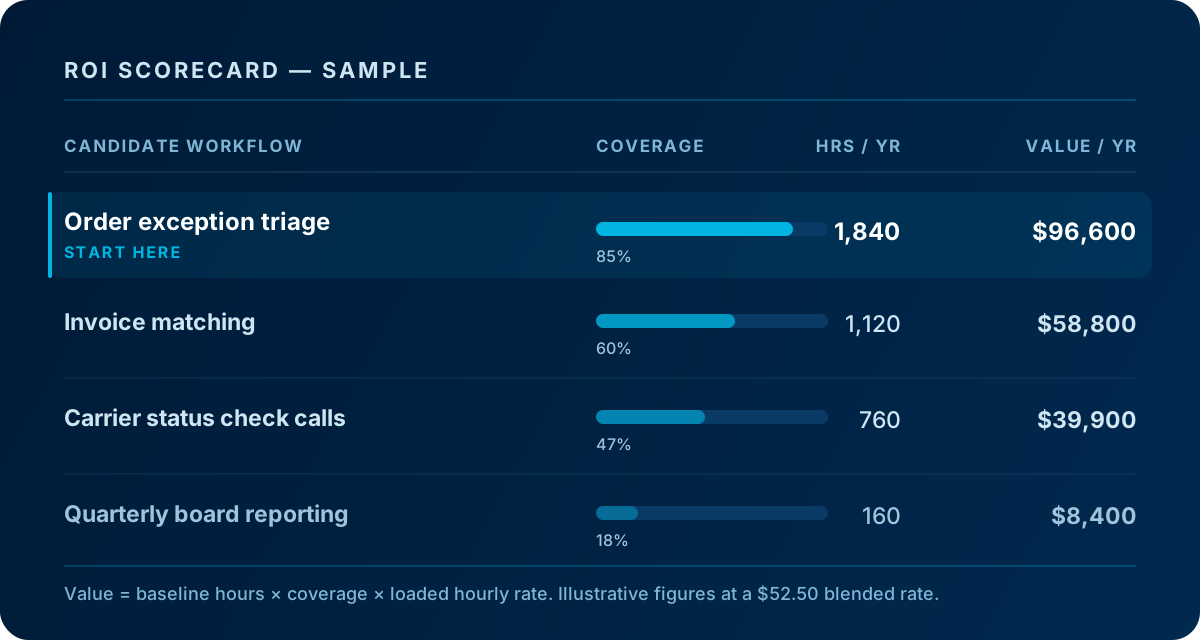
- Estimate time saved = baseline hours × automation coverage × hourly rate.
- Calculate upside revenue = conversion lift × average deal value.
- Highlight second-order benefits: faster onboarding, richer analytics, happier teams.
Step 5: Keep the Engine Honest
- Review the scorecard quarterly and retire automations that no longer pay off.
- Catalog new inputs: product changes, data freshness, compliance updates.
- Feed insights back into marketing and sales enablement loops.
Every step above assumes somebody is available to build the thing the scorecard recommends, which is the whole premise of our AI automation services — a model with no delivery plan attached is just a tidier way to stall. For the delivery half, the agentic AI blueprint covers the thirty-day pilot shape, while the manual freight sales desk and order exception handling show the before and after in two very different operations.
Make It Repeatable
Teams that scale automations consistently do three things:
- Hold monthly “automation council” working sessions.
- Publish a simple dashboard showing pipeline, savings, and customer metrics.
- Loop customer-facing teams into beta programs so feedback arrives fast.
Ready to tailor the model to your funnels? We can plug your real numbers into our ROI simulator and build a quarter-by-quarter roadmap. Let’s start with a discovery call.
Sami Raza
Software Developer & Technical Author
Sami Raza builds AI automation for logistics, DTC, and construction operations teams at ApexifyLabs, and writes about the operational failures that automation is actually worth pointing at.