Why Unconfirmed Supplier POs Break DTC Replenishment
Sending the PO is the easy part. On mid-size DTC brands, the acknowledgment nobody chased is what turns a planned replenishment into an air freight bill.
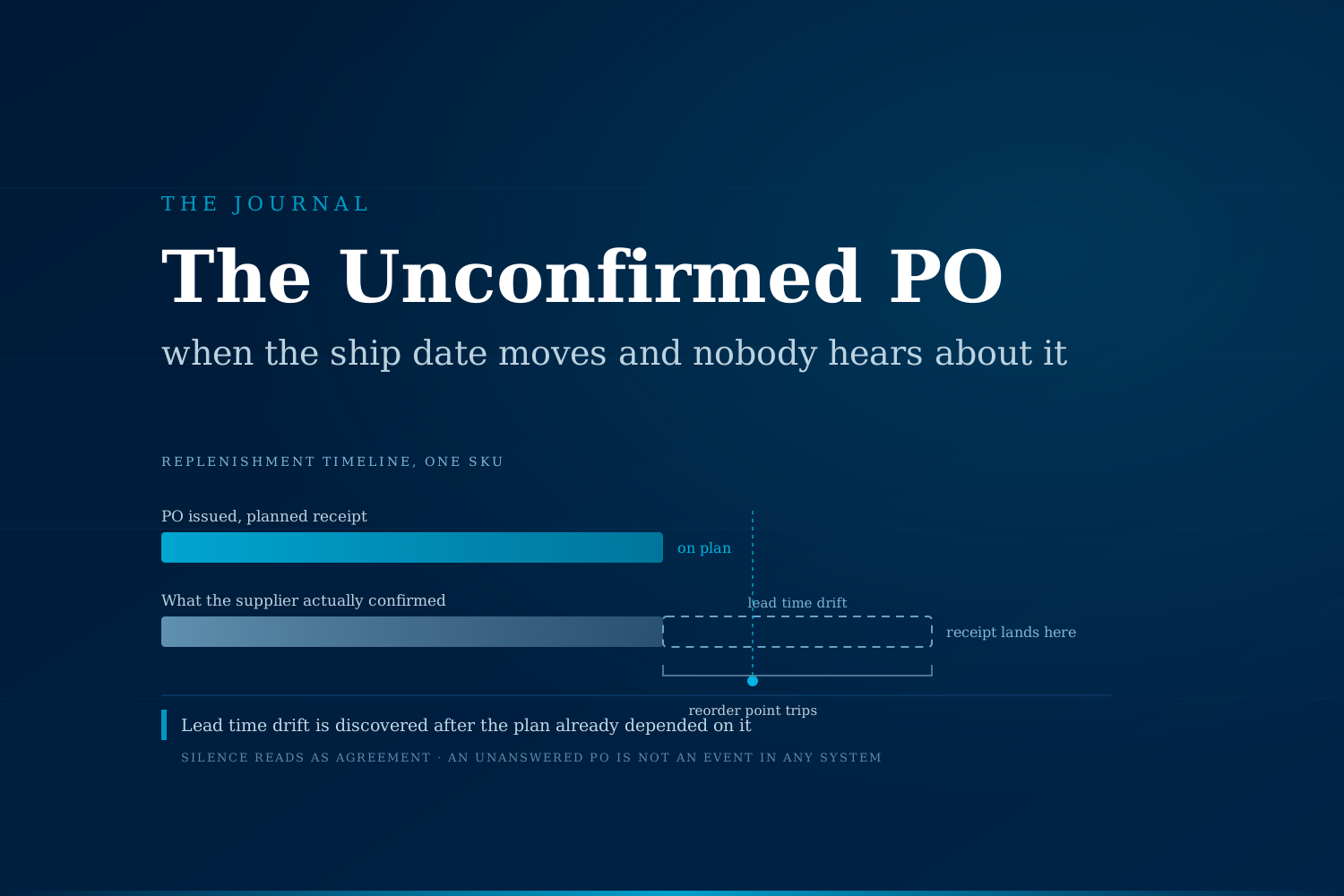
A purchase order is not a commitment until the supplier confirms it. Many DTC brands treat the sent PO as the plan of record, then discover at the reorder point that quantities, ship dates, or both moved weeks earlier. The confirmation step is where replenishment accuracy is won or lost.
What is a supplier PO acknowledgment, and why does it matter to a DTC brand?
The acknowledgment is the supplier's reply to a purchase order: yes to these SKUs, at this quantity, shipping on this date, at this price. On large enterprise supply chains it arrives as a structured message and updates the planning system automatically. On a $2M to $30M DTC brand it usually arrives as an email, sometimes a WhatsApp message, occasionally a marked-up spreadsheet, and often not at all.
That difference matters because everything downstream of the PO is calculated from a date. The reorder point, the safety stock buffer, the launch calendar, the paid media flight, and the cash forecast all assume a receipt window. When the supplier moves that window and the brand does not register the move, none of those downstream numbers get corrected. The plan stays confident and stays wrong.
The failure is rarely dramatic. A contract manufacturer confirms 4,000 units instead of 6,000 because a component is short. A factory shifts a ship date by eleven days to consolidate a container. A supplier acknowledges verbally on a call and never sends anything in writing. Each of these is a normal, reasonable supplier behavior. The problem is that the brand's system of record never hears about it.
Why does the drift stay invisible until the reorder point?
Three structural reasons, and none of them are about anyone being careless.
First, the outbound PO and the inbound acknowledgment live in different places. The PO is generated in the inventory or ERP tool. The acknowledgment lands in a shared purchasing inbox, or in the personal inbox of whoever owns that supplier relationship. Nothing reconciles the two, so a mismatch between what was ordered and what was confirmed is only visible to a human who happens to compare them line by line.
Second, silence reads as agreement. When no acknowledgment arrives, the default assumption on most purchasing desks is that the PO was accepted as written. There is no alert for an unanswered PO, because an unanswered PO is not an event in any system. It is the absence of an event, and absences are the hardest thing for a manual process to notice.
Third, lead times are stored as static values. Most brands carry one number per supplier, set when the relationship started and rarely revisited. Actual performance drifts around that number by weeks, especially across holiday production shutdowns and peak container season, but the planning math keeps using the original figure. The McKinsey Global Institute's work on global value chains found that disruptions lasting a month or longer now hit companies roughly every 3.7 years, which means the static lead time is wrong more often than the model assumes.
By the time the reorder point trips and someone looks at the inbound schedule, the drift has already happened. The remaining choices are all expensive.
What does an unconfirmed PO actually cost?
The direct costs are the ones a founder can list from memory: expedited freight to recover a missed window, split shipments to get partial cover on shelf, and the discount needed to move whatever arrived late into a season that has passed. Rate data published by Freightos and Drewry has consistently shown air freight running several times the per-kilogram cost of ocean on the same lane, so a single recovery decision can wipe out the margin on the entire replenishment run.
The indirect cost is larger and much harder to see. IHL Group's long-running inventory distortion research has repeatedly put the combined global cost of out-of-stocks and overstocks above $1 trillion a year, and the demand-side half of that is not a shipping problem. The widely cited Gruen, Corsten and Bharadwaj study conducted for the Grocery Manufacturers of America found a worldwide average out-of-stock rate around 8.3 percent, and that roughly a third of shoppers responded by buying the item somewhere else rather than waiting.
For a DTC brand, "somewhere else" is usually a competitor the customer had never tried before. The stockout does not just defer the revenue. It funds a trial purchase for someone else, at the exact moment the brand was paying to acquire that customer.
There is a third cost that shows up on the ops team rather than the P&L. Chasing acknowledgments is unstructured, interrupt-driven work: a follow-up email, a time zone wait, a partial answer, another follow-up. APQC's procurement benchmarking consistently shows a wide spread between top and bottom quartile organizations on purchase order cycle time, and most of that spread is not negotiation. It is waiting and re-asking.
Manual PO follow-up versus an AI-assisted replenishment desk
The comparison is not about removing the buyer. Supplier relationships are relationships, and the negotiation, the escalation, and the judgment on which supplier gets the next order stay human. What changes is the reconciliation layer underneath, which is clerical work that has been sitting on a senior person's desk because nobody built anywhere else to put it.
| Step | Typical manual flow | AI-assisted flow |
|---|---|---|
| PO issued | Sent from the inventory tool, filed in a folder | Issued and tracked as an open commitment with an expected reply window |
| Acknowledgment received | Lands in a shared inbox among everything else | Parsed on arrival, matched back to the originating PO line by line |
| Confirmed vs ordered | Compared by hand, if at all | Variances on quantity, date, and price surfaced automatically as exceptions |
| No reply at all | Nobody notices until someone remembers | Unanswered PO becomes an aging item with escalating priority |
| Follow-up | Buyer writes the chase email when there is time | Drafted with the specific open line items, timed to the supplier's working hours |
| Lead time | One static number per supplier | Rolling actuals per supplier and per SKU family, updated as receipts land |
| Downstream impact | Discovered at the reorder point | Reorder point, safety stock, and cash forecast re-run the moment a date moves |
| Escalation | Ad hoc, usually late | Triggered by value at risk and days to stockout, routed to the right person |
The pattern worth noticing is that the AI layer is not making purchasing decisions. It is making sure the decisions a human already made stay connected to what the supplier actually agreed to.
Three signals a DTC brand is planning on unconfirmed POs
If a founder or head of ops wants a quick read on whether this is live in their business, three checks usually settle it in an afternoon.
- Nobody can state the current unacknowledged PO count. Ask how many open POs have received no written confirmation and how old the oldest one is. If the answer requires a search through an inbox, the number is not being managed, and it is almost never zero.
- Supplier lead times in the planning tool have not changed in a year. Compare the stored lead time against the last six actual receipts for the same supplier. A consistent spread in either direction means the reorder point has been calculated from a number the supply chain stopped honoring some time ago.
- Expedited freight is treated as a cost of doing business. When air or partial-container recovery shows up every quarter without anyone tracing it back to a specific date change, the brand is paying repeatedly to fix a communication failure rather than fixing the communication.
Any one of these on its own is survivable. All three together usually mean the replenishment plan and the supplier's actual production schedule have been running as two separate documents.
What changes when the acknowledgment loop closes?
The most immediate change is boring and valuable: the brand knows, on any given day, which of its open orders are actually confirmed and which are assumptions. That single distinction changes how confidently the team can commit to a launch date or a promotional calendar.
The second change is that lead time stops being a guess. Once actual receipt performance is captured per supplier rather than per relationship, the reorder point moves from a number someone set once to a number that reflects how that factory has behaved over the last two quarters. Safety stock can then come down where a supplier is reliable and go up where one is not, instead of being uniformly padded to cover the worst case everywhere.
The third change is where the buyer's attention goes. Instead of spending the morning discovering what changed, the day starts with the short list of things that changed and matter. The escalation conversation happens while there is still time for it to be a scheduling conversation rather than a freight-booking conversation.
None of this shows up as one large savings line. It shows up as fewer stockouts on the SKUs that drive repeat purchase, a materially smaller expedited freight line, and a purchasing desk that spends its hours on supplier terms instead of on chasing replies.
The pitch
If the purchasing inbox is where PO confirmations go to be manually reconciled, or if the last unplanned air freight bill traced back to a ship date that moved three weeks before anyone noticed, the acknowledgment loop is worth mapping as its own workflow. In our experience it is rarely one broken step. It is usually two or three handoffs that were never designed, just inherited as the business grew.
If any of this sounds like your replenishment desk, we run a completely free automation audit for DTC ops teams that want a second opinion before committing to anything. No slide deck, no obligation. → Book the audit
Sami Raza
Software Developer & Technical Author
Sami Raza builds AI automation for logistics, DTC, and construction operations teams at ApexifyLabs, and writes about the operational failures that automation is actually worth pointing at.