Material Delivery Misses Are a GC Labor Cost
Late or wrong material deliveries on GC jobsites show up as idle labor, not procurement variance. The cost rarely lands where the lever sits.
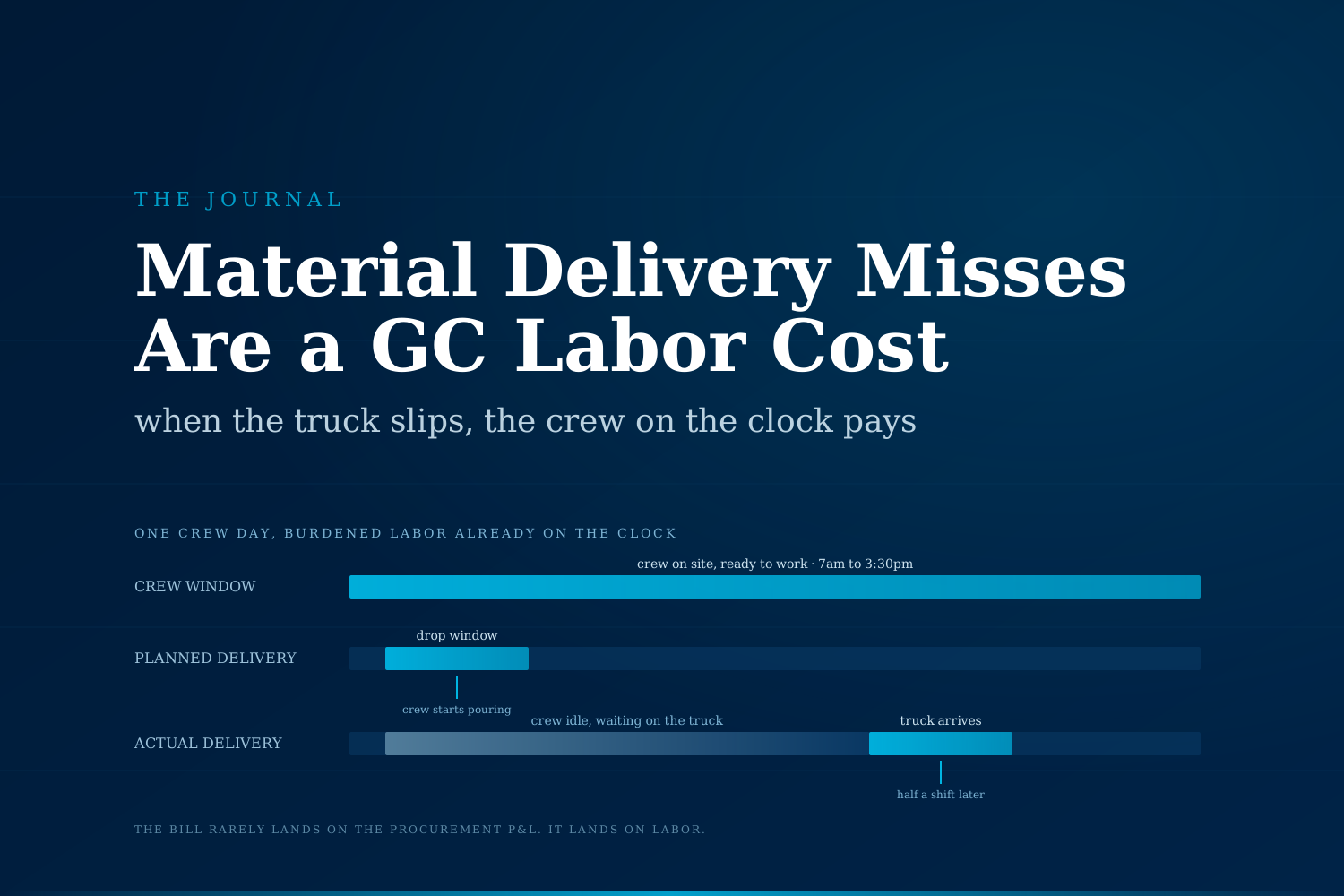
Late or incorrect material deliveries are not a procurement problem on most general contractor sites. They are a labor problem. Every hour a crew sits idle while a wrong-spec truck turns around, or a partial pallet stalls a pour, prices out at full burdened cost. That bill rarely lands in the material variance line.
Why does a missed material delivery cost more than the material itself?
The visible cost of a delivery miss is the line item: a re-pull, a restocking fee, an expedited truck. The hidden cost is the crew that was already mobilized for that material. A four-person framing crew at a fully burdened rate of $75 to $110 per hour, idle for half a shift while a stud delivery is sorted out, costs more in labor than the material on the truck. Multiply that across a year of incidents on a portfolio of jobs, and the procurement function's "small misses" become a real margin item.
The McKinsey Global Institute's "Reinventing Construction" report flagged construction productivity growth at roughly 1 percent per year over the prior two decades, compared with 2.8 percent across the broader global economy. The report named coordination breakdowns between procurement, scheduling, and field execution as a structural driver of the gap. Material misses sit in the middle of that triangle.
A mid-size general contractor doing $40M to $90M in revenue typically runs eight to fifteen active jobs at a time. If even one in five jobs sees a material delivery miss in a given week, a conservative estimate based on field reports, and the average miss idles a small crew for two to four hours, the labor cost alone runs into six figures annually. That money rarely appears in the procurement P&L. It shows up as productivity drag in the WIP report, which is exactly where it is hardest to attribute.
What does a material delivery miss usually look like on a GC's desk?
Four patterns recur on operator calls:
- Wrong spec on the truck. Submittal-approved item versus what got shipped. The supplier substituted, or the PM signed off on a substitution that didn't get communicated to the field in time.
- Partial delivery. Half the pallet count, no notice. Crews can start, but the back end of the day stalls and staging capacity gets tied up.
- Wrong window. Delivery arrives at 11 AM for a 7 AM concrete pour, or shows up the day after the crew demobilized for a different scope.
- Right truck, no receiver. Material arrives on schedule, but the foreman expecting it is across town and the laborer signing off does not catch a discrepancy until two days later, after it has been staged.
None of these are exotic. They are the everyday output of a procurement workflow that depends on email chains, supplier portals, and tribal knowledge about which vendors call when something slips.
Manual material coordination vs an AI-coordinated procurement desk
Here is how the two operating models compare on a working day:
| Function | Manual coordination | AI-coordinated desk |
|---|---|---|
| Delivery confirmation 24 to 48 hours out | PM calls supplier reps when they remember; some confirmed, some not | Automated confirmation request to every supplier with an open PO in the window; misses surface on one dashboard |
| Substitution alert | Discovered when the truck arrives | Flagged from the supplier's response when spec deviates; routed to PM for approval before dispatch |
| Window-change negotiation | Reactive; foreman calls when the crew is already on site | Calendar of crew demobilizations is cross-checked; conflicts flagged the day a delivery slot is booked |
| Receiver check-in | Manual sign-off, often by a laborer | Photo and packing-list cross-check at the gate; discrepancies opened as a ticket the same hour |
| Cost attribution | Material variance only | Idle-labor cost auto-tagged to the originating PO line for WIP visibility |
The point of the table is not that the manual model is incompetent. It is that the manual model relies on a small number of senior procurement and field people to keep dozens of moving parts in their heads at once. When that bench is thin, or when volume spikes during peak season, misses compound.
What changes when the procurement desk is AI-coordinated?
A few things stop being the senior PM's job:
- Routine 48-hour delivery confirmations. The desk pings every supplier on the schedule and surfaces the ones who did not respond, or who confirmed with a caveat.
- First-pass supplier substitution checks against submittals on file. A human still approves or rejects, but the comparison work is done before they look.
- Foreman alerts when an inbound truck is within a one-hour window of arrival, with the bill of lading and submittal stub attached so the receiver knows what to verify.
- Idle-labor cost roll-ups on jobs where deliveries slipped, broken out by supplier and PO line. The PM running buyout for the next job can see which suppliers are actually costing labor, not just material.
What we will not pretend: this does not eliminate every miss. Suppliers run their own schedules and their own equipment. What it does is convert a miss from a same-day surprise into a flagged exception with one to three days of lead time to absorb.
When is this worth tackling on a mid-size GC?
A few signals tend to push the conversation up the priority list:
- More than two material-driven idle events per week across the active portfolio.
- A WIP report where labor productivity variance consistently outruns material variance, with no one able to attribute the gap to a specific cause.
- A senior PM or procurement lead spending a meaningful share of their week chasing delivery confirmations by phone.
- A supplier base of more than 30 active vendors per year, where the volume has outgrown an inbox-based workflow.
If two or more of these are true, the labor cost of misses is almost certainly larger than the team realizes. Past benchmarking work from the Construction Industry Institute has reported that material-related inefficiencies routinely consume a low double-digit share of total field hours on industrial and commercial projects. Even at the conservative end of that range, on a $60M GC, the math is hard to ignore.
What does the field experience look like after the change?
Foremen describe two changes most often. First, they stop being the early warning system. When something is going to slip, they hear about it on Monday for a Wednesday delivery, instead of on Wednesday morning when the crew is already on site. Second, the morning huddle changes shape. Instead of working from a verbal status report on what is or is not expected, the foreman walks in with a delivery slate that already reflects yesterday's supplier responses.
That is the operational signal that material coordination has stopped being a heroic effort and started being a system. The crew either gets what they need on time, or they get told early enough to redeploy on something productive.
A note on what this is not
This is not a procurement-software replacement story. Most mid-size GCs already have a buyout system, a project management platform, and a supplier portal or three. The gap is rarely the system of record. The gap is the coordination work that happens between those systems and between people. AI-coordinated desks live in that gap. They read the POs and the submittals, they reach out to the suppliers, they reconcile responses, and they surface the exceptions that matter.
When that coordination layer is missing, the strongest people on the team spend their cycles on work that is effectively administrative. When it is in place, those same people spend their cycles on the few decisions that actually need human judgment.
If your field team is absorbing more material misses than they used to and the labor cost is showing up as productivity drag without a clear owner, we run a completely free automation audit for general contractors that want a second opinion on where their procurement desk leaks. No commitment, no slide deck.
Sami Raza
Software Developer & Technical Author
Sami Raza builds AI automation for logistics, DTC, and construction operations teams at ApexifyLabs, and writes about the operational failures that automation is actually worth pointing at.